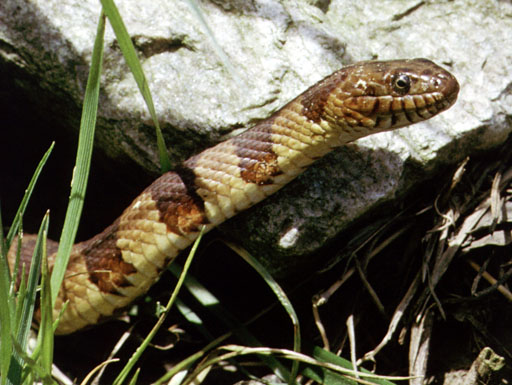
Common Watersnake (Nerodia sipedon) lives in freshwater habitats across Eastern North America. It feeds on fish and frogs. Its conservation status is Least Concern.
Fascinating facts about the Common Watersnake
- The common watersnake can reach a length of 135 cm (4 ft 5 in), but most adults are much smaller. One study found females averaging 81.4 cm (2 ft 8 in) and males 69.6 cm (2 ft 3½ in). Females typically weigh 159-408 g (5½, 14½ oz) while males range 80.8-151 g (2⅞, 5⅜ oz). The biggest females tip the scales at 560 g (20 oz) and the largest males at 370 g (13 oz). This pronounced size dimorphism.
- Mating season runs from April to June, after which the female gives birth to live young 19-23 cm (7½, 9 in) long. A single litter can contain up to 30 offspring, though most mothers produce about eight, and births occur between August and October. Other sources report litters ranging from 4 to 99, with larger females yielding larger broods. Males reach sexual maturity at about 21 months, while females first breed at three years.
- During daylight the snake prowls the water's edge for small fish, tadpoles, frogs, worms, leeches, crayfish, large insects, mollusks, salamanders, other snakes, turtles, tiny birds and mammals; at night it switches to minnows and other shallow-water fish. The Lake Erie subspecies now eats the invasive round goby for up to 90 % of its diet, a shift that helped its recovery.
- Northern water snakes are now listed among species hit by Snake Fungal Disease (SFD). A specimen from western Lake Erie, Ohio, captured in August 2009, showed crusty, thickened scales with raised blisters. The disease also causes scabbed scales, cloudy eyes, facial swelling and skin ulcers. SFD has been confirmed in nine states, highlighting how human-mediated spread of pathogens can threaten even common reptiles and underscoring the need for strict biosecurity when handling wild snakes.
Sources
Every fact above was checked against these pages, and kept only where one of them states it.
At a glance
RangeEastern North America
HabitatFreshwater habitats
DietFish and frogs
About the Common Watersnake
As the common watersnake glides effortlessly through the murky waters, its sleek, serpentine body undulates with a hypnotic rhythm, leaving behind a trail of rippling waves that disturb the otherwise glassy surface. With eyes ever-vigilant, this semi-aquatic predator navigates the aquatic realm with precision, its scaly skin glistening in the dappled sunlight that filters down from above. In this realm, the watersnake reigns supreme, a master of stealth and deception, its very presence a reminder of the hidden world that thrives just beneath our feet.
Hear the Common Watersnake, and 4,400+ more
Real recorded sounds, 11 nature games and a free Daily 5, 1v1 quiz duels, conservation wins and a safe Kids mode. Free on Feravox.
More reptiles to discover