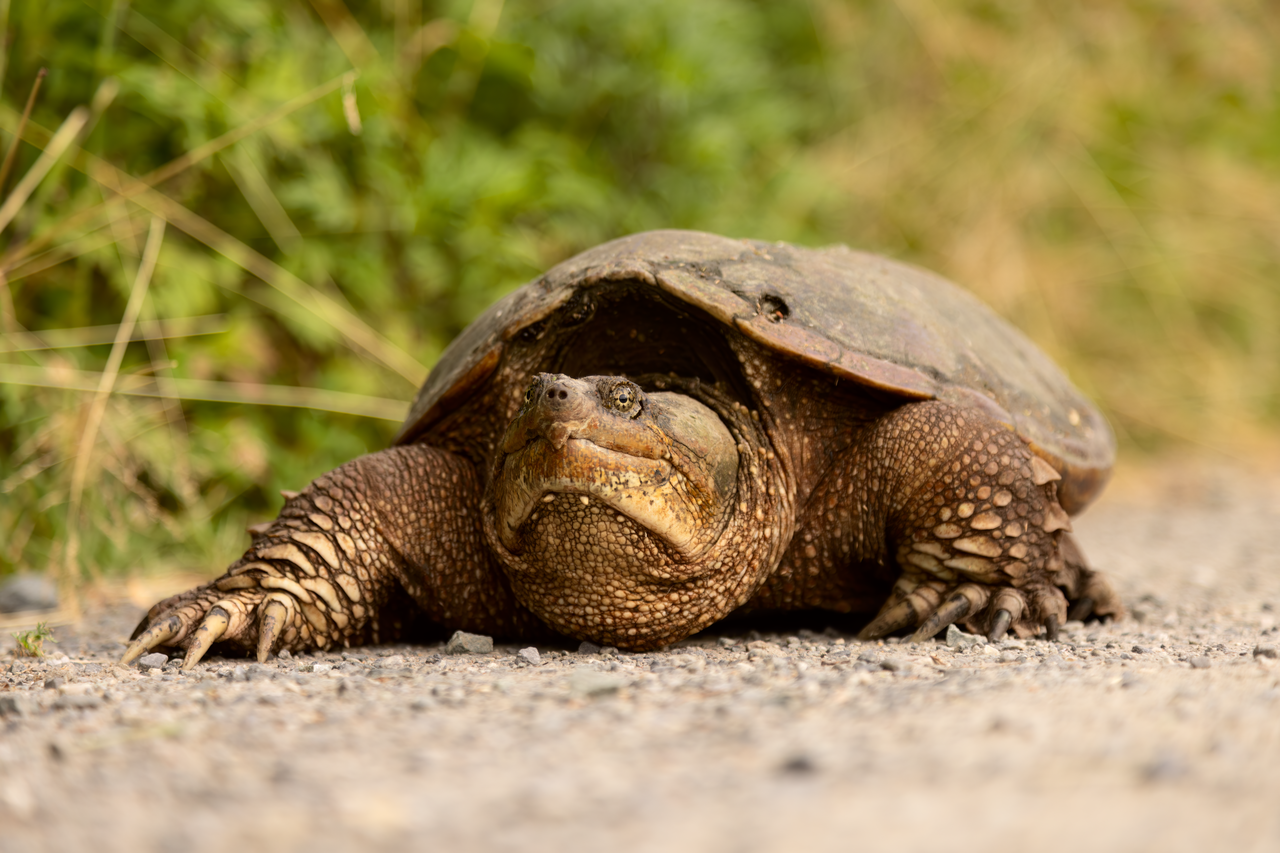
Common Snapping Turtle (Chelydra serpentina) lives in freshwater lakes across Southeastern Canada to Rocky Mountains, Nova Scotia, Florida. Its conservation status is Least Concern.
Fascinating facts about the Common Snapping Turtle
- Some common snapping turtles may outlive a century, with long-term mark-recapture data from Algonquin Park in Ontario suggesting a maximum age over 100 years. In the north they wait 15-20 years before reproducing, maturing later and larger than their southern cousins.
- The biggest wild common snapping turtle ever recorded tipped the scales at 34 kg (75 lb), while captive individuals can swell to 39 kg (86 lb) when over-fed. Most adults weigh between 4.5-16 kg (9.9-35.3 lb), and males over 10 kg are usually old, having kept growing throughout life. These massive bodies make the species the heaviest native freshwater turtle in northern North America, giving them a defensive edge that few predators can overcome.
- A single female can lay anywhere from 25 to 80 eggs each season, and in rare cases up to 83 eggs have been reported. Eggs are only 26-28 mm wide, and incubation time swings between 9 and 18 weeks depending on temperature, about 63 days at 30 °C versus 140 days at 20 °C. Because females can store sperm for several seasons, they can produce clutches even without a recent mate, ensuring steady recruitment despite the high loss of hatchlings to predators.
- When snapping turtles snap shut, they generate between 62 and 564 Newtons of bite force, enough to crush hard-shelled prey like mollusks, yet still below the average human bite of 300-700 N. This powerful jaw lets them tackle a diet that spans fish, frogs, birds, small mammals, carrion, and surprisingly large amounts of aquatic vegetation, making them versatile omnivores that can shift between scavenging and active hunting as food availability changes.
- Roads are a silent killer for snapping turtles: a southwestern Ontario study recorded a drop from 941 individuals in 1985 to just 177 in 2002, a loss of 764 turtles in only 17 years. This steep decline shows how vehicle traffic can quickly erode local populations, especially since adults travel long distances over land to find new ponds for nesting. Installing exclusion fencing could aid in decreasing population loss.
Sources
Every fact above was checked against these pages, and kept only where one of them states it.
At a glance
RangeSoutheastern Canada to Rocky Mountains, Nova Scotia, Florida
HabitatFreshwater lakes
DietFish and carrion
About the Common Snapping Turtle
In the murky depths of North America's freshwater lakes and rivers, the common snapping turtle reigns as a formidable and ancient predator, its rugged, armor-plated shell a testament to its unyielding resilience. With powerful strokes of its webbed feet, it moves through the water with a deliberate slowness, as if savoring the secrets of its submerged world, while its sharp, hooked beak lies in wait to snap shut with lightning speed. As it glides effortlessly through the aquatic shadows, its primal, unblinking gaze seems to hold the wisdom of a bygone era, a reminder of the enduring power and mystery of the natural world.
Hear the Common Snapping Turtle, and 4,400+ more
Real recorded sounds, 11 nature games and a free Daily 5, 1v1 quiz duels, conservation wins and a safe Kids mode. Free on Feravox.
Common Snapping Turtle photographed on Feravox
More reptiles to discover