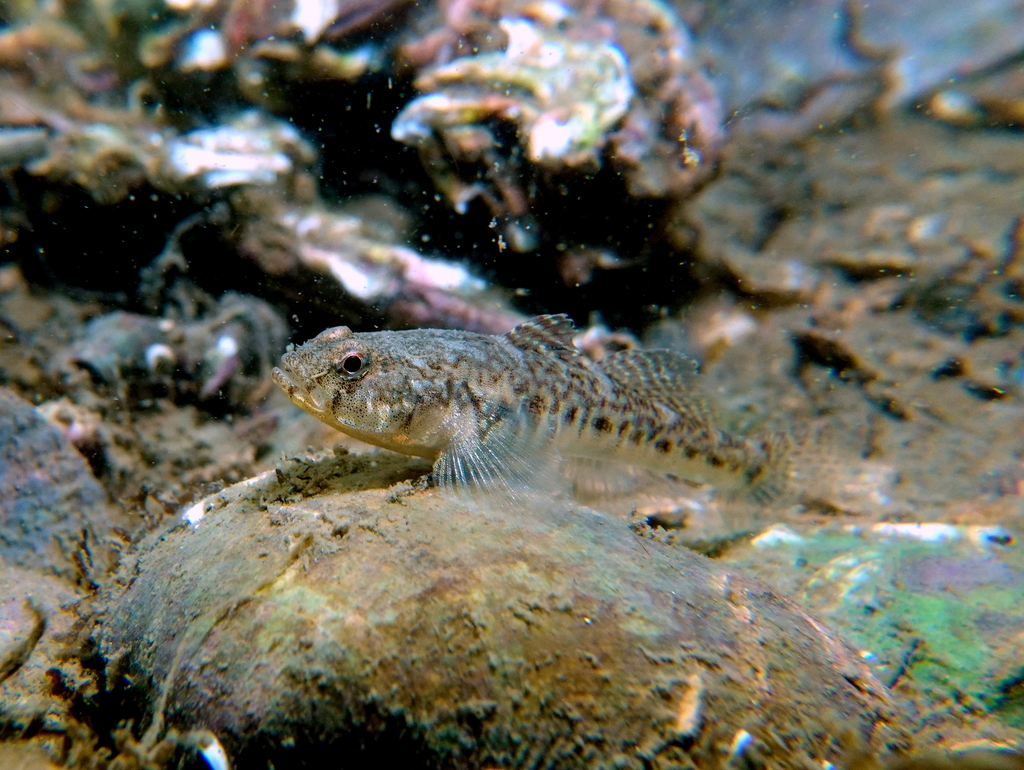
Photo: Klaus Kevin Kristensen
Feravox · The Voice of the Wild
Common Goby
Pomatoschistus microps
Least Concern
Common Goby (Pomatoschistus microps) lives in shallow estuarine mud across Atlantic-Baltic coasts. It feeds on small crustaceans and worms. Its conservation status is Least Concern.
The common goby (Pomatoschistus microps) is a diminutive ray-finned fish that scarcely exceeds nine centimetres in total length, though most adults hover around four to five centimetres. Its body is a subtle canvas of light grey or sandy brown, brushed with indistinct dark markings and fine striations on pale fins. Two dorsal fins sit close together, the front bearing six to eight spines and the rear eight to eleven soft rays, while the pelvic fins are fused into a single suction disc. Males reveal a conspicuous dark spot on the anterior dorsal fin and darker bases on the pectoral and caudal fins, colors that intensify during the breeding season, turning the whole fish into a richer, more dramatic hue. In the shallow, sandy- or muddy-bottomed estuaries and brackish lagoons that fringe the Atlantic and Baltic coasts, from Norway down to Morocco, Mauritania, and the Canary Islands, this goby darts among the substrate at depths of zero to twelve metres. It feeds on a buffet of tiny crustaceans, worms, harpacticoids, amphipods, chironomid larvae and mites, hunting with the precision of a miniature predator. A surprising trait lies in its reproductive devotion: after laying eggs beneath shells, stones or aquatic plants from February to September, the male guards the clutch until the embryos hatch after about nine days, a paternal vigilance that ensures the next generation of these three-year-old survivors.
Real recorded sounds, 11 nature games and a free Daily 5, 1v1 quiz duels, conservation wins and a safe Kids mode. Free on Feravox.