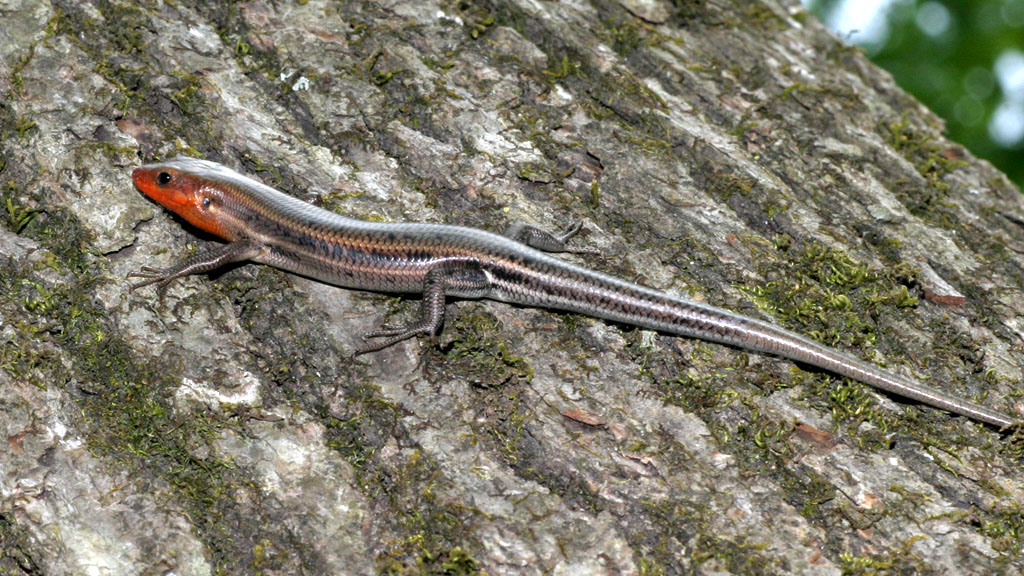
Common Five-Lined Skink (Plestiodon fasciatus) lives in eastern deciduous forests across North America. It feeds on insects and spiders. Its conservation status is Least Concern.
Fascinating facts about the Common Five-Lined Skink
- Juvenile five-lined skinks are dark brown to black with five distinctive white to yellowish stripes and a bright blue tail, making them instantly recognisable. The vivid blue colour fades to light blue as they age, and the stripes may slowly disappear. Females, however, are more likely to retain the blue tail colour as they grow older, so some older individuals still display the striking hue.
- Adult female five-lined skinks often keep the blue tail colour as they age, unlike most older individuals that become uniformly brownish. This retention means older females may still display the striking hue. The blue tail is thought to serve as an intraspecific signal, indicating juvenile or female status and helping to prevent attacks from more aggressive males.
- When threatened, five-lined skinks can shed their entire tail or a segment as an antipredation strategy. The bright blue colour of the tail is thought to attract predators to this expendable part. After tail loss the detached portion continues to twitch while the skink darts to shelter, increasing its chances of escape.
- A female five-lined skink lays a clutch of fifteen to eighteen eggs in a concealed cavity beneath a rotting log, stump, board, loose bark, a rock, or an abandoned rodent burrow. She prefers large, moderately decayed logs and selects sites where soil moisture is higher than surrounding areas, often digging deeper in drier spots. Even when suitable shelters are abundant, females tend to aggregate their nests, leading to communal nesting clusters.
- Eggs of the five-lined skink incubate for twenty-four to fifty-five days, with warmer temperatures shortening the period and cooler conditions lengthening it. During this time the female often broods the clutch, adopting various positions that increase contact with the eggs, especially when soil moisture is low to reduce transpirational loss. She may also urinate in the nest and turn the eggs to maintain humidity, behaviours that improve hatchling survival.
Sources
Every fact above was checked against these pages, and kept only where one of them states it.
At a glance
RangeNorth America
HabitatEastern deciduous forests
DietInsects and spiders
About the Common Five-Lined Skink
As the sun warms the forest floor, the Common Five-Lined Skink emerges from its hiding places, its slender body gliding effortlessly across the leaf litter with a mesmerizing rhythm. With its iridescent scales glistening like polished onyx, this diminutive reptile navigates its surroundings with an air of quiet confidence, its sharp eyes scanning the underbrush for unsuspecting insects to snatch. As it moves, the skink's distinctive five-lined pattern seems to shimmer and dance across its back, a dazzling display of evolutionary adaptation that has allowed this remarkable creature to thrive in its woodland realm.
Hear the Common Five-Lined Skink, and 4,400+ more
Real recorded sounds, 11 nature games and a free Daily 5, 1v1 quiz duels, conservation wins and a safe Kids mode. Free on Feravox.
More reptiles to discover