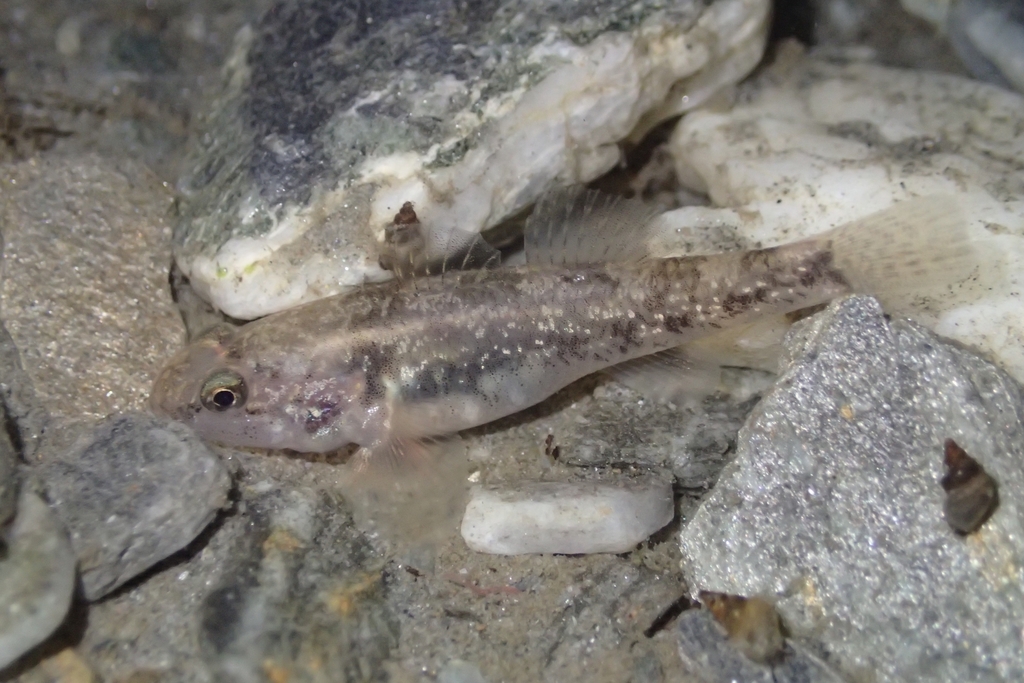
Photo: Oscar Dove
Feravox · The Voice of the Wild
Common Bully
Gobiomorphus cotidianus
Least Concern
Common Bully (Gobiomorphus cotidianus) lives in benthic freshwater habitats across New Zealand. It feeds on small benthic invertebrates. Its conservation status is Least Concern.
The common bully (Gobiomorphus cotidianus), known in Māori as toitoi, is a modest-sized fish endemic to New Zealand, rarely exceeding 15 cm. Its most reliable field mark is a set of vertical lines on the cheek, complemented by subtle head-pore placements and scale patterns that are hard to discern without close inspection. An amphidromous species, the bully thrives in marine, brackish and fresh waters, favouring benthic zones of moderate to slow-moving streams, coastal rivers and shallow mainland lakes. In the littoral margins of lakes and streams, especially during summer, females cling clusters of several hundred to a few thousand eggs to the undersides of hard substrates, where males guard the brood until hatching. The larvae drift as plankton, feeding on zooplankton before settling to the bottom at about 18 mm and adopting a fully benthic lifestyle. Their diet is opportunistic, comprising small benthic invertebrates, insect larvae and crustacea, making them a key link in the food web. A surprising trait is their role as biological vectors for New Zealand’s freshwater mussels, which hitch rides on the fish’s gills to disperse their larvae far beyond parental habitats, a partnership that subtly shapes riverine ecosystems. Beyond the coast, common bullies have colonised land-locked lakes after natural blockages isolated river sections, where they become an important prey item for larger freshwater predators such as eels and trout. Their life history is rapid: they mature at roughly one year, with an average generational turnover of two years, allowing populations to rebound quickly after disturbance. Seasonal movements see them shift into littoral zones in summer, a behaviour that not only facilitates reproduction but also concentrates them where they are most likely to be observed, reinforcing their reputation as the bully species most often sighted by anglers and naturalists alike. The species’ adaptability across salinity gradients, its pivotal ecological role as both predator and prey, and its unexpected partnership with mussels illustrate how a seemingly humble fish can wield outsized influence in New Zealand’s freshwater tapestry
Real recorded sounds, 11 nature games and a free Daily 5, 1v1 quiz duels, conservation wins and a safe Kids mode. Free on Feravox.