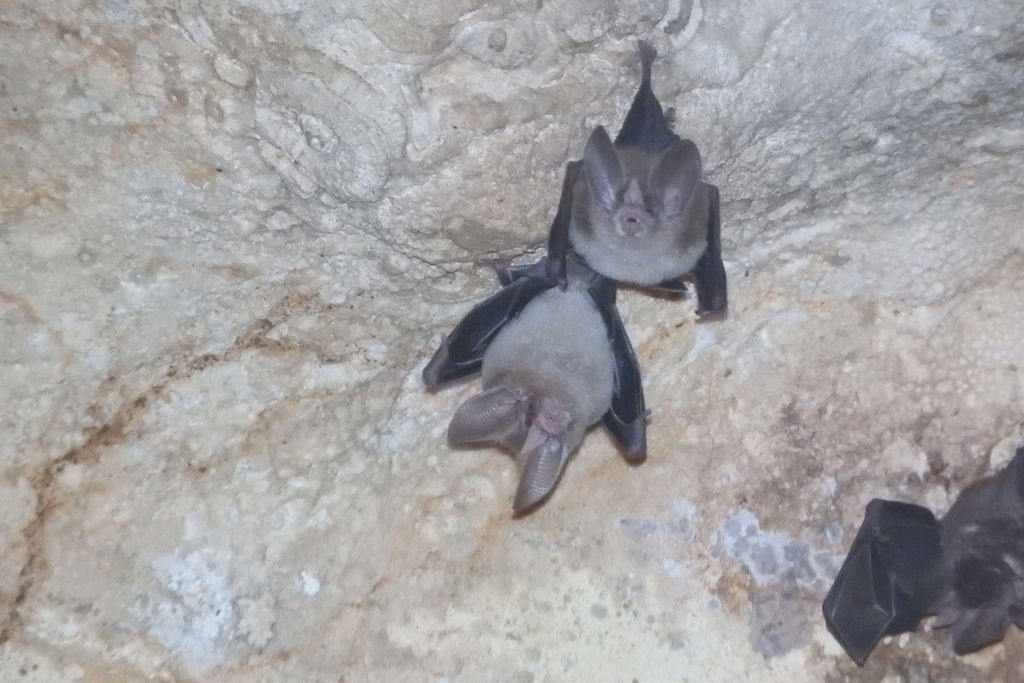
Common Big-eared Bat (Micronycteris microtis) lives in tropical rainforest across Central and South America. Its conservation status is Least Concern.
Fascinating facts about the Common Big-eared Bat
- Recent research has demonstrated this bat's ability to find motionless food within clutter. Echolocating bats discriminate between background and prey based on glints or Doppler shifts in the echo induced by the (wing-)movements of the prey, but M. microtis can detect completely motionless prey. The bat is able to discriminate ecologically relevant stimuli within an extremely complex cluttered sonic environment.
- The common big-eared bat shouts at frequencies, sweeping a broad-band call that packs most of its power into a second harmonic ranging from 95 to 75 kHz. The echolocation call of M. microtis is a broad band multi-harmonic FM sweep with most energy in the second harmonic between 95 and 75 kHz, i.e. quite similar to that of Macrophyllum macrophyllum, although presumably of lower intensity.
- Weighing only between 3.4 and 9.1 g, its forearms stretch 32-38 mm and its ears fan out 18-23 mm. It is a small species of bat with individuals weighing 3.4-9.1 g (0.12-0.32 oz). Its forearm length is 32-38 mm (1.3-1.5 in). Its ears are large and rounded, at 18-23 mm (0.71-0.91 in) long.
- Mother bats keep feeding their youngsters, extending the family's food supply for half a year. M. microtis mothers will provide pups with prey items for 5 months after weaning.
Sources
Every fact above was checked against these pages, and kept only where one of them states it.
At a glance
RangeCentral and South America
HabitatTropical rainforest
DietInsects and spiders
About the Common Big-eared Bat
In the velvety darkness of the tropical night, the Common Big-eared Bat unfurls its delicate wings, a whispered promise of agility and stealth as it dances through the forest, its oversized ears twitching with every faint rustle of leaves. With each deft flutter, it navigates the intricate lattice of branches and vines, a masterful weaver of sound and shadow, its high-frequency calls piercing the air like a sprinkling of stardust. As it flits and swoops, its large ears rotate independently, drinking in the symphony of nocturnal sounds that guide it through this secret world.
Hear the Common Big-eared Bat, and 4,400+ more
Real recorded sounds, 11 nature games and a free Daily 5, 1v1 quiz duels, conservation wins and a safe Kids mode. Free on Feravox.