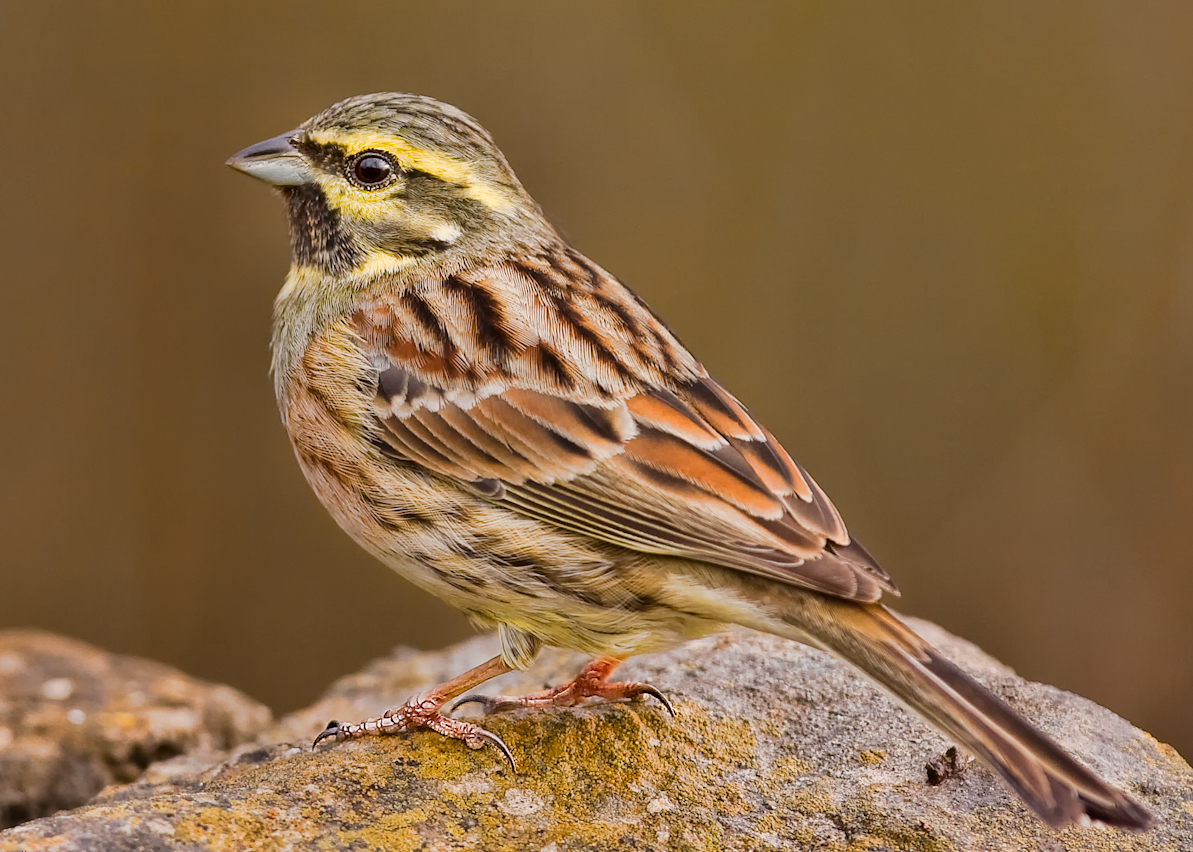
Cirl Bunting (Emberiza cirlus) lives in open woodland across Southern Europe, North Africa. It feeds on seeds and insects. Its conservation status is Least Concern.
Hear the Cirl Bunting
A real field recording of the Cirl Bunting, made in the wild.
The cirl bunting was deliberately released in the 19th century on New Zealand's South Island, creating a self-sustaining colony that still exists today. Because the species is a resident of warm areas and does not migrate in winter, the introduced birds were able to remain year-round. Their preference for sunny, open slopes matches many South Island habitats, helping the population persist.
Cirl buntings are highly sedentary, typically venturing only about 250 metres from their nest while feeding in the summer months. When winter arrives they expand their foraging range to as far as 2 kilometres to locate stubble fields where seeds are available. Their winter feeding often occurs in flocks, taking advantage of the mixed grass-and-arable farmland that provides both seed and insect resources.
Targeted stewardship lifted the Devon cirl bunting population from 118 pairs in 1989 to 700 pairs by 2003, a rise of more than five times. Conservation measures such as leaving spring barley stubble untouched over winter provide the spilled grain and weed seeds the birds need to survive the cold months. Partnerships like the Natural England-RSPB "Cirl Bunting Project" coordinate these actions and monitor progress.
The cirl bunting appears on the road signs of Stokeinteignhead, making the bird a local emblem. It has a bright yellow head with a black crown and, as a resident of warm Mediterranean-type habitats, it does not migrate and favours sunny open slopes with scattered scrub.
Historically the cirl bunting was widespread across southern England, but today it survives only in south Devon. Agricultural changes at the northern edge of its range drove a steep decline, confining the bird to a small coastal area. Conservation schemes have boosted numbers locally, yet the species has not re-expanded beyond this Devon stronghold. The bird's limited distribution underscores how farming practices can reshape a species' range.
Sources
Every fact above was checked against these pages, and kept only where one of them states it.
In the sun-drenched landscapes of southern Europe, the Cirl Bunting flits with understated elegance, its earthy tones and subtle song a testament to its unassuming nature. As it forages for seeds and insects, its sharp, black-striped head darts with precision, a masterclass in economy of motion, while its wings beat in a soft, pulsing rhythm that belies the remarkable endurance of this small, yet resilient, songbird. With each delicate step, the Cirl Bunting weaves an intricate narrative of survival and adaptation, its very existence a poignant reminder of the beauty that thrives in the unassuming corners of our world.
Advertisement
Hear the Cirl Bunting, and 4,400+ more
Real recorded sounds, 11 nature games and a free Daily 5, 1v1 quiz duels, conservation wins and a safe Kids mode. Free on Feravox.