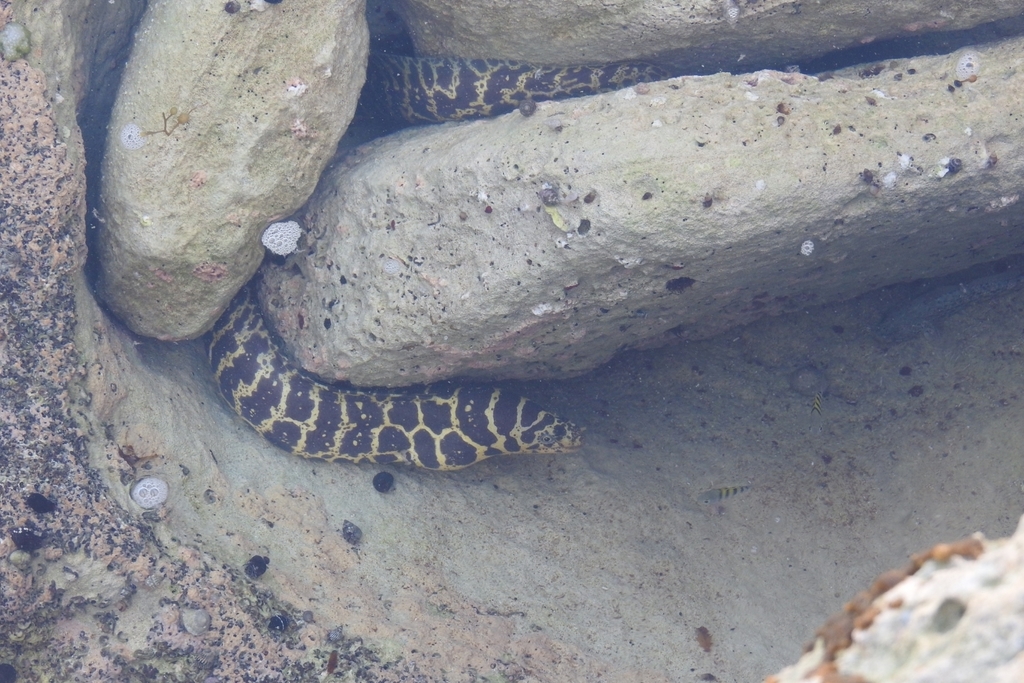
Photo: Sebastián de Jesús Herrera Buenfil
Feravox · The Voice of the Wild
Chain Moray
Echidna catenata
Least Concern
Chain Moray (Echidna catenata) lives in reef and rocky shores across Western Atlantic. It feeds on crabs and other crustaceans. Its conservation status is Least Concern.
The chain moray, Echidna catenata, is an elongated, heavy-bodied eel that glides through shallow Atlantic reefs with a dark brown to black coat pierced by a lattice of vivid yellow, chain-like lines. Its rounded snout houses pointed, blunt teeth, especially on the roof of the mouth, perfect for crushing the hard shells of its favorite prey, crabs. A single continuous fin runs along its dorsal, tail, and anal regions, while pectoral and ventral fins are absent, and its scaleless skin is slick with a clear mucus that reduces drag in the clear, shallow waters it inhabits. Typically measuring 30 to 45 cm, individuals can reach a maximum of 165 cm, though most are closer to 40 cm, and their striking yellow eyes peer from the crevices they occupy just a few metres below the surface. Nocturnal by nature, the chain moray spends daylight hours concealed in holes and rock crevices, often with only its head protruding, continuously pumping water over its gills. When night falls, it may ambush passing crabs, shrimps, worms, octopuses, or small fish, sometimes striking with its body partly out of the water and even foraging in tide pools where it can survive up to half an hour on land. Its feeding repertoire includes tearing apart large crabs and swallowing smaller ones whole, and it can chase prey for as far as 5 m, a surprising level of agility for a creature that often appears motionless. This blend of stealth, powerful jaws, and unexpected terrestrial tolerance makes the chain moray a uniquely adaptable predator of the shallow Atlantic seascape.
Real recorded sounds, 11 nature games and a free Daily 5, 1v1 quiz duels, conservation wins and a safe Kids mode. Free on Feravox.