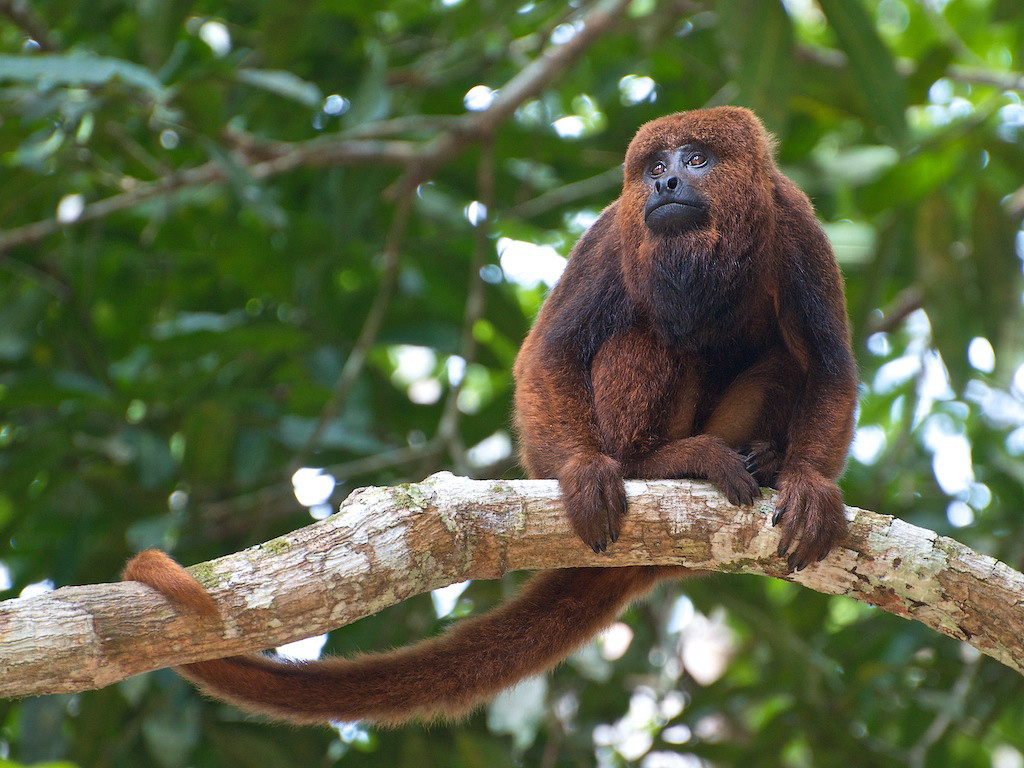
Brown Howler Monkey (Alouatta guariba) lives in tropical rainforest across South America. It feeds on leaves and fruits. Its conservation status is Vulnerable.
Hear the Brown Howler Monkey
A real field recording of the Brown Howler Monkey, made in the wild.
The northern brown howler (A. guariba) is classified as critically endangered, reflecting its precarious status within the species. This subspecies inhabits the Atlantic forest, a stretch that runs from Bahia and Espírito Santo down to Rio Grande do Sul in Brazil and reaches Misiones in Argentina. Its limited distribution and the ongoing loss of forest habitat heighten its risk of extinction, making conservation efforts especially urgent for these populations.
Their calls are amplified by an enlarged larynx and a spacious open chest that acts as a resonating chamber, giving the howls extraordinary reach. Specialized vocal chords further shape the sound, allowing males to produce the dominant roars that signal mate defence and territorial ownership. Because males initiate virtually all howling, these acoustic features enable them to broadcast their presence across the forest, reinforcing social hierarchy within the troop.
On spotting a black hawk eagle, a brown howler first alarms the group and then falls silent, signalling imminent danger. The troop promptly descends into the understory and disperses in an organised retreat, with adult individuals leading the young away from the predator's reach. This three-stage response, alarm, silence, and coordinated movement, helps protect the most vulnerable members, as the eagle primarily targets juveniles.
When a ground predator approaches, brown howlers stay high in the canopy and keep completely silent. This silence can last between five and fifteen minutes, effectively masking their presence from the threat. The behaviour is part of a broader anti-predator strategy that also includes descending into the understory and organised dispersal when aerial raptors are sighted.
Brown howlers are extremely vulnerable to the yellow-fever virus, suffering a very high death rate when infected. Because mortality is so rapid, large numbers of dead individuals serve as an early warning of a regional outbreak. Researchers note that, despite this susceptibility, the species does not act as a reservoir for the virus, meaning it does not maintain the pathogen within its population.
Sources
Every fact above was checked against these pages, and kept only where one of them states it.
Deep within the lush canopies of the Atlantic Forest, the brown howler monkey reigns as a sonorous sentinel, its haunting vocalizations echoing through the misty dawn air as it moves with deliberate intent, its powerful arms propelling it from branch to branch with a slow, majestic ease. With eyes that gleam like dark, polished stones, this majestic creature surveys its domain, a true monarch of the treetops, its rugged, rust-hued fur blending seamlessly into the dappled shade. As it navigates the labyrinthine forest, its very presence seems to embody the wild, unbridled spirit of this threatened ecosystem.
Advertisement
Hear the Brown Howler Monkey, and 4,400+ more
Real recorded sounds, 11 nature games and a free Daily 5, 1v1 quiz duels, conservation wins and a safe Kids mode. Free on Feravox.