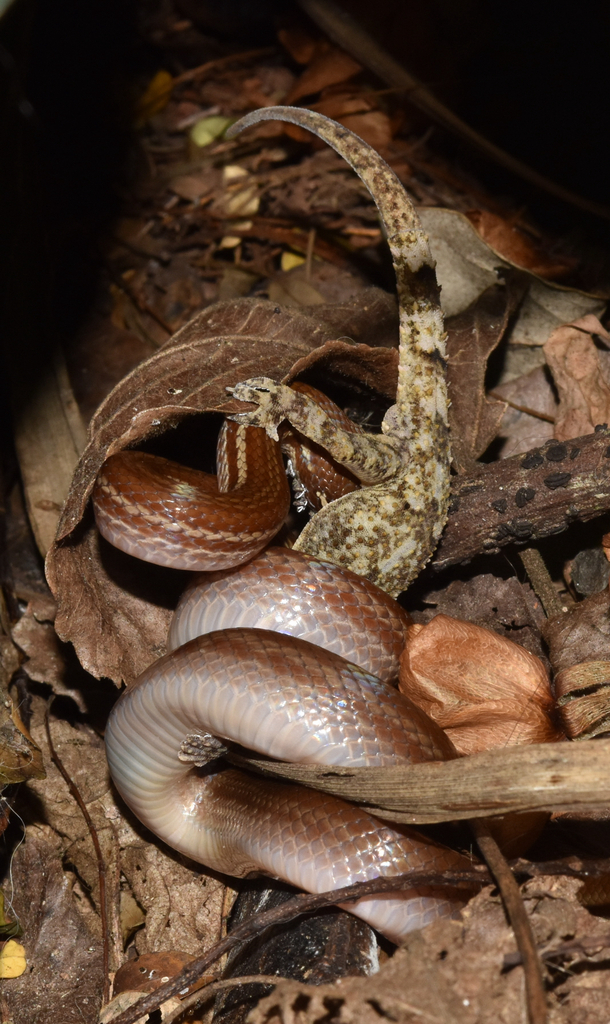
Photo: Sunčana Bradley
Feravox · The Voice of the Wild
Brown House Snake
Boaedon capensis
Least Concern
Brown House Snake (Boaedon capensis) lives in human habitations across Southern Africa. It feeds on rodents and mice. Its conservation status is Least Concern.
The brown house snake, Boaedon capensis, drifts through the savannas and towns of Botswana, South Africa, Mozambique, Zambia and Zimbabwe, its dark brown, olive-green or near-black dorsal hue shifting like the soil beneath it. Bold, thick stripes trace a line from the rostral scale across the eye to the back of the head, often accompanied by a chain-like lateral stripe that may fade two-thirds down the body, leaving only the chocolate base tone. Occasionally, individuals appear patternless, their head markings the sole reminder of the species’ signature design, while iridescent scales flash an oily sheen when caught in the light. Females outsize their male counterparts, sometimes reaching four feet (120 cm), whereas males typically stop at two to two-and-a-half feet (61–76 cm). In the night, these nocturnal hunters slip into human habitations, drawn by the steady supply of rodents that gather around stored grain. Their diet can be astonishingly efficient: a single snake may consume an entire nest of mice in one sitting, and in the wild they breed once or twice a year. In captivity, the same opportunistic appetite fuels prolific reproduction, up to six clutches a year, each laying five to sixteen eggs roughly every sixty days, making them a favorite among both novice and seasoned reptile enthusiasts.
Real recorded sounds, 11 nature games and a free Daily 5, 1v1 quiz duels, conservation wins and a safe Kids mode. Free on Feravox.