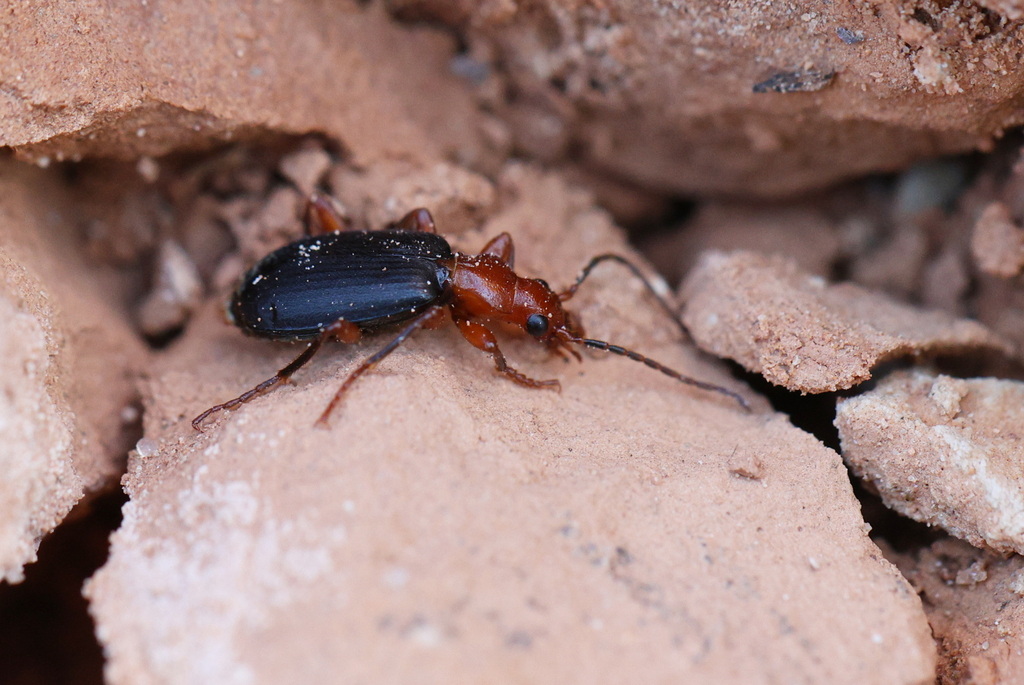
Bombardier Beetle (Brachinus crepitans) lives in grassland and open ground across Europe, Africa, and Asia. Its conservation status is Least Concern.
Fascinating facts about the Bombardier Beetle
- The beetle's scientific name, Brachinus crepitans, comes from a Latin term meaning "crackle," a reference to the audible pop it produces when threatened. As a ground beetle in the Brachininae subfamily, it inhabits dry, sunny spots across Europe, western Asia and northern Africa.
- When the beetle feels threatened it ejects a liquid from two glands located near its anus. One gland stores hydrogen peroxide while the other contains hydroquinone; the two chemicals meet in a specialised firing chamber where enzymes trigger a rapid reaction that propels the mixture outward, deterring predators.
- The beetle's early life stage is not fully documented, but scientists think the larvae live as external parasites. They attach to the pupae of other ground-beetle species and consume them from the outside, targeting species such as Amara convexiuscula and the staphylinid Tasgius ater. This parasitic habit links the beetle's development directly to the presence of these other insects in its habitat, influencing where the larvae can successfully grow.
- Adults measure between 7 and 10.2 mm in length, averaging about 8 mm. Their head and pronotum are brown while the elytra are greenish, giving a distinctive colour pattern. They are typical ground beetles of the Brachininae subfamily and occur in dry, sunny habitats such as under stones, calcareous grasslands and chalk quarries. This size and colouring help them blend into the stone and soil environment where they hunt.
- In Ukraine the beetle lives in the steppes of Lviv, near the village of Osovitsa in Podolian Province. It is also recorded from Zolochiv in Kharkiv Oblast, showing a spread across both western and eastern steppe zones. These steppe habitats are dry and sunny, matching the species' overall preference for open grasslands. Sheltering under stones in these areas lets the beetle stay protected while it is active during its May-June flight period.
Sources
Every fact above was checked against these pages, and kept only where one of them states it.
At a glance
RangeEurope, Africa, and Asia
HabitatGrassland and open ground
DietInsects and larvae
About the Bombardier Beetle
In the scorching underbrush, a tiny titan emerges, its armored shell glinting like polished onyx as the bombardier beetle navigates its domain with deliberate, purposeful strides. As it moves, the air is filled with the acrid scent of warning, a potent signal to potential predators that this unassuming insect is capable of unleashing a blistering blast of boiling hot benzoquinone from its abdomen, a defensive feat that has earned it a revered place among the insect world's most formidable warriors. With each step, the bombardier beetle claims its territory, an unyielding guardian of its sun-baked realm.
Hear the Bombardier Beetle, and 4,400+ more
Real recorded sounds, 11 nature games and a free Daily 5, 1v1 quiz duels, conservation wins and a safe Kids mode. Free on Feravox.
More insects and spiders to discover