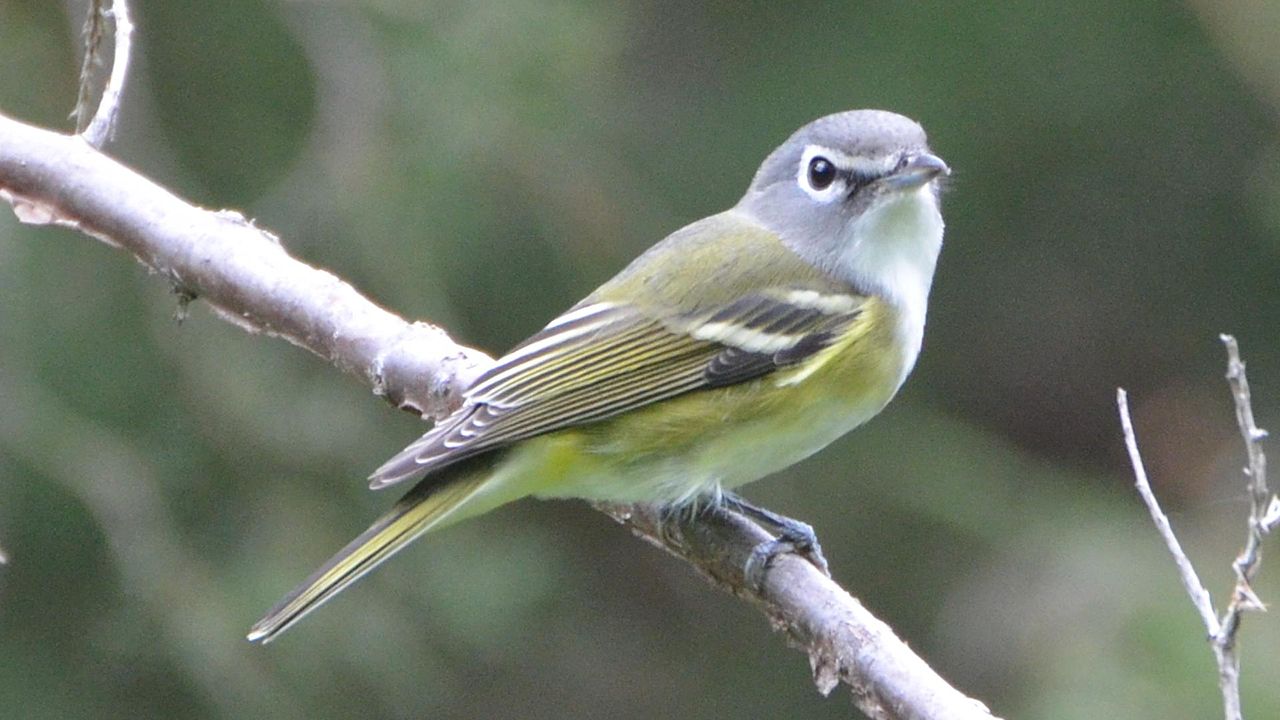
Blue-Headed Vireo (Vireo solitarius) lives in deciduous forest across North America. It feeds on insects and spiders. Its conservation status is Least Concern.
Hear the Blue-Headed Vireo
A real field recording of the Blue-Headed Vireo, made in the wild.
At just over a foot long, the blue-headed vireo packs a surprising heft: it measures 126-148 mm (5.0-5.8 in) in length, spreads a wingspan of 200-240 mm (7.9-9.4 in) and weighs 13-19 g (0.46-0.67 oz). Those dimensions match the precise range reported by researchers, who also logged a slightly smaller wing span of 138.4-155.6 mm in a separate study. Its modest size belies a relatively long life for a songbird, averaging about 7 years 5 months in the wild, with the longest recorded individual reaching 7.4 years.
When males stake out a breeding patch, they defend territories that can span 1.5-6.6 hectares (3.7-16.3 acres). Within these bounds, a pair lays 3-5 eggs, each about 17-23.1 × 13.3-15.8 mm, and incubates them for roughly 14 days. After hatching, chicks stay in the nest for another 14 days before fledging, making the total parental effort about 28 days.
Only about 10-30 % of hatchlings survive to fledging, a grim statistic driven largely by brood parasitism. Brown-headed cowbirds lay their larger eggs in vireo nests, prompting parents to raise the parasite's chick while their own starve. Researchers recorded 65 nests that accepted cowbird eggs, with only two cases where the vireo abandoned the nest entirely. This high parasitism pressure explains why blue-headed vireos have evolved unusually cooperative breeding: both sexes share incubation and feeding duties.
Population trends have been upward since the 1970s, culminating in a 2004 assessment that placed the blue-headed vireo in the IUCN's "Least Concern" category. Yet human structures can still cause sudden losses: three TV towers in Wisconsin killed 175 individuals in a single night in September 1963. Habitat loss from invasive hemlock woolly adelgids further narrows nesting options, forcing birds to wait for deciduous leaf-out before they can breed.
Unlike most songbirds, blue-headed vireos show a hormonal balance that fuels shared parenting. Males keep testosterone low throughout the breeding season, a hormone usually linked to aggression, while maintaining high prolactin levels that promote incubation and chick-feeding. This endocrine mix lets males build nests, incubate by day and feed nestlings, while females handle night incubation. The strategy results in both parents contributing equally to offspring care, offering a live example of social and genetic monogamy in birds.
Sources
Every fact above was checked against these pages, and kept only where one of them states it.
In the verdant understory of North America's deciduous forests, the Blue-Headed Vireo flits with unassuming elegance, its slate-gray crown and olive-green back blending seamlessly into the dappled shade as it searches for insects and spiders to fuel its energetic existence. With each nimble leap from branch to branch, the vireo's bright, inquisitive eyes scan the surroundings, drinking in every detail of its intricate world, as if perpetually uncovering hidden wonders. As it moves, the bird's melodic song - a series of descending phrases that seem to tumble through the air like a gentle brook - weaves a sonic tapestry that is at once haunting and beautiful.
Advertisement
Hear the Blue-Headed Vireo, and 4,400+ more
Real recorded sounds, 11 nature games and a free Daily 5, 1v1 quiz duels, conservation wins and a safe Kids mode. Free on Feravox.