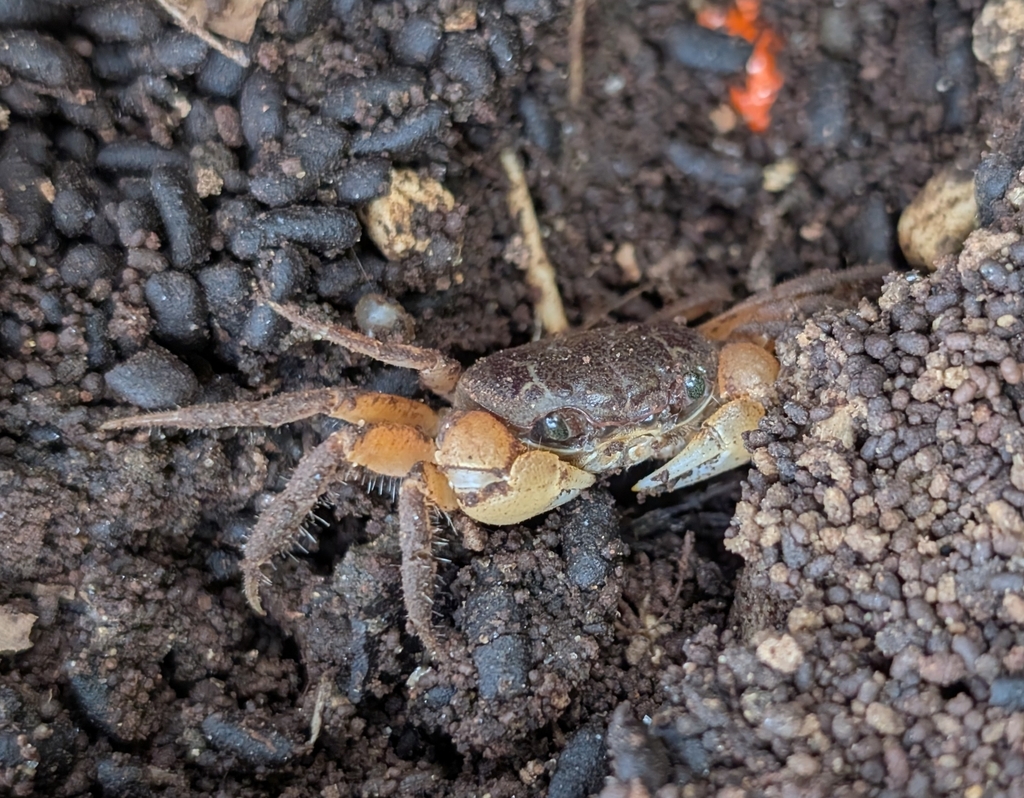
Blue Crab (Tuerkayana hirtipes) lives in brackish water across Chesapeake Bay. It feeds on clams and mussels. Its conservation status is Least Concern.
Fascinating facts about the Blue Crab
- Tuerkayana hirtipes blankets the western Pacific like a living map, turning islands from southern Japan to New Caledonia into its backyard. It has been recorded from southern Japan, Taiwan, southern China, Palau, Guam, eastern Australia, Fiji, Hawaii (a single record, almost certainly erroneous), the Solomon Islands, New Caledonia, the Philippines, Indonesia, Vietnam, Malaysia and Singapore.
- The first scientific glimpse of Tuerkayana hirtipes dates back to the mid-19th century, when James Dwight Dana named it Cardisoma hirtipes in 1851 after pulling specimens from Fiji during the United States Exploring Expedition. Because the original samples vanished, researchers set a new standard by designating a neotype from Fiji in 2012, anchoring the species' identity for future work. This historical thread shows how even lost specimens can be rescued by modern taxonomy, ensuring that the crab's name stays tied to a real, verifiable animal.
- In late 2018, scientists gave the crab a fresh family portrait by carving out the new genus Tuerkayana, pulling together four former Cardisoma and Discoplax species under one roof.
- Spotting Tuerkayana hirtipes is like finding a blue-tinted rock in the forest: its carapace is smooth, distinctly inflated, and painted blue or blue-brown, unlike the purple shades of its relatives.
- Its carapace looks like a balloon, a shape that sets it apart from its close cousins.
Sources
Every fact above was checked against these pages, and kept only where one of them states it.
At a glance
RangeChesapeake Bay
HabitatBrackish water
DietClams and mussels
About the Blue Crab
As the turquoise waters of the coastal shallows dance with the sunlight, the blue crab emerges, its vibrant shell a mesmerizing spectacle of sapphire and indigo hues. With deliberate, sidestepping gait, it navigates the underwater realm, its eyes twitching with an air of quiet vigilance, ever alert to the subtleties of its surroundings. In this ephemeral world of shifting tides and whispering seaweed, the blue crab reigns as a master of adaptability, its remarkable resilience a testament to the enduring power of life in the ocean's margins.
Hear the Blue Crab, and 4,400+ more
Real recorded sounds, 11 nature games and a free Daily 5, 1v1 quiz duels, conservation wins and a safe Kids mode. Free on Feravox.
More ocean life to discover