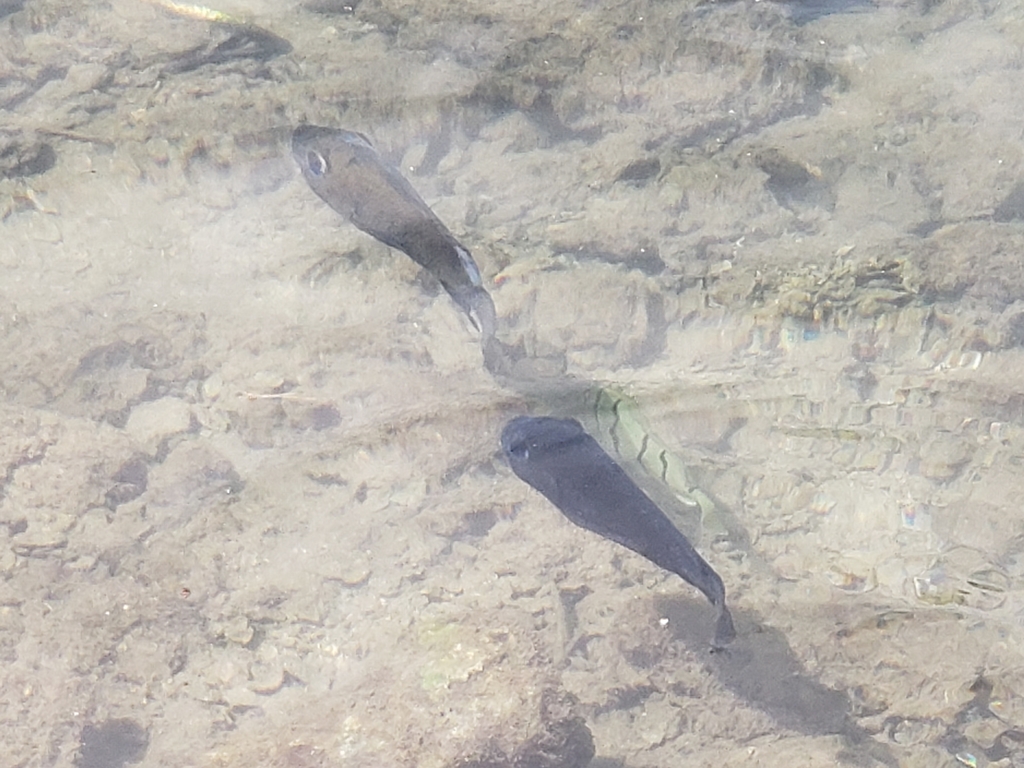
Photo: Tyler Bishop
Feravox · The Voice of the Wild
Blackchin Tilapia
Sarotherodon melanotheron
Least Concern
Blackchin Tilapia (Sarotherodon melanotheron) lives in mangrove estuaries across West Africa. It feeds on aufwuchs detritus bivalves. Its conservation status is Least Concern.
The blackchin tilapia (Sarotherodon melanotheron) glides through West African mangroves with a pale body that can flash light blue, orange, or golden yellow, each adult marked by a dark chin patch and irregular bars or spots along its sides. Its small, tooth-filled mouth, packed with a few hundred teeth in three to six rows, lets it scrape biofilm, detritus, bivalves and zooplankton from surfaces, even though it lacks gill rakers. Males are only subtly larger-headed than females, sometimes showing a gold tint on the operculum, while the dorsal fin bears 15–17 spines and 10–12 soft rays, and the anal fin 3 spines and 8–10 soft rays. Growing up to 28 cm but usually stopping near 17.5 cm, it forms nocturnal schools that drift into brackish lagoons, estuaries and even pure seawater, a rare tolerance among cichlids. Its reproductive drama unfolds in shallow shore waters where the female courts, digs a pit and leads the male into a bond; the male then guards the fertilized eggs while the female, though rarely, has been observed mouth-brooding in a Ghanaian strain. A surprising twist is its ability to thrive in both fresh and salty habitats, allowing it to colonise mangrove swamps, freshwater streams and coastal lagoons, and to become a prolific invader far beyond its native range.
Real recorded sounds, 11 nature games and a free Daily 5, 1v1 quiz duels, conservation wins and a safe Kids mode. Free on Feravox.