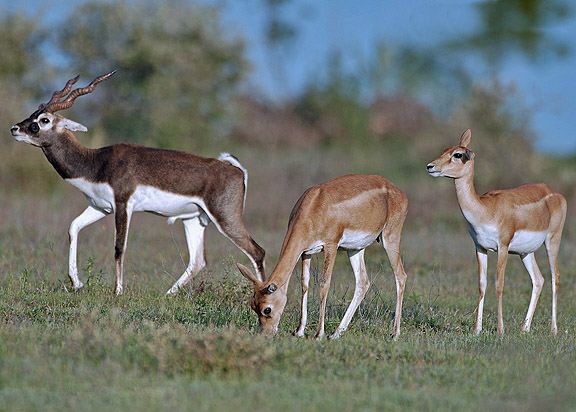
Blackbuck (Antilope cervicapra) lives in open savanna across Indian subcontinent. It feeds on grasses and leaves. Its conservation status is Least Concern.
Fascinating facts about the Blackbuck
- Standing just under a meter tall, blackbucks reach 74 to 84 cm at the shoulder, while males tip the scales at 20-57 kg with an average of 38 kg. Their corkscrew horns stretch 35-75 cm, and in Texas some males have been recorded with horns up to 58 cm long. This blend of compact height, hefty mass, and long, spiraled horns lets them sprint up to 80 km/h.
- Male blackbucks defend tiny kingdoms of just 1.2 to 12 hectares (3.0 to 29.7 acres) during the lek-season, marking borders with scent from pre-orbital and interdigital glands, plus faeces and urine. Only dominant bulls hold these patches, while females wander in to feed and mate. By concentrating females in a small arena, the lek boosts a male's chance of passing on his genes, but also forces weaker bulls into risky fights that can leave them injured or expelled.
- Blackbuck males carry an extra Y chromosome, an XY1Y2 system, giving them 31-33 chromosomes versus 30-32 in females. Such oversized sex chromosomes were once thought unique to rodents, yet a 1968 study showed the blackbuck (and the sitatunga) also possess them, with the X chromosome making up 14.96 % of the haploid set instead of the usual 5 %. This genetic quirk hints at a rapid evolutionary path driven by strong male competition in leks.
- Nepal plans to move 18 blackbucks, six males and 12 females, from western reserves into a 20-hectare (50-acre) fenced enclave near Chitwan, a tiger-rich landscape. The new site's grasses tower up to 4.5 m (15 ft), far taller than the short savanna shoots the species prefers, and leopards have already killed over 50 blackbucks in nearby Bardiya in a single year. These mismatches raise the odds of stress-induced poor adaptation, higher predation, and possible population collapse.
- Introduced to Texas in 1932, the blackbuck now numbers around 20,000 individuals across the state, making it the most abundant exotic ungulate after the chital by 1988.
Sources
Every fact above was checked against these pages, and kept only where one of them states it.
At a glance
RangeIndian subcontinent
HabitatOpen savanna
DietGrasses and leaves
About the Blackbuck
Across the sun-baked savannas and grasslands of the Indian subcontinent, the blackbuck roams with an air of quiet elegance, its slender legs carrying it with effortless grace as it navigates the scrubby terrain in search of sustenance. With its striking coat of dark brown and white, this majestic antelope moves through the landscape like a phantom, its large eyes ever-vigilant for the presence of predators. As it runs, its horns, spiraling upward like twisted scimitars, seem to propel it forward, imbuing its flight with a sense of wild and unbridled beauty.
Hear the Blackbuck, and 4,400+ more
Real recorded sounds, 11 nature games and a free Daily 5, 1v1 quiz duels, conservation wins and a safe Kids mode. Free on Feravox.