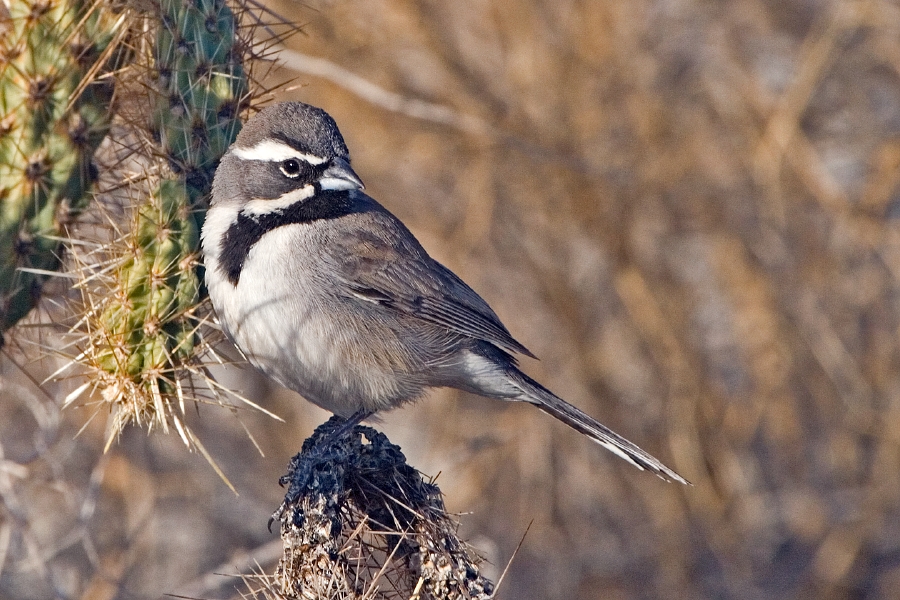
Black-Throated Sparrow (Amphispiza bilineata) lives in arid desert hillsides and scrub across Southwestern United States and Mexico. Its conservation status is Least Concern.
Hear the Black-Throated Sparrow
A real field recording of the Black-Throated Sparrow, made in the wild.
Fascinating facts about the Black-Throated Sparrow
After other sparrows were reassigned, the black-throated sparrow remains the sole species in the genus Amphispiza according to most major taxonomic authorities. It was first described in 1850 as Emberiza bilineata, and in 1874 Elliott Coues created the new genus with this bird as the type. Several former members such as the five-striped sparrow, Bell's sparrow and sagebrush sparrow were later moved to different genera, leaving only this species in Amphispiza.
The black-throated sparrow occupies an extremely large range that stretches from western Canada across the United States to the Atlantic coast, with occasional records as far north as British Columbia, Alberta and Saskatchewan and as far east as Florida, New Jersey, Ontario and Quebec. Its core distribution includes Mexico and the United States, where it inhabits dry semi-open landscapes.
The three northernmost subspecies, A. b. bilineata, A. b. opuntia, and A. b. deserticola, are partial migrants, leaving the northern parts of their breeding ranges after the season and moving southward within the species' overall distribution. They remain present year-round in areas such as southeastern California, southern Arizona, southern New Mexico, Texas and Mexico.
The black-throated sparrow's song is built in two distinct sections. The first part is an introductory phrase that ends in a buzz, and the second part repeats a series of trills that can also contain buzzes. The species is noted for having very few other calls.
On the islands of the Sea of Cortez the black-throated sparrow breeds later in the year, nesting from late September through October. The female constructs an open cup nest from a mix of plant fibres, often lining it with fine fibres or animal hair, and places it near the ground in a fork of a dense shrub. Nests built in mesquite tend to have lower success than those in other shrubs, and clutches usually contain three or four eggs out of a possible two to five.
Sources
Every fact above was checked against these pages, and kept only where one of them states it.
In the arid expanse of the desert southwest, the Black-Throated Sparrow flits with effortless ease, its gray-brown plumage blending seamlessly into the rocky outcroppings it calls home. As it darts between scrubby bushes and cacti, its black throat patch glints like polished onyx, a subtle yet striking accent that sets this unassuming bird apart from its more flamboyant counterparts. With a gentle, lilting song, the Black-Throated Sparrow navigates its harsh yet beautiful landscape, a testament to the quiet resilience of life in the harshest of environments.
Advertisement
Hear the Black-Throated Sparrow, and 4,400+ more
Real recorded sounds, 11 nature games and a free Daily 5, 1v1 quiz duels, conservation wins and a safe Kids mode. Free on Feravox.