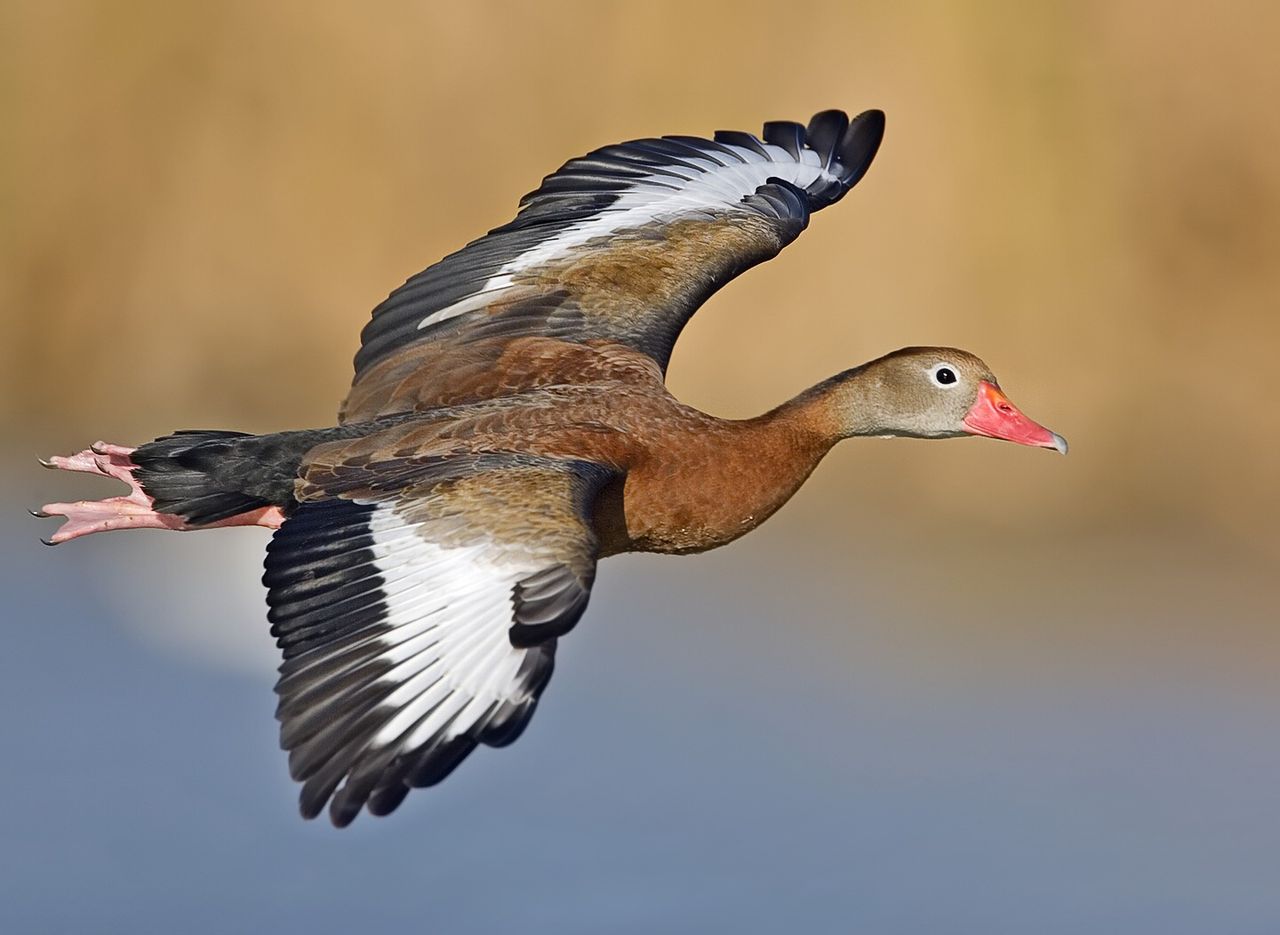
Black-Bellied Whistling-Duck (Dendrocygna autumnalis) lives in freshwater wetlands across North America, South America. Its conservation status is Least Concern.
Hear the Black-Bellied Whistling-Duck
A real field recording of the Black-Bellied Whistling-Duck, made in the wild.
Fascinating facts about the Black-Bellied Whistling-Duck
Black-bellied whistling ducks form a strong monogamous pair-bond that is unusual for ducks and more typical of geese and swans. Their partners often remain together for many years, creating a stable breeding unit. Both adults take part in every stage of raising the brood, from sitting the eggs to caring for the ducklings after they hatch. This shared responsibility reinforces the durability of the partnership.
A single clutch of black-bellied whistling ducks contains nine to eighteen white eggs, each measuring between 4.5 and 6.2 cm in length and 3 to 4.2 cm in width, making them relatively large for a mid-sized duck. After hatching, the ducklings tumble out of the cavity within two days and are able to feed themselves straight away. They remain with their parents for up to eight weeks, gaining protection and guidance during this vulnerable period.
While black-bellied whistling ducks usually nest in hollow trees, often in palms in South America, they will also use ground sites when cavities are unavailable. They readily exploit human structures such as chimneys, abandoned buildings and specially supplied nest boxes, a behaviour that has become common in southeast Texas and Mexico where nest boxes are increasingly provided. This flexibility broadens their breeding opportunities across varied habitats.
A thin white wing bar runs across the secondary feathers, a feature found in no other whistling duck. In flight the contrast of the white bar against dark primaries makes them easy to spot.
The species numbers between 1,100,000 and 2,000,000 individuals worldwide and the count is still rising. This large, growing population underpins its IUCN status of Least Concern.
Sources
Every fact above was checked against these pages, and kept only where one of them states it.
In the warm, golden light of dawn, the Black-Bellied Whistling-Duck emerges from its nocturnal slumber, its soft, whistled calls carrying across the tranquil wetlands like a gentle breeze. As it waddles through the shallow waters, its dark belly and chestnut flanks glisten with dew, while its bright orange legs move with a quiet purpose, stirring the murky depths in search of hidden treasures. With its unique, haunting voice and serene demeanor, this unassuming duck weaves a subtle spell of enchantment, a true marvel of the natural world.
Advertisement
Hear the Black-Bellied Whistling-Duck, and 4,400+ more
Real recorded sounds, 11 nature games and a free Daily 5, 1v1 quiz duels, conservation wins and a safe Kids mode. Free on Feravox.