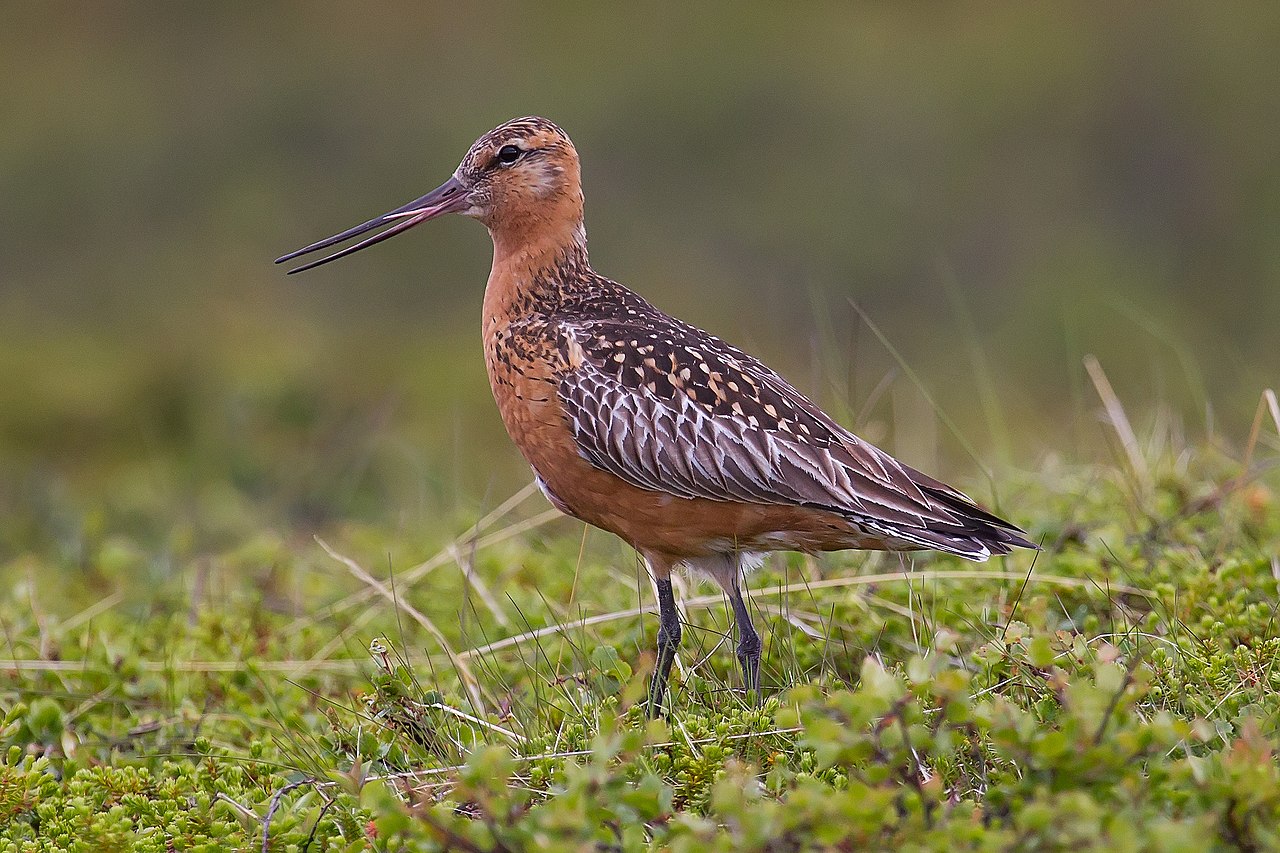
Bar-tailed Godwit (Limosa lapponica) lives in arctic tundra and intertidal mudflat across Alaska to New Zealand. Its conservation status is Near Threatened.
Hear the Bar-tailed Godwit
A real field recording of the Bar-tailed Godwit, made in the wild.
A single bar-tailed godwit flew nonstop from western Alaska to New Zealand in just eight days, covering a record 11,680 km (7,260 mi) and then returned for a 174-day round-trip of 29,280 km (18,190 mi) with 20 days of flying. This shows how the species pushes the limits of avian endurance, proving that birds can sustain extreme fuel loads and organ reduction to cross entire oceans without stopping for food.
Seven godwits tagged in New Zealand were tracked on a nonstop return to the Yellow Sea in China, flying 9,575 km (5,950 mi) and one individual actually covered 11,026 km (6,851 mi) in nine days. This demonstrates the species' ability to navigate across the Pacific without refuelling, relying on massive fat stores that are the greatest recorded for any migratory bird.
The subspecies L. l. baueri, the largest of the five recognized forms, deposits 75-85 g more fat than its smaller relatives, allowing flights of 6,000-8,600 km (3,700-5,300 mi) without wind assistance and up to 8,200-8,600 km with favorable winds. This extra fuel explains why baueri birds can make the longest nonstop Pacific crossings among godwits.
Bar-tailed godwits carry the greatest fat loads of any studied migratory bird, shrinking their digestive organs to make room for fuel. This physiological adaptation lets them fly up to 11,680 km nonstop, a distance no other bird achieves without feeding, highlighting the extreme trade-off between organ size and endurance.
During the southern migration, more than 12,000 shorebirds, including bar-tailed godwits, stop at Penang's Teluk Air Tawar mudflats, refuelling before a 20,000-km (12,400-mi) flight to Australia and New Zealand. This single site supports thousands of birds, showing how a handful of wetlands are critical waypoints for inter-hemispheric journeys.
Sources
Every fact above was checked against these pages, and kept only where one of them states it.
As the Bar-tailed Godwit takes to the skies, its slender form slices through the air with effortless elegance, propelled by the relentless urge to migrate to its Arctic breeding grounds. With each beat of its wing, it embarks on an odyssey of over 11,000 kilometres, a testament to its remarkable endurance and navigational prowess. In a world of shifting landscapes and unpredictable tides, this near-threatened bird has evolved to thrive in the margins, its haunting calls echoing across the wetlands like a poignant reminder of the beauty and fragility of life.
Advertisement
Hear the Bar-tailed Godwit, and 4,400+ more
Real recorded sounds, 11 nature games and a free Daily 5, 1v1 quiz duels, conservation wins and a safe Kids mode. Free on Feravox.