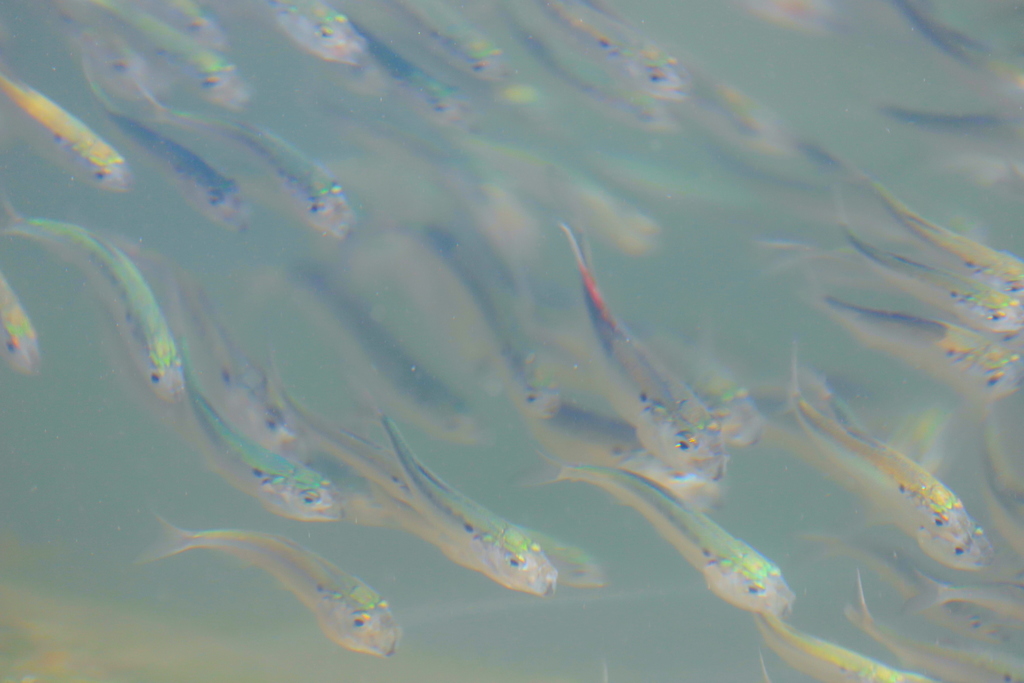
Photo: Steven Bodzin
Feravox · The Voice of the Wild
Atlantic Menhaden
Brevoortia tyrannus
Least Concern
Atlantic Menhaden (Brevoortia tyrannus) lives in coastal estuarine waters across Nova Scotia to Florida. It feeds on zooplankton and phytoplankton. Its conservation status is Least Concern.
The Atlantic menhaden (Brevoortia tyrannus) glides through the North Atlantic’s coastal and estuarine waters, its silvery, moderately compressed body marked by a distinctive black shoulder spot behind the gill openings. Growing to about 15 inches, these fish form massive, size-stratified schools that stretch from Nova Scotia down to northern Florida, with juveniles crowding the Chesapeake Bay and southern coastline while the larger, older individuals dominate the cooler northern waters. Their life is a perpetual migration: eggs, buoyant and hatching in two to three days, drift into the open ocean, the larvae ride continental-shelf currents into sheltered estuaries where they spend a year, known locally as “peanut bunker”, before re-entering the sea as they mature. Menhaden are filter feeders whose diet shifts with age; tiny gill rakers in the first year capture zooplankton, but as the rakers enlarge, phytoplankton become the primary fare. This dietary transition is surprising because, despite popular belief that they cleanse waters, adult menhaden feed largely on zooplankton, and their nitrogen excretion may actually fuel phytoplankton growth. They live up to a decade, serving as a crucial forage link for predators ranging from striped bass and bluefish to ospreys, eagles, humpback whales, and even dolphins that can consume 20 pounds a day.
Real recorded sounds, 11 nature games and a free Daily 5, 1v1 quiz duels, conservation wins and a safe Kids mode. Free on Feravox.