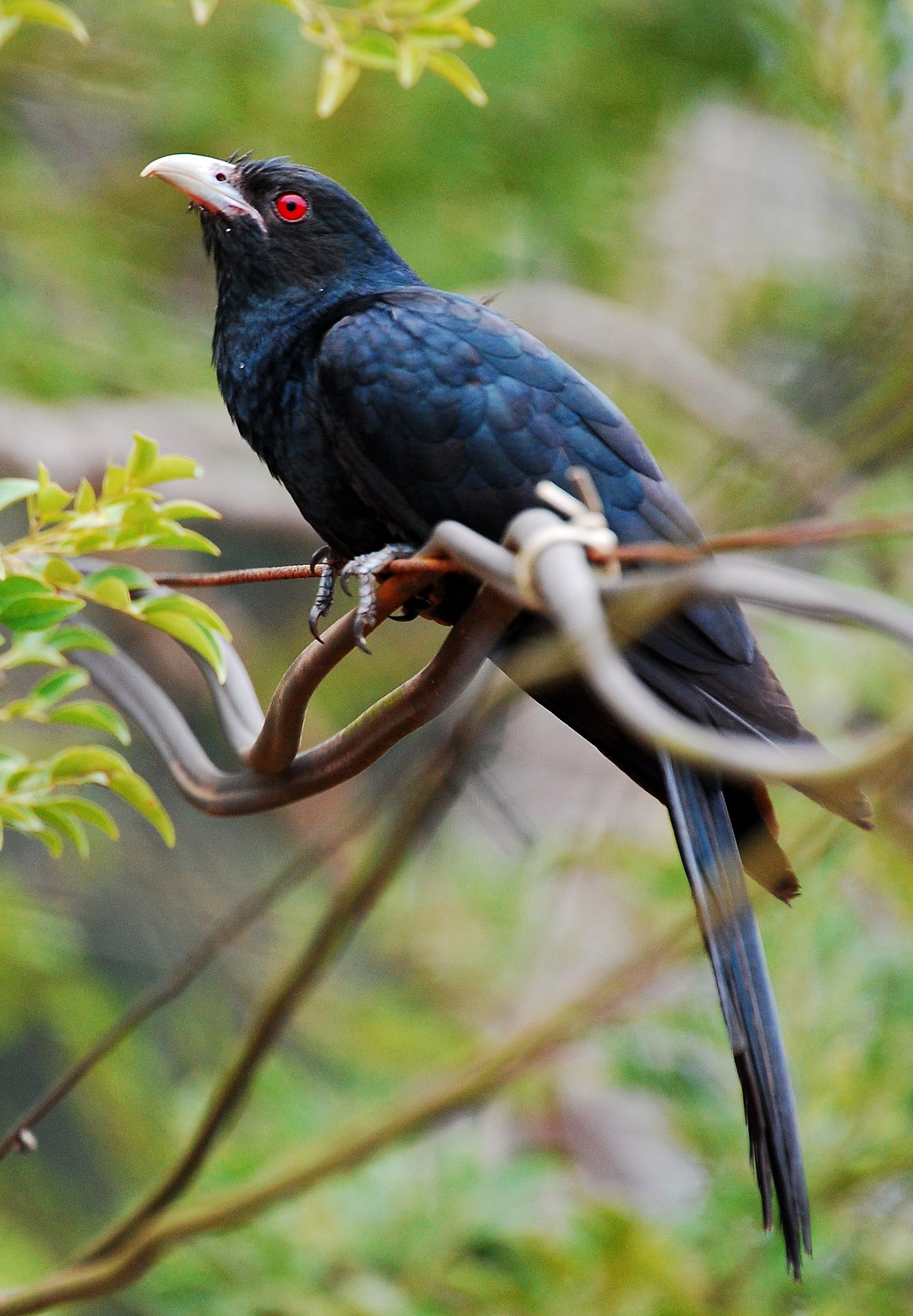
Asian Koel (Eudynamys scolopaceus) lives in tropical woodland across Southeast Asia, Australia. It feeds on fruits and insects. Its conservation status is Least Concern.
Hear the Asian Koel
A real field recording of the Asian Koel, made in the wild.
Asian koels lay a single egg in the nests of crows and other birds, with 5 % of jungle crow (Corvus splendens) nests and 0.5 % of Corvus macrorhynchos nests parasitized in India. In Bangladesh, parasitism rates soar to 35.7 % in long-tailed shrikes, 31.2 % in common mynas and 10.8 % in house crows. The first koel egg appears about one and a half days after the host's first egg, and the koel chick hatches roughly three days before the host's, giving it a developmental head start that boosts survival without needing to evict host chicks.
Unlike most cuckoos, adult koels feed mainly on fruit and have a huge gape that swallows hard palm fruits such as Arenga and Livistona. By regurgitating large-seeded sandalwood (Santalum album) fruits near the parent tree and dispersing small-seeded fruits farther away. Their habit of defending fruiting trees also shapes the foraging behavior of other frugivores.
The Asian koel is a pioneer colonizer: it was among the first birds to settle on the volcanic island of Krakatoa, and it only reached Singapore in the 1980s, where it quickly became common. Its ability to thrive in new light-woodland and cultivated habitats shows a remarkable capacity for range expansion.
The koel's song has echoed through South Asian poetry for millennia; the Vedas, dated to about 2000 BC, call it "Anya-Vapa", the earliest written hint of brood parasitism. Historically prized as cage birds, koels could survive up to 14 years on boiled rice, a testament to their hardiness. This cultural reverence, from ancient scriptures to modern state symbols, underscores how human societies have long recognized and protected a bird that both sings and steals nests.
At 39-46 cm long and weighing 190-327 g, the Asian koel. Its glossy bluish-black male plumage and crimson iris make it unmistakable, while females sport brown crowns and rufous streaks. linking ecosystems as both predator and seed-disperser.
Sources
Every fact above was checked against these pages, and kept only where one of them states it.
In the lush tapestry of the Asian forest, the Asian Koel weaves its melodic spell, a brooding presence with eyes like polished onyx, its sleek, iridescent plumage glimmering like the night sky as it moves with stealthy purpose through the shadows. With a call that echoes like a lament through the trees, this enigmatic bird navigates the dense undergrowth, its very existence a testament to the enduring power of adaptation and resilience. As it flits, unseen, from branch to branch, the Asian Koel embodies the mystique of a world that remains forever hidden, yet endlessly alluring.
Advertisement
Hear the Asian Koel, and 4,400+ more
Real recorded sounds, 11 nature games and a free Daily 5, 1v1 quiz duels, conservation wins and a safe Kids mode. Free on Feravox.