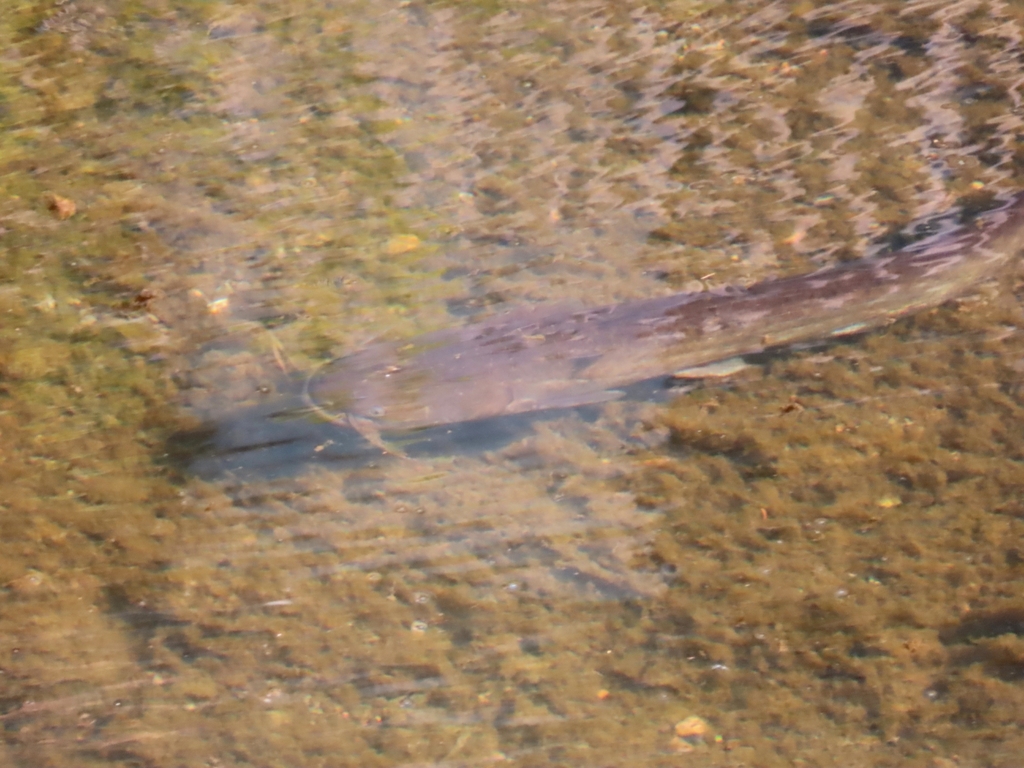
Photo: mami_t_t
Feravox · The Voice of the Wild
Amur Catfish
Silurus asotus
Least Concern
Amur Catfish (Silurus asotus) lives in freshwater rivers and lakes across East Asia. It feeds on aquatic insects, crustaceans, fish. Its conservation status is Least Concern.
The Amur catfish (Silurus asotus) is a hulking silurid with a white-streaked belly and sporadic white spots along its olive-green to yellowish-brown sides. Its flattened, broad head bears a terminal mouth armed with countless tiny, sharp teeth, while long, filamentous barbels, one pair maxillary longer than the head and a pair of mandibular barbels about a quarter that length, sweep the murky bottom as it prowls at night. Growing up to 130 cm and 30–40 kg, the species typically measures 30–60 cm, adding roughly 20–50 cm each year and can reach lengths of 1.5 m under optimal conditions. It inhabits the slow-moving rivers, irrigation canals, lakes and ponds of China, Japan, the Korean Peninsula, Taiwan, the Russian Amur Basin and northern Vietnam, favouring warm waters of 20–27 °C and dense underwater vegetation that offers both cover and ambush points. Nocturnal by nature, the Amur catfish descends to the substrate to hunt, using its sensitive barbels to locate aquatic insects, crustaceans and smaller fish. Its expandable mouth lets it tackle surprisingly large prey, and its nocturnal feeding is linked to a swollen swim bladder that limits buoyancy, keeping it close to the bottom. During the spring-summer rains, females release green-tinged eggs that hatch in as little as 27 hours in warm water, a rapid development that can stretch to 48 hours in cooler streams. A striking trait of this species is the extra pair of mandibular barbels found only in juveniles measuring 6–7 cm, a fleeting adaptation that disappears as they mature, hinting at a complex ontogenetic shift in sensory strategy.
Real recorded sounds, 11 nature games and a free Daily 5, 1v1 quiz duels, conservation wins and a safe Kids mode. Free on Feravox.