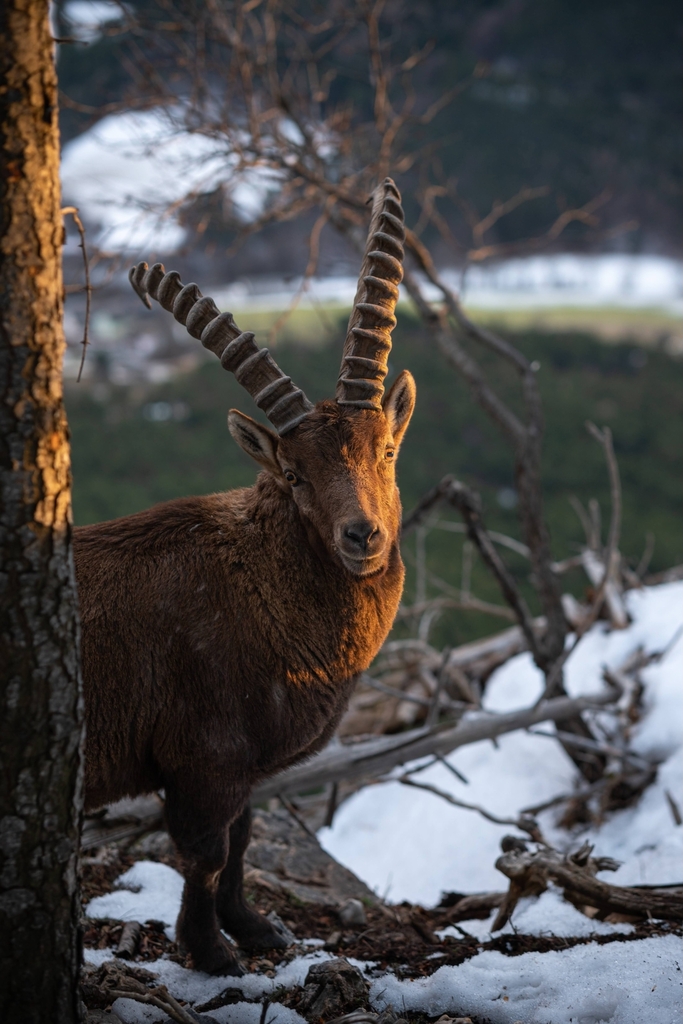
Alpine Ibex (Capra ibex) lives in mountainous Alpine terrain across European Alpine regions. It feeds on grasses and leaves. Its conservation status is Least Concern.
Fascinating facts about the Alpine Ibex
- Alpine ibex can cling to a 57-degree wall. The Alpine ibex's climbing ability is such that it has been observed scaling the 57-degree slopes of the Cingino Dam in Piedmont, Italy, where it licks salts. Only females and kids, which are lighter and have shorter legs than adult males, climb the steep dam. Kids have been observed at 49 m (161 ft) ascending in a zig-zag path and descending in straight paths. This extreme grip lets them reach food on sheer rock faces.
- By the 19th century the species teetered on the brink, surviving in a single refuge of fewer than 100 animals. It went through a population bottleneck of fewer than 100 individuals, all living in Gran Paradiso National Park, Italy. Such a narrow gene pool left the modern ibex with very low genetic diversity, making it vulnerable to disease and inbreeding. Yet that tiny herd became the source for later reintroductions, showing how a handful of survivors can seed a continent-wide recovery when protected.
- From a handful of survivors the ibex rebounded to tens of thousands. The Alpine ibex population reached 3,020 in 1914, 20,000 in 1991, and 55,297 in 2015. After a dip to about 400 by 1945, numbers rose again to 4,000 in the national park by 2005. This surge demonstrates how coordinated protection, hunting bans, and re-introductions can reverse near-extinction in a large, mobile mammal.
- At 69-98 cm (27-39 in), the horns of males are substantially longer than those of females, which reach only 18-35 cm (7.1-13.8 in) in length. The size gap mirrors overall sexual dimorphism: males stand 90-101 cm tall and weigh up to 117 kg, whereas females are 73-84 cm tall and weigh up to 32 kg. These massive horns are weapons in the winter rut, shaping dominance hierarchies and mating success.
- In Gran Paradiso, home ranges of the Alpine Ibex can exceed 700 ha (1,700 acres) and in reintroduced populations, home ranges may approach 3,000 ha (7,400 acres). Range size swells in summer when food is scattered and shrinks in winter as animals cluster on snow-free cliffs.
Sources
Every fact above was checked against these pages, and kept only where one of them states it.
At a glance
RangeEuropean Alpine regions
HabitatMountainous Alpine terrain
DietGrasses and leaves
About the Alpine Ibex
In the rugged expanse of the Alps, the ibex reigns supreme, its sure-footedness a testament to its ancient adaptation to this unforgiving realm. With each deliberate step, it navigates the treacherous terrain with a quiet confidence, its curved horns bobbing gently as it scales sheer rock faces and traverses narrow ledges with an effortless ease. As it moves through its mountain kingdom, the ibex embodies a profound resilience, its very existence a remarkable testament to the enduring power of life in one of the most inhospitable landscapes on Earth.
Hear the Alpine Ibex, and 4,400+ more
Real recorded sounds, 11 nature games and a free Daily 5, 1v1 quiz duels, conservation wins and a safe Kids mode. Free on Feravox.
Alpine Ibex photographed on Feravox