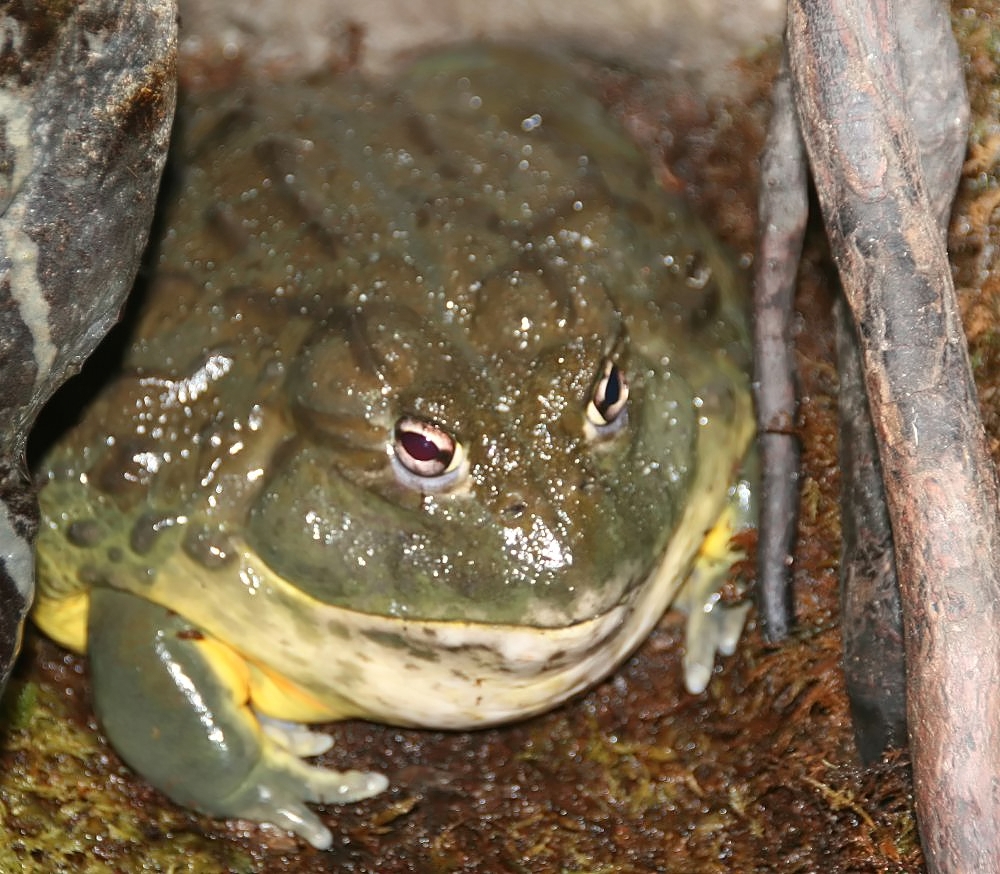
African Bullfrog (Pyxicephalus adspersus) lives in freshwater across Southern Africa. It feeds on insects and fish. Its conservation status is Least Concern.
Fascinating facts about the African Bullfrog
- Male African bullfrogs reach up to 1.4 kg in weight and measuring 24.5 cm from snout to vent. In contrast, females are roughly half that size, a rare reversal of the typical amphibian pattern where females are larger to aid amplexus, and males dominate breeding arenas.
- The African bullfrog is a voracious carnivore that will consume any animal it can swallow, from insects and small rodents to reptiles, birds, fish and other amphibians. A specimen at Pretoria Zoo swallowed 17 juvenile Rinkhals snakes in a single feeding. Juvenile bullfrogs also practice cannibalism, sometimes eating the tadpoles they guard.
- During dry periods the African bullfrog enters dormancy and constructs a cocoon that envelops its whole body, leaving only the external nostrils exposed. This cocoon reduces evaporative water loss. When rain returns, the moisture softens the cocoon, enabling the animal to break free and resume activity.
- When the shallow breeding pool begins to evaporate, the male African bullfrog springs into action, using both his powerful legs and his head to carve a narrow channel that links the drying water to a deeper, permanent pond. The tadpoles normally complete metamorphosis in about three weeks.
- The African bullfrog ranks as the sixth-largest frog on Earth, surpassed only by five other species. It shares this position with the goliath frog, helmeted water toad, Lake Junin frog, Blyth's river frog and the cane toad.
Sources
Every fact above was checked against these pages, and kept only where one of them states it.
At a glance
RangeSouthern Africa
HabitatFreshwater
DietInsects and fish
About the African Bullfrog
In the scorching savannas of southern Africa, the African Bullfrog emerges as a formidable and fascinating creature, its sturdy physique and voracious appetite allowing it to thrive in a world of predators and prey. As it moves through the muddy waters and grassy wetlands, its powerful hind legs propel it forward with a slow, deliberate gait, like a tank navigating the unpredictable terrain of its domain. With its remarkable ability to estivate during periods of drought, the African Bullfrog has adapted to the harsh rhythms of its environment, ensuring its survival in a landscape of extremes.
Hear the African Bullfrog, and 4,400+ more
Real recorded sounds, 11 nature games and a free Daily 5, 1v1 quiz duels, conservation wins and a safe Kids mode. Free on Feravox.
More amphibians to discover