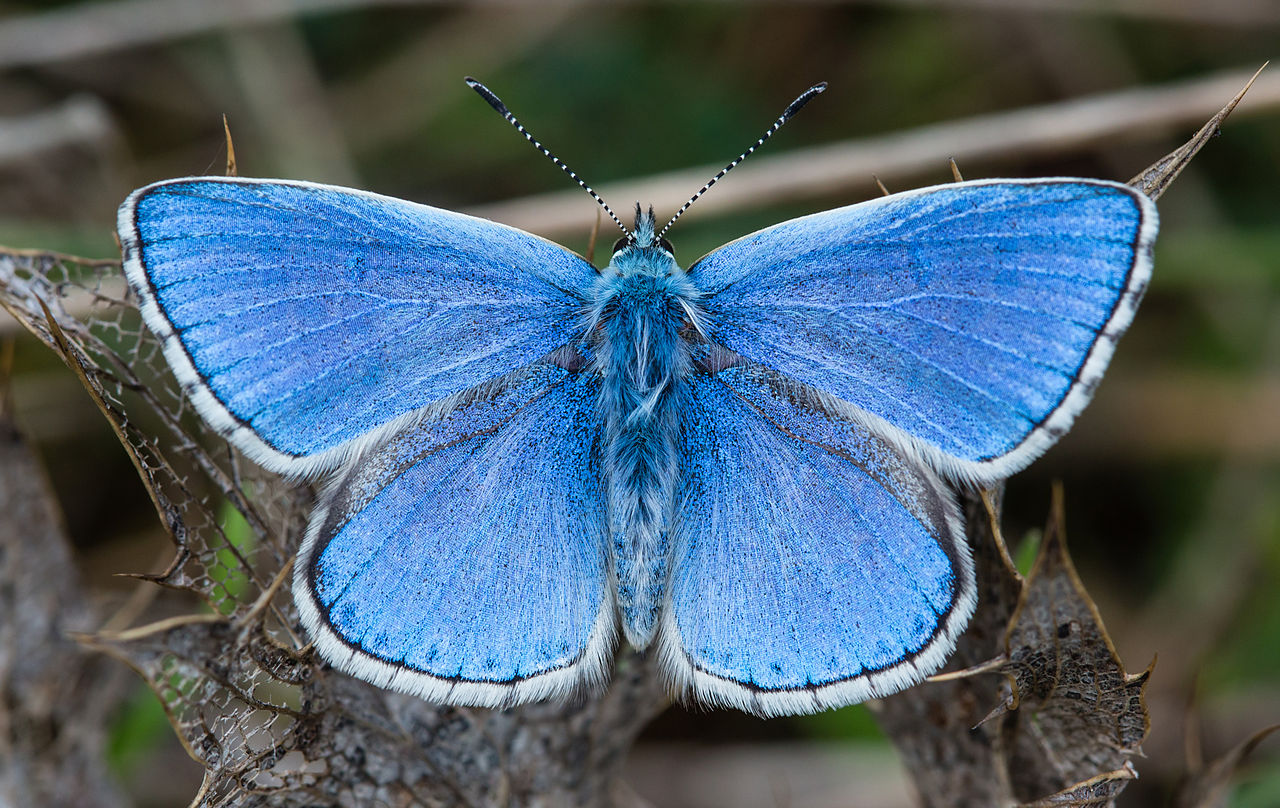
Adonis Blue (Polyommatus bellargus) lives in dry grassy areas across Palearctic ecozone. It feeds on horseshoe vetch leaves.
Fascinating facts about the Adonis Blue
- A tiny sky-blue flash spans just 3 cm, about the length of a matchstick, yet its caterpillars grow to 1.6 cm, a third of a ruler, cloaked in dark green with bright orange-yellow bands. This size lets the larvae slip among the low leaves of horseshoe vetch, their sole food, while the adult darts low over grass, staying hidden from predators. Their miniature stature is a key to thriving in the thin, sun-baked chalk soils where larger insects would be exposed.
- Adonis blues live on calcareous grasslands that stay hot and dry, because their larvae depend on horseshoe vetch, a plant that thrives on thin, lime-rich soils. The vetch flourishes where sheep graze, but disappears after a few years when cattle turn the pasture to compacted grass. Human-made earthworks, like the ancient ridges on Martin Down in Dorset, can preserve those thin soils and thus act as accidental refuges for both plant and butterfly.
- In Britain the butterfly has vanished from three counties, Cambridgeshire, Essex and Suffolk, and its national population has shrunk by more than 90 % since 1950, a loss spread over the last fifty years of changing farm practices. Its remaining strongholds cluster in Dorset, Wiltshire, Sussex and the Isle of Wight, where suitable chalk grass still exists. This dramatic drop shows how tightly the species is tied to a single habitat type that modern agriculture is eroding.
- Adonis blues can be seen soaring up to 2,100 m (7,000 ft) in mountainous terrain, yet most of their flights occur between May and September in two distinct broods, with a third late-summer brood in the southern part of their range in September and October.
- First described in 1775 by S. A. von Rottemburg as Papilio bellargus, the Adonis blue was noted as "very rare locally" even then. After a 40-year disappearance, it re-appeared in 2006 on a Gloucestershire site in the Cotswolds, showing that targeted conservation and warmer, drier summers can revive lost populations. This comeback highlights how climate shifts and careful land management can create new windows for a species once thought extinct locally.
Sources
Every fact above was checked against these pages, and kept only where one of them states it.
At a glance
RangePalearctic ecozone
HabitatDry grassy areas
DietHorseshoe vetch leaves
About the Adonis Blue
As the warm sunlight dances across the rolling hills, the Adonis Blue butterfly emerges, its iridescent wings beating in a hypnotic rhythm as it flutters from flower to flower, sipping nectar with delicate precision. With its shimmering blue hue and delicate white fringes, this enchanting creature embodies the very essence of summer, its gentle flight weaving a mesmerizing trail through the lush meadows and wildflower-strewn grasslands. As it alights upon a tender bloom, its wings fold and unfold in a slow, majestic dance, revealing the intricate beauty that makes this tiny creature a true marvel of the natural world.
Hear the Adonis Blue, and 4,400+ more
Real recorded sounds, 11 nature games and a free Daily 5, 1v1 quiz duels, conservation wins and a safe Kids mode. Free on Feravox.
More insects and spiders to discover