Feravox · The Voice of the Wild
Shingleback: a two-minute wildlife lesson
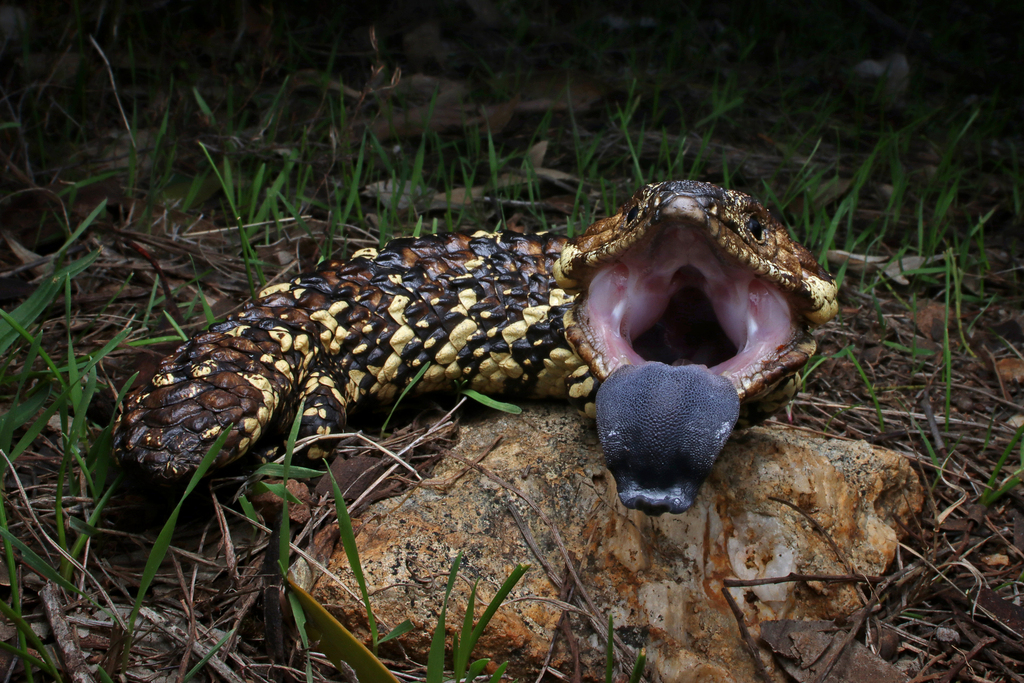
Which end is the head? The shingleback's short, stumpy tail looks like its head, which may confuse predators. It also stores fat for winter.
Skinks, Geckos and Snakes · day 4 of 7
Five facts
- Which end is the head? The shingleback's short, stumpy tail looks like its head, which may confuse predators. It also stores fat for winter.
- Shinglebacks are loyal partners. A pair can meet up again each spring, year after year, for as long as 20 years.
- Threatened, it opens its bright pink mouth wide, flashes a vivid blue tongue and hisses loudly.
- Mothers give birth to just one to four babies, and they are big ones.
- Being slow, it eats slow food: plants, flowers and snails, whose shells it crushes easily with its strong jaws.
The quiz
1. What part of the shingleback looks like its head?
- Its back legs
- Its tail (correct)
- Its belly
- Its front feet
Its stumpy tail resembles its head, which may confuse predators.
2. For how long can a shingleback pair keep meeting up?
- Only one season
- Up to 20 years (correct)
- About 2 weeks
- Up to 3 months
A pair can come back together each year for as long as 20 years.
3. What colour tongue does it show when threatened?
- Black
- Yellow
- Green
- Blue (correct)
It gapes and displays its blue tongue, often while hissing.
4. How many babies does a shingleback mother usually have?
- Two to three (correct)
- About 20
- About 50
- More than 10
A brood is one to four large young, most often two or three.
5. What does it crush with its strong jaws?
- Turtle shells
- Tree branches
- Snail shells (correct)
- Rocks
It can easily crush through snail shells.
Same week
Today’s lesson is waiting
Two minutes a day, a new wild animal. Free on iPhone, Android and the web.
Hear them, don't just read about them
Feravox is a free wildlife app: 4,400+ species with real recorded sounds, 11 nature games and a free Daily 5, 1v1 quiz duels, conservation wins, and a safe Kids mode.
Nature documentaries
Blue Planet III2026 · BBC OnePlanet Earth III2023 · BBC OneBlue Planet II2017 · BBC OnePlanet Earth II2016 · BBC OneFrozen Planet II2022 · BBC OneSeven Worlds, One Planet2019 · BBC OneMammals2024 · BBC OneSecret Garden2026 · BBC OneWild Isles2023 · BBC OneOur Planet2019 · NetflixOur Planet II2023 · NetflixThe Blue Planet2001 · BBC One