Feravox · The Voice of the Wild
Sand Cat: a two-minute wildlife lesson
From the outside its ears look like a pet cat's, but the tube leading inside is about twice as big.
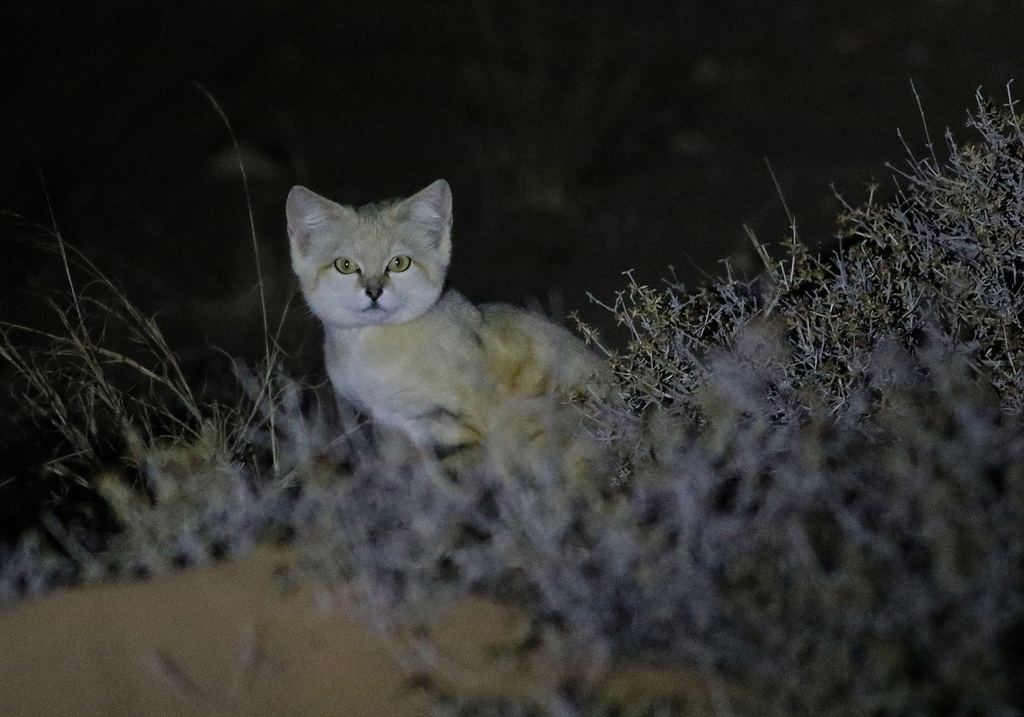
Wild Cats · day 3 of 7
Five facts
- From the outside its ears look like a pet cat's, but the tube leading inside is about twice as big.
- Long hairs between its toes make furry cushions that protect its pads on hot sand, and they blur its footprints too.
- It gets the water it needs from its food. The Toubou people say sand cats visit their camps at night to drink camel milk.
- It runs with its belly low to the ground and can burst into a sprint of 30 to 40 km per hour.
- In 2018, several sand cats in the Moroccan Sahara were seen napping in ravens' nests up in acacia trees.
The quiz
1. How big is a sand cat's ear canal compared with a pet cat's?
- Half the size
- Exactly the same
- About twice the size (correct)
- Ten times smaller
The outer ear looks like a pet cat's, but the canal is about twice as big.
2. What do the long hairs between its toes do?
- Protect its pads from hot sand (correct)
- Help it climb smooth walls
- Help it swim
- Keep insects away
The fur cushions shield its foot pads as it walks over hot sand.
3. Where does a sand cat get most of the water it needs?
- From desert flowers
- From morning snow
- From licking rocks
- From its prey (correct)
Its prey gives it the moisture it needs, though it drinks when water is around.
4. How fast can a sand cat sprint?
- 5 to 10 km per hour
- 30 to 40 km per hour (correct)
- 100 to 120 km per hour
- 200 km per hour
It can burst into a sprint of 30 to 40 km per hour.
5. Where were sand cats seen resting in Morocco in 2018?
- In fishing boats
- In ravens' nests in trees (correct)
- On rooftops
- Inside caves by the sea
Several were spotted resting in raven nests built in acacia trees.
Same week
Today’s lesson is waiting
Two minutes a day, a new wild animal. Free on iPhone, Android and the web.
Hear them, don't just read about them
Feravox is a free wildlife app: 4,400+ species with real recorded sounds, 11 nature games and a free Daily 5, 1v1 quiz duels, conservation wins, and a safe Kids mode.
Nature documentaries
Blue Planet III2026 · BBC OnePlanet Earth III2023 · BBC OneBlue Planet II2017 · BBC OnePlanet Earth II2016 · BBC OneFrozen Planet II2022 · BBC OneSeven Worlds, One Planet2019 · BBC OneMammals2024 · BBC OneSecret Garden2026 · BBC OneWild Isles2023 · BBC OneOur Planet2019 · NetflixOur Planet II2023 · NetflixThe Blue Planet2001 · BBC One