Feravox · The Voice of the Wild
Northern Pintail: a two-minute wildlife lesson
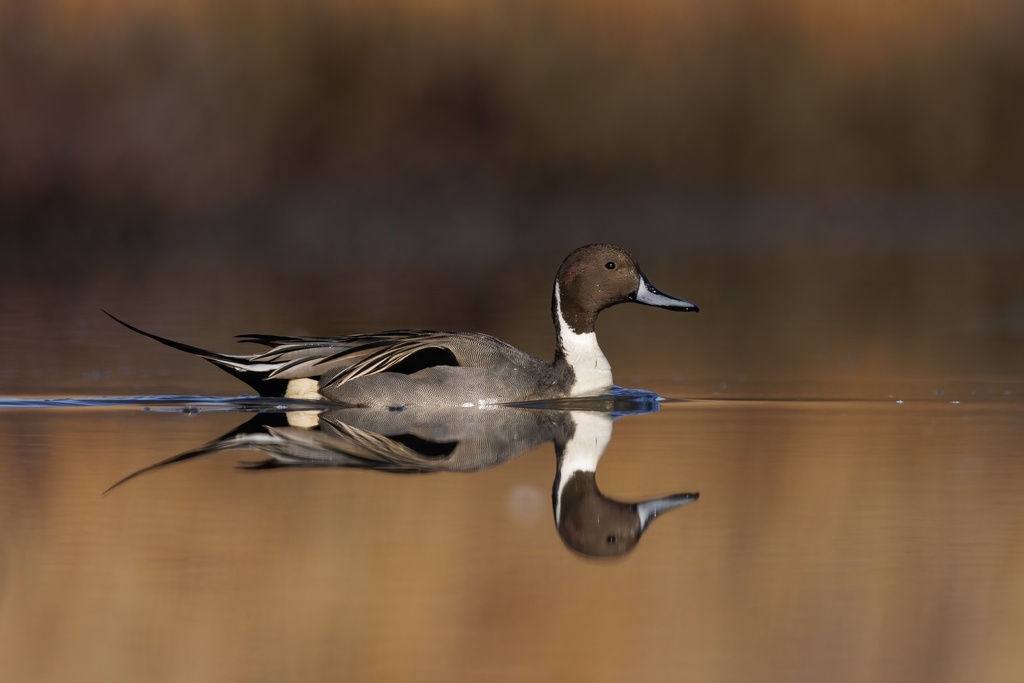
The male's long, pointed middle tail feathers give this elegant duck its name, both in English and in Latin.
Ducks, Geese and Swans · day 3 of 7
Five facts
- The male's long, pointed middle tail feathers give this elegant duck its name, both in English and in Latin.
- Its long neck lets it pull food from the bottom of water up to 30 cm deep, out of reach of shorter-necked ducks like the mallard.
- Pintails are very fast fliers. Unlike other ducks, they hold their wings slightly swept back instead of straight out.
- The drake doesn't quack: he gives a soft "proop-proop" whistle. It's the female who quacks, a bit like a mallard.
- Pintails can live a long time. The oldest one on record, a bird from the Netherlands, reached 27 years and 5 months.
The quiz
1. What gives the pintail its name?
- Its sharp, pointed bill
- The male's long central tail feathers (correct)
- Its pointed wings
- Its sharp whistling call
Both names come from the male's long, pointed central tail feathers.
2. What is the deepest water a pintail can reach the bottom of to feed?
- 1 m
- 3 m
- 10 m
- 30 cm (correct)
Its long neck lets it reach food on the bottom up to 30 cm deep.
3. How does a pintail hold its wings in flight?
- Slightly swept back (correct)
- Straight out from the body, like other ducks
- Held still for long glides
- Tucked in close to its body
Its wings are slightly swept back, unlike those of other ducks.
4. What sound does the male pintail make?
- A loud descending quack
- A deep honk
- A soft whistle (correct)
- A low croak
The drake gives a soft proop-proop whistle; the quack is the female's.
5. How old was the oldest pintail on record?
- 5 years
- 27 years and 5 months (correct)
- 50 years
- 12 years
A Dutch bird reached 27 years and 5 months.
More about the Northern Pintail
Same week
Today’s lesson is waiting
Two minutes a day, a new wild animal. Free on iPhone, Android and the web.
Hear them, don't just read about them
Feravox is a free wildlife app: 4,400+ species with real recorded sounds, 11 nature games and a free Daily 5, 1v1 quiz duels, conservation wins, and a safe Kids mode.
Nature documentaries
Blue Planet III2026 · BBC OnePlanet Earth III2023 · BBC OneBlue Planet II2017 · BBC OnePlanet Earth II2016 · BBC OneFrozen Planet II2022 · BBC OneSeven Worlds, One Planet2019 · BBC OneMammals2024 · BBC OneSecret Garden2026 · BBC OneWild Isles2023 · BBC OneOur Planet2019 · NetflixOur Planet II2023 · NetflixThe Blue Planet2001 · BBC One