Monk Parakeet: a two-minute wildlife lesson
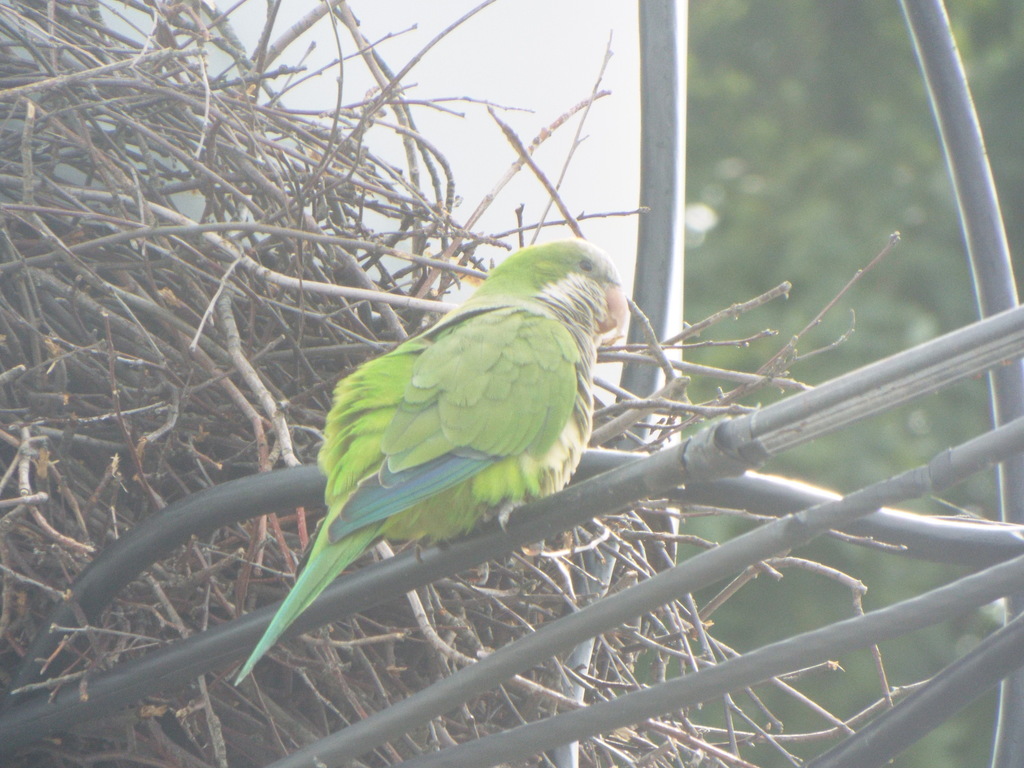
Most parrots nest in tree holes. Monk parakeets build their own bulky nests out in the open, in trees or on things people have built.
Parrots and Colourful Birds · day 1 of 7
Five facts
- Most parrots nest in tree holes. Monk parakeets build their own bulky nests out in the open, in trees or on things people have built.
- Pairs often share one giant group nest, each living in its own "apartment". Some of these nests grow as big as a small car.
- Their huge nests attract lodgers: pigeons, sparrows, small falcons called American kestrels, and sometimes even red squirrels.
- Each group can develop its own calling "dialect". Around Milford, in the US state of Connecticut, at least three dialects are heard.
- In New York they love nesting on utility poles. They have not spread to Manhattan, where the wires run underground.
The quiz
1. Where do monk parakeets nest, unlike most parrots?
- Inside tree holes
- In big nests they build in the open (correct)
- In burrows dug in the ground
- Inside termite mounds
They build large nests out in the open instead of using tree holes.
2. How big can a shared monk parakeet nest grow?
- A teacup
- A tennis ball
- A shoebox
- A small car (correct)
Group nests with separate apartments can reach the size of a small car.
3. Which mammal sometimes moves into a monk parakeet nest?
- The red squirrel (correct)
- The beaver
- The mole
- The hedgehog
Red squirrels are among the lodgers that may share these nests.
4. What can separate groups of monk parakeets develop?
- Spotted eggs
- Their own calling dialects (correct)
- A yearly migration to Africa
- Webbed feet for swimming
Groups can have different dialects, with at least three around Milford alone.
5. Why have monk parakeets not moved into Manhattan?
- There are too many hawks
- It has no parks
- Its wires run underground (correct)
- The winters are too cold
They nest on utility poles, and Manhattan's wiring is underground.
Same week
Today’s lesson is waiting
Two minutes a day, a new wild animal. Free on iPhone, Android and the web.
Hear them, don't just read about them
Feravox is a free wildlife app: 4,400+ species with real recorded sounds, 11 nature games and a free Daily 5, 1v1 quiz duels, conservation wins, and a safe Kids mode.