Feravox · The Voice of the Wild
Great Horned Owl: a two-minute wildlife lesson
An owl's wings are built for silence: serrated edges, soft down and a trailing fringe all cut the noise.
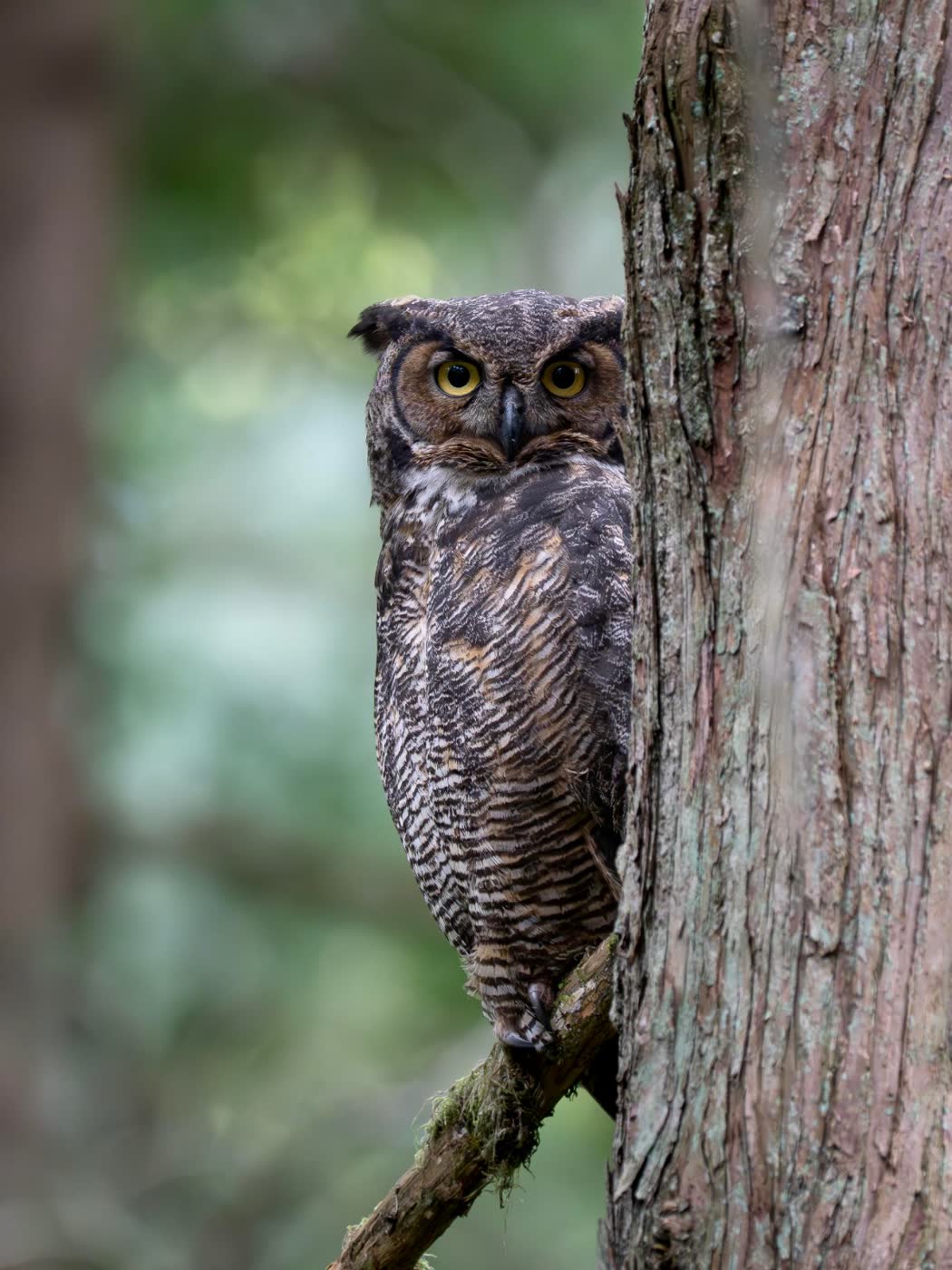
Owl Week · day 2 of 7
Five facts
- An owl's wings are built for silence: serrated edges, soft down and a trailing fringe all cut the noise.
- Its wings let the great horned owl fly very slowly for its size, gliding on breezes at just 2 miles per hour (about 3 km/h).
- Its talons crush with at least 300 psi, far beyond a human hand's grip, enough to subdue prey as large as rabbits or even skunks.
- Uneven ear openings let the owl triangulate sounds, even under snow. Its hearing is estimated at up to ten times a human's.
- Great horned owls are among North America's earliest nesters. Depending on the region, eggs are laid from late November to late April.
The quiz
1. What is one trick that makes the owl's wings quiet?
- Oily feathers
- Folded wing tips
- A fringe on the trailing edge (correct)
- Hollow feather tubes
Serrated edges, soft down and a trailing fringe all cut the noise.
2. How slowly can a great horned owl glide?
- 2 miles per hour (correct)
- 10 miles per hour
- 20 miles per hour
- 50 miles per hour
Gliding on breezes, it can fly as slowly as 2 miles per hour.
3. How hard can the owl's talons crush?
- About 30 psi
- Under 100 psi
- Exactly 3 psi
- At least 300 psi (correct)
Its talons crush with at least 300 psi.
4. How much better is the owl's hearing estimated to be than a human's?
- Up to twice as good
- Up to ten times better (correct)
- About the same
- Slightly worse
Its hearing is estimated at up to ten times a human's.
5. How early do the owl's eggs appear compared with most raptors?
- At exactly the same time
- Only a few days earlier
- Weeks or months earlier (correct)
- Weeks or months later
Its eggs appear weeks or months before most raptors.
More about the Great Horned Owl
Same week
Today’s lesson is waiting
Two minutes a day, a new wild animal. Free on iPhone, Android and the web.
Hear them, don't just read about them
Feravox is a free wildlife app: 4,400+ species with real recorded sounds, 11 nature games and a free Daily 5, 1v1 quiz duels, conservation wins, and a safe Kids mode.
Nature documentaries
Blue Planet III2026 · BBC OnePlanet Earth III2023 · BBC OneBlue Planet II2017 · BBC OnePlanet Earth II2016 · BBC OneFrozen Planet II2022 · BBC OneSeven Worlds, One Planet2019 · BBC OneMammals2024 · BBC OneSecret Garden2026 · BBC OneWild Isles2023 · BBC OneOur Planet2019 · NetflixOur Planet II2023 · NetflixThe Blue Planet2001 · BBC One