Feravox · The Voice of the Wild
Gray Treefrog: a two-minute wildlife lesson
The gray treefrog can shift from almost black to almost white to match its background. It changes more slowly than a chameleon.
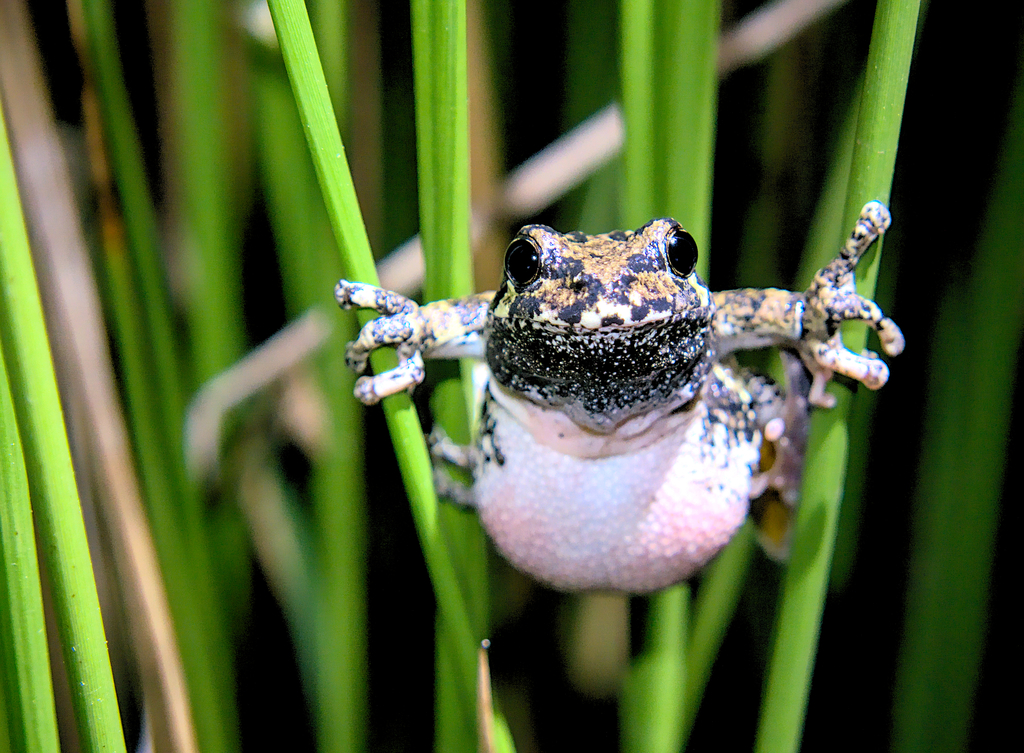
Frogs and Toads · day 6 of 7
Five facts
- The gray treefrog can shift from almost black to almost white to match its background. It changes more slowly than a chameleon.
- Hidden under its back legs are bright yellow patches. You normally only see this flash of colour when the frog jumps.
- It has a near-identical twin, Cope's gray treefrog. The best clue is the trill: Cope's call is shorter and faster.
- On summer nights, gray treefrogs gather around windows and porch lights to snack on the insects drawn to the glow.
- Fresh from the pond, the new little froglets nearly always go green for a day or two, then change to grey.
The quiz
1. How does the gray treefrog's colour change compare with a chameleon's?
- It is much faster
- It is slower (correct)
- It only happens once in its life
- It is exactly the same
It can go from nearly black to nearly white, but more slowly than a chameleon.
2. When can you normally see the bright yellow patches on its back legs?
- When it sleeps
- Only in winter
- When it eats
- When it jumps (correct)
The bright patches are usually only visible while the frog is jumping.
3. How can you tell the gray treefrog from its twin, Cope's gray treefrog?
- By its call (correct)
- By its red eyes
- By its size, twice as big
- By its blue belly
They look almost the same, but Cope's call is shorter and faster.
4. Why do gray treefrogs gather around porch lights at night?
- To keep warm
- To catch insects drawn to the light (correct)
- To lay their eggs
- To hide from the rain
Insects are attracted to the light, and the frogs come to eat them.
5. What colour do new froglets nearly always become for a short time?
- Red
- Black
- Green (correct)
- Blue
Froglets go green for a day or two, then become grey.
Same week
Today’s lesson is waiting
Two minutes a day, a new wild animal. Free on iPhone, Android and the web.
Hear them, don't just read about them
Feravox is a free wildlife app: 4,400+ species with real recorded sounds, 11 nature games and a free Daily 5, 1v1 quiz duels, conservation wins, and a safe Kids mode.
Nature documentaries
Blue Planet III2026 · BBC OnePlanet Earth III2023 · BBC OneBlue Planet II2017 · BBC OnePlanet Earth II2016 · BBC OneFrozen Planet II2022 · BBC OneSeven Worlds, One Planet2019 · BBC OneMammals2024 · BBC OneSecret Garden2026 · BBC OneWild Isles2023 · BBC OneOur Planet2019 · NetflixOur Planet II2023 · NetflixThe Blue Planet2001 · BBC One