Golden Lion Tamarin: a two-minute wildlife lesson
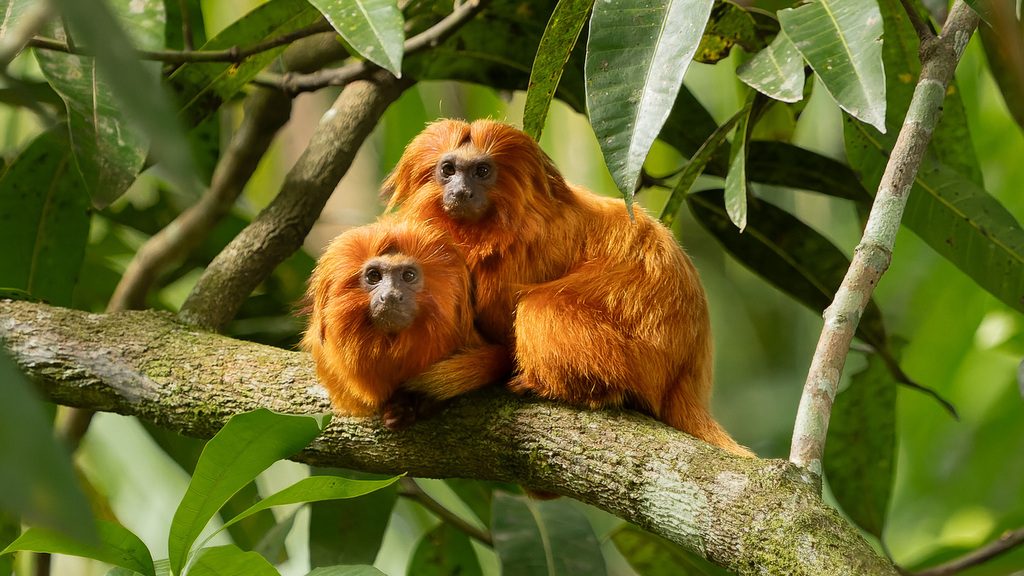
Long hairs around its face form a fiery orange mane, hence the lion in its name. At about 620 g, it is the biggest of the marmosets and tamarins.
Monkeys of the Americas · day 1 of 7
Five facts
- Long hairs around its face form a fiery orange mane, hence the lion in its name. At about 620 g, it is the biggest of the marmosets and tamarins.
- To catch hidden insects and frogs, it slides its long fingers, even its whole arm, into cracks and holes, feeling around by touch alone.
- Twins are common. A mother cannot manage alone, so the whole family pitches in to carry and raise the babies.
- Tamarins are early sleepers. They spend more than half of each day in their sleeping spot, and one study found them in bed 82 minutes before sunset.
- After an outbreak of yellow fever, biologists began giving wild tamarins a vaccine in 2021, apparently a first for a wild endangered primate.
The quiz
1. Where does the golden lion tamarin get the lion in its name?
- Its loud roar
- The mane of long hairs around its face (correct)
- Its habit of hunting in packs
- The tuft at the end of its tail
Extra-long hairs around its face and ears form a mane.
2. How does it find prey hidden in cracks and holes?
- It sniffs them out from far away
- It listens for their heartbeat
- It feels around with its fingers and arm (correct)
- It waits for them to come out at night
It reaches into hidden spots and gropes blindly by touch.
3. Why does the whole family help raise the babies?
- Twins are common and a mother cannot cope alone (correct)
- The mother leaves right after the birth
- The father is not allowed near them
- The babies are born without fur
Tamarins often have twins, and the mother needs the group's help.
4. How much of the day do golden lion tamarins usually spend in their sleeping spot?
- About an hour
- Only at noon
- A quarter of the day
- More than half of it (correct)
They are tucked away in their sleeping spot for over half of each day.
5. What did biologists start doing for wild tamarins in 2021?
- Fitting them with tiny raincoats
- Vaccinating them against yellow fever (correct)
- Moving them all to islands
- Feeding them every morning
Biologists began vaccinating wild tamarins in 2021 after a yellow fever outbreak.
More about the Golden Lion Tamarin
Same week
Today’s lesson is waiting
Two minutes a day, a new wild animal. Free on iPhone, Android and the web.
Hear them, don't just read about them
Feravox is a free wildlife app: 4,400+ species with real recorded sounds, 11 nature games and a free Daily 5, 1v1 quiz duels, conservation wins, and a safe Kids mode.