Feravox · The Voice of the Wild
Gharial: a two-minute wildlife lesson
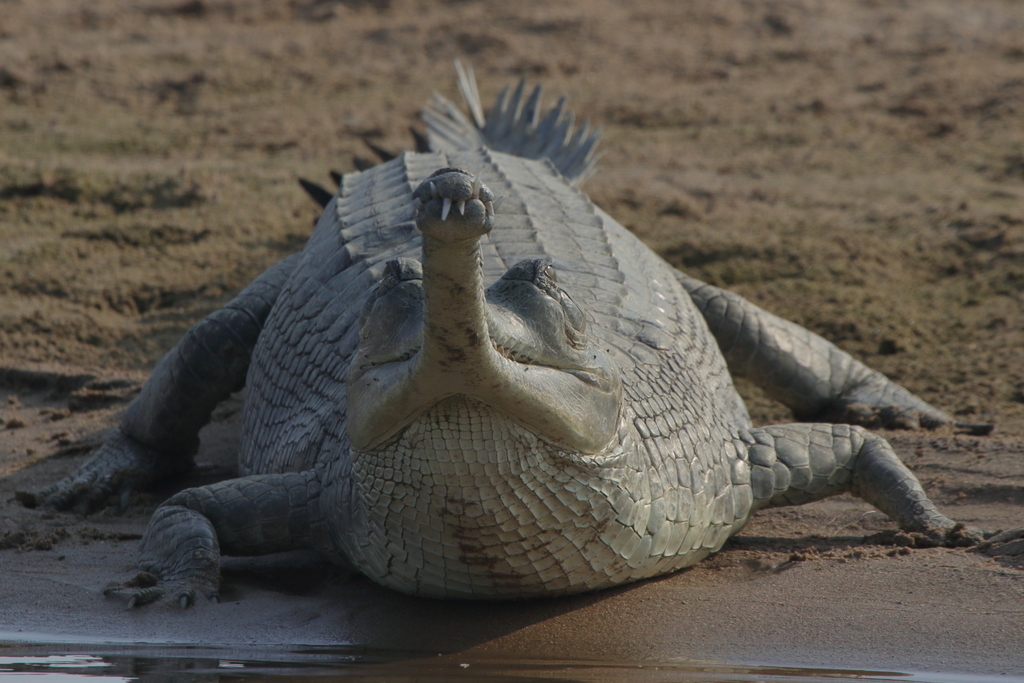
Grown males carry a round bump on the tip of the snout that looks like a clay pot called a ghara. That pot gave the gharial its name.
Crocodiles and Big Reptiles · day 1 of 7
Five facts
- Grown males carry a round bump on the tip of the snout that looks like a clay pot called a ghara. That pot gave the gharial its name.
- The hollow pot on a male's nose lets him hiss loudly enough to be heard 75 m away. Scientists think the sound draws in females.
- Its long, thin snout slips through water with hardly any drag, and its sharp teeth interlock to grip fish. It never chews: dinner goes down whole.
- No other crocodilian is so tied to water. The gharial climbs out only to warm up in the sun and to dig nests on damp sandbanks.
- Gharial eggs are the biggest of any crocodilian, about 160 g each. When the babies chirp inside the nest, the mother digs them out.
The quiz
1. What is a "ghara", the object that gave the gharial its name?
- A fishing net
- A river boat
- A clay pot (correct)
- A temple drum
The male's snout bump looks like a clay pot called a ghara.
2. How far away can a male gharial's hiss be heard?
- About 5 m
- About 75 m (correct)
- About 20 km
- About 50 cm
His hollow nose bump lets him hiss loud enough to carry 75 m.
3. How does a gharial eat a fish?
- It chews it for a long time
- It shares it with its group
- It leaves it to soften on the bank
- It swallows it whole (correct)
The gharial does not chew; it gulps its prey down whole.
4. Why does a gharial leave the water?
- Only to bask and to nest (correct)
- To hunt rabbits at night
- To climb trees and rest
- To sleep in caves all winter
It is the most aquatic crocodilian and comes out only to bask and build nests.
5. What is special about gharial eggs?
- They are the smallest of all crocodilians
- They are the largest of all crocodilians (correct)
- They are laid in tree holes
- They float on the river
Each egg weighs about 160 g, more than any other crocodilian egg.
Same week
Today’s lesson is waiting
Two minutes a day, a new wild animal. Free on iPhone, Android and the web.
Hear them, don't just read about them
Feravox is a free wildlife app: 4,400+ species with real recorded sounds, 11 nature games and a free Daily 5, 1v1 quiz duels, conservation wins, and a safe Kids mode.
Nature documentaries
Blue Planet III2026 · BBC OnePlanet Earth III2023 · BBC OneBlue Planet II2017 · BBC OnePlanet Earth II2016 · BBC OneFrozen Planet II2022 · BBC OneSeven Worlds, One Planet2019 · BBC OneMammals2024 · BBC OneSecret Garden2026 · BBC OneWild Isles2023 · BBC OneOur Planet2019 · NetflixOur Planet II2023 · NetflixThe Blue Planet2001 · BBC One