Feravox · The Voice of the Wild
Amazon River Dolphin: a two-minute wildlife lesson
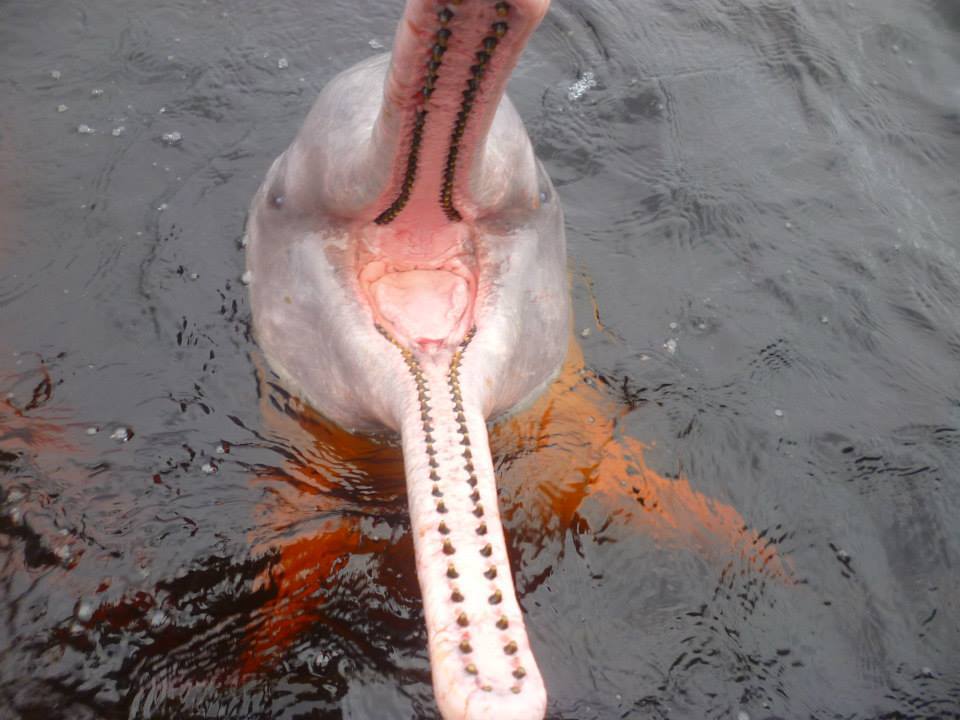
A boto can turn its head 90 degrees, because its neck vertebrae are not fused like those of oceanic dolphins.
Dolphins and Otters · day 2 of 7
Five facts
- A boto can turn its head 90 degrees, because its neck vertebrae are not fused like those of oceanic dolphins.
- Adult botos turn pink from repeated skin abrasion. Males are pinker, from more frequent trauma in fights with their own kind.
- Hunting in murky water, a boto makes 30 to 80 clicks a second and uses the echoes to find its prey.
- At feeding time, up to 35 pink river dolphins can team up to catch their prey.
- Few toothed whales eat such a mix: botos catch as many as 53 kinds of fish, plus river turtles, water frogs and freshwater crabs.
The quiz
1. How far can a boto turn its head?
- 15 degrees
- 90 degrees (correct)
- 45 degrees
- 360 degrees
Its vertebrae are not fused, so the head can turn 90 degrees.
2. Why do adult botos turn pink?
- Repeated abrasion of the skin (correct)
- They eat pink shrimp
- The sun tints their skin
- They are born pink
Repeated skin abrasion turns adults pink, males more than females.
3. How many clicks per second do botos fire in murky water?
- 1 to 5
- 10 to 15
- 30 to 80 (correct)
- 300 to 800
They fire 30 to 80 clicks per second.
4. How many pink dolphins can work together to catch fish?
- Only 2 or 3
- As many as 8
- As many as 350
- As many as 35 (correct)
Up to 35 pink river dolphins can team up to catch prey.
5. How many species of fish do botos feed on?
- Up to 3
- Up to 53 (correct)
- Up to 12
- Up to 500
Botos eat as many as 53 kinds of fish.
More about the Amazon River Dolphin
Same week
Today’s lesson is waiting
Two minutes a day, a new wild animal. Free on iPhone, Android and the web.
Hear them, don't just read about them
Feravox is a free wildlife app: 4,400+ species with real recorded sounds, 11 nature games and a free Daily 5, 1v1 quiz duels, conservation wins, and a safe Kids mode.
Nature documentaries
Blue Planet III2026 · BBC OnePlanet Earth III2023 · BBC OneBlue Planet II2017 · BBC OnePlanet Earth II2016 · BBC OneFrozen Planet II2022 · BBC OneSeven Worlds, One Planet2019 · BBC OneMammals2024 · BBC OneSecret Garden2026 · BBC OneWild Isles2023 · BBC OneOur Planet2019 · NetflixOur Planet II2023 · NetflixThe Blue Planet2001 · BBC One