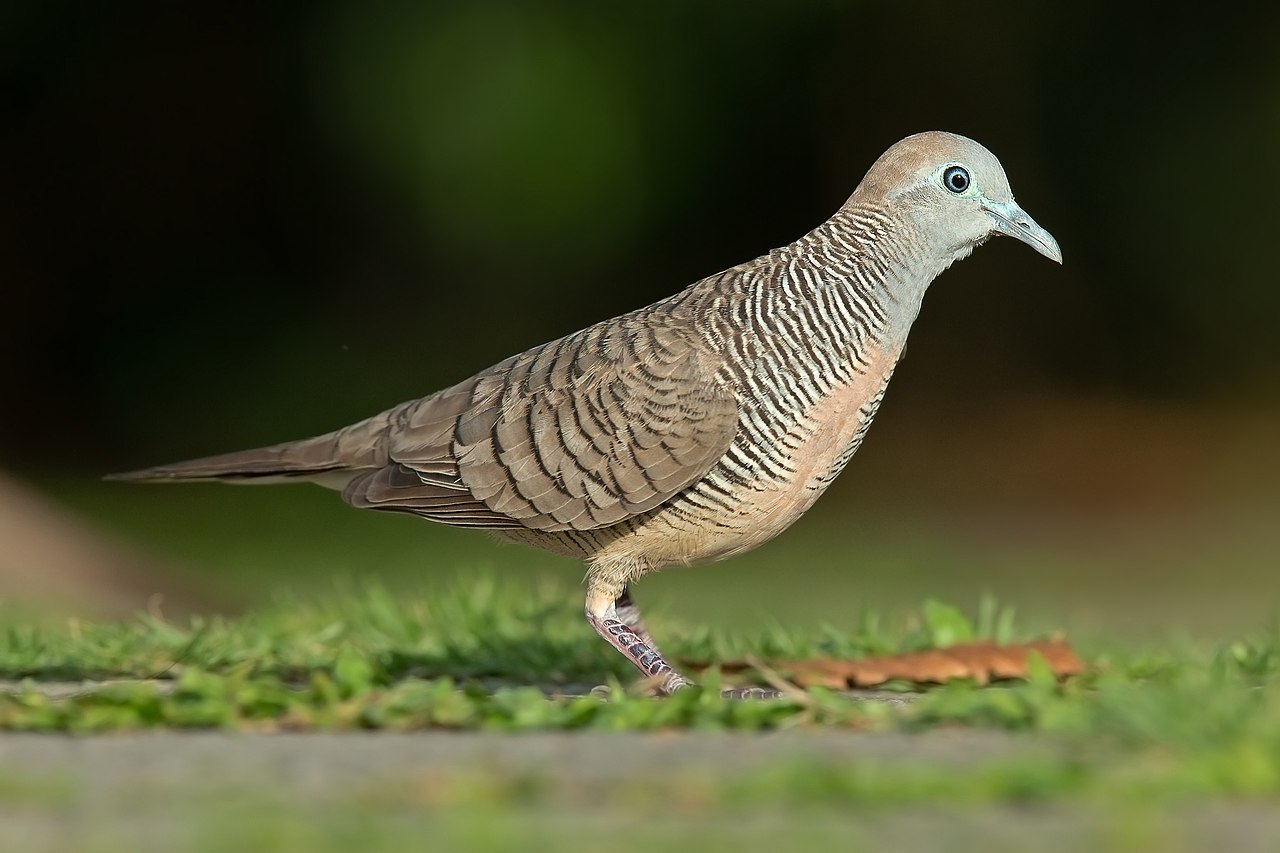
Zebra Dove (Geopelia striata) lives in open savanna across Southeast Asia. It feeds on seeds and grains. Its conservation status is Least Concern.
Fascinating facts about the Zebra Dove
- The zebra dove has been introduced to islands across the globe, establishing wild populations far beyond its native Southeast Asian range. After escaping or being released it now occurs in places such as Hawaii, where it was introduced in 1922, and Tahiti in 1950. It is also present on New Caledonia, the Seychelles, the Chagos Archipelago from 1960 and Saint Helena, showing its remarkable colonising ability on remote islands.
- In Thailand and Indonesia the zebra dove is kept as a pet because of its soft, staccato coo, and organised competitions are held to judge which individual has the best voice. The bird is known locally as perkutut in Indonesia and tukmo in the Philippines, reflecting the onomatopoeic nature of its call. Its pleasant vocalisations have made it a favourite in household aviaries throughout its range.
- Both male and female zebra doves share incubation duties, keeping their one or two white eggs warm for 13 to 18 days before the chicks hatch. After hatching, the young leave the nest within two weeks and are capable of strong flight after about three weeks, allowing them to quickly become independent. This shared parental care ensures a higher chance of survival for the small clutch.
- Zebra doves search for food alone or in pairs, moving across bare ground, short grass or roads with a rodent-like scurrying gait. Their diet consists mainly of small grass and weed seeds, but they also take insects and other tiny invertebrates when available. This solitary foraging style is aided by their colouration, which camouflages them well on the ground, making them hard to spot while they feed.
- Measuring just 20-23 cm in length with a wingspan of 24-26 cm, the zebra dove is a small, slender bird with a long, narrow tail that ends in distinctive white tips. Its upperparts are brownish-grey marked by black-and-white barring, while the underparts are pinkish with black bars along the neck, breast and belly. The face shows a blue-grey hue and bare blue skin surrounds the eyes, adding to its subtle colour palette.
Sources
Every fact above was checked against these pages, and kept only where one of them states it.
At a glance
RangeSoutheast Asia
HabitatOpen savanna
DietSeeds and grains
About the Zebra Dove
In the sun-drenched grasslands, the Zebra Dove moves with quiet purpose, its gentle coos and soft, grey-brown plumage a soothing presence amidst the rustling blades. As it forages for seeds and fruits, its delicate feet barely disturb the earth, and its mournful calls weave a melancholic melody that echoes across the landscape. With its subtle beauty and unassuming nature, this diminutive dove is a humble gem, often overlooked yet always a delightful discovery in the wild.
Hear the Zebra Dove, and 4,400+ more
Real recorded sounds, 11 nature games and a free Daily 5, 1v1 quiz duels, conservation wins and a safe Kids mode. Free on Feravox.