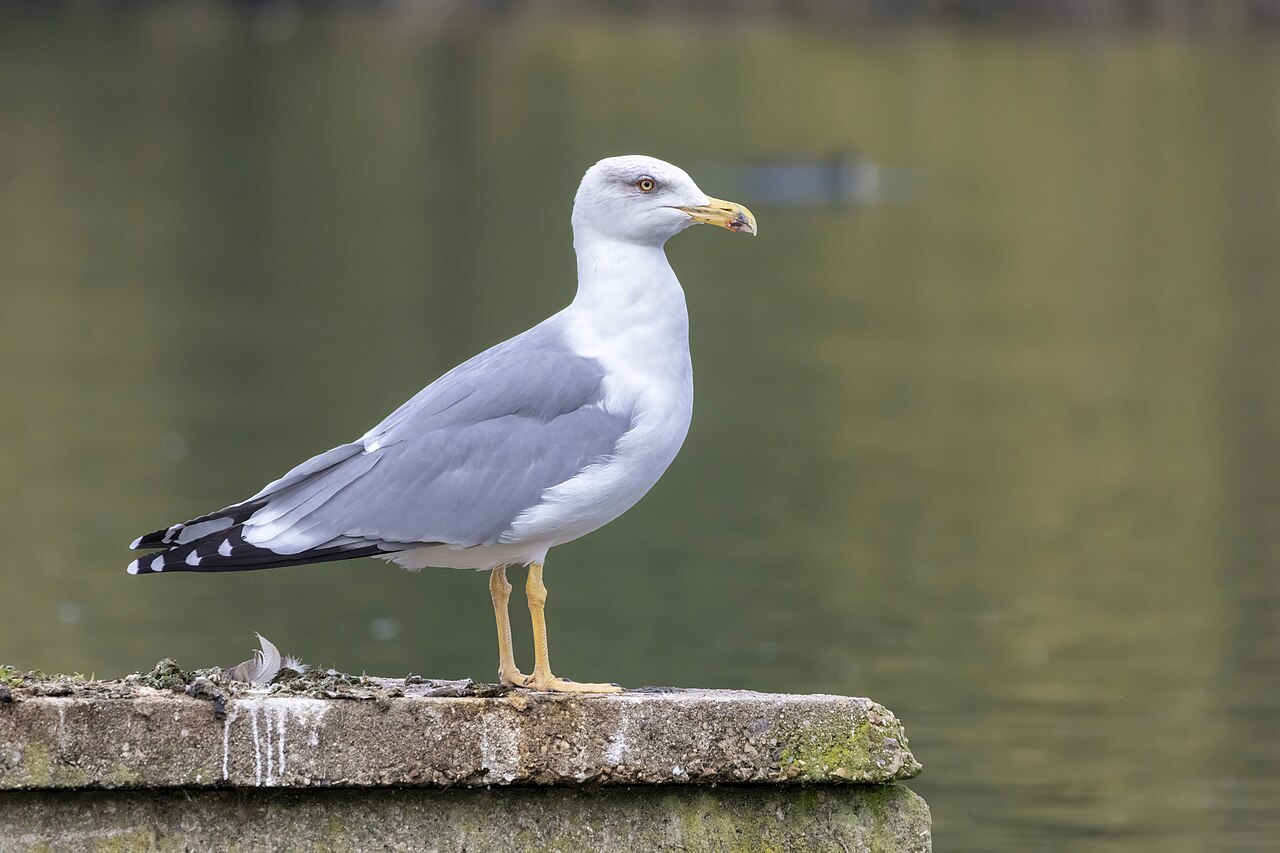
Yellow-Legged Gull (Larus michahellis) lives in coastal areas across Southern Europe, North Africa. It feeds on fish and crustaceans. Its conservation status is Least Concern.
Fascinating facts about the Yellow-Legged Gull
- Genetic analysis places the yellow-legged gull nearer to the great black-backed gull than to the herring gull it once resembled. DNA research shows it is closest to the great black-backed gull L. marinus and also shares a close relationship with the Armenian gull L. By contrast, the Caspian gull is genetically nearer to the herring gull and the lesser black-backed gull L.
- When Rome's rubbish vanished during Italy's 2020 lockdown, yellow-legged gulls turned predator, snatching rats and rock doves as prey. Normally they are omnivores and opportunistic foragers, scavenging on rubbish tips and hunting in fields or along the coast. The shortage of food scraps forced them to adopt a predatory diet, a shift that was directly observed in Rome.
- Yellow-legged gulls normally breed in colonies, laying three eggs between mid-March and early May. In recent decades they have begun nesting on human structures, with colonies reported on rooftops, city walls and even tree branches in Gibraltar, Galicia and Portugal. Their nest remains a sparse mound of vegetation, whether placed on the ground, a cliff ledge or these new urban sites, allowing them to exploit a wider range of breeding habitats.
- Since 1995 only one to four pairs have tried to breed in southern England, and these attempts are sometimes mixed with lesser black-backed gulls, resulting in slow colonisation. While many individuals stay in the same region year-round, a substantial portion migrate south for the winter, reaching West African coasts such as Senegal and Gambia or travelling to the Red Sea.
Sources
Every fact above was checked against these pages, and kept only where one of them states it.
At a glance
RangeSouthern Europe, North Africa
HabitatCoastal areas
DietFish and crustaceans
About the Yellow-Legged Gull
As the Yellow-Legged Gull soars overhead, its piercing cry echoes across the sun-drenched coastline, a beacon of vitality in a realm where the rhythms of the sea and the shore converge. With wings outstretched, it rides the thermal currents with effortless ease, its bright yellow legs tucked neatly beneath its sleek, grey-white feathers, a testament to its mastery of the marine landscape. In its graceful, fluid movements, we witness a remarkable blend of adaptability and resilience, a true embodiment of the unyielding spirit of the coastal wilderness.
Hear the Yellow-Legged Gull, and 4,400+ more
Real recorded sounds, 11 nature games and a free Daily 5, 1v1 quiz duels, conservation wins and a safe Kids mode. Free on Feravox.