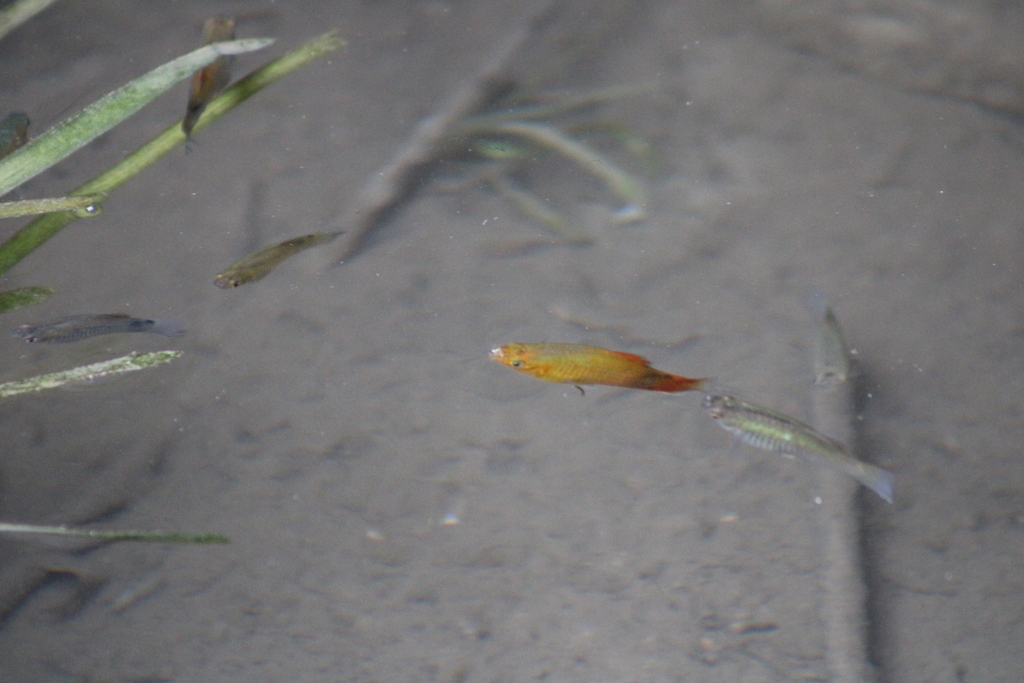
Photo: Philip Schaffer
Feravox · The Voice of the Wild
Southern Platyfish
Xiphophorus maculatus
Data Deficient
Southern Platyfish (Xiphophorus maculatus) lives in slow-moving canals across Mexico to Belize. It feeds on omnivorous (plants, insects).
The southern platyfish, Xiphophorus maculatus, is a modest freshwater live-bearer that reaches just 6 cm in length, its slender body capped by a slightly pointed caudal fin in males and a fan-shaped anal fin in females. In the wild its drab hue lacks the bold lateral stripe seen in many of its relatives, but the species’ most striking feature lies beneath the surface: a trio of sex chromosomes, W, X, and Y, interacting with four autosomal alleles to produce a bewildering mosaic of male and female genotypes, a genetic complexity that still fascinates researchers. Native to slow-moving canals, ditches and warm springs from Veracruz, Mexico, to northern Belize, the platy is an omnivore, grazing on algae, snacking on tiny crustaceans, insects and annelid worms, and thriving in waters of pH 7.0–8.0, hardness 9–19 dGH and temperatures of 18–25 °C. In captivity, they mature in three to four months, giving birth to 20–40 fry that dart among plant roots, a testament to their prolific nature and the reason hobbyists find them both a blessing and a headache as surprise generations appear in community tanks. Their genome, sequenced in 2013, continues to unlock clues about their unique sex-determination system, making the platy not just a popular aquarium resident but a living laboratory for evolutionary biology,
Real recorded sounds, 11 nature games and a free Daily 5, 1v1 quiz duels, conservation wins and a safe Kids mode. Free on Feravox.