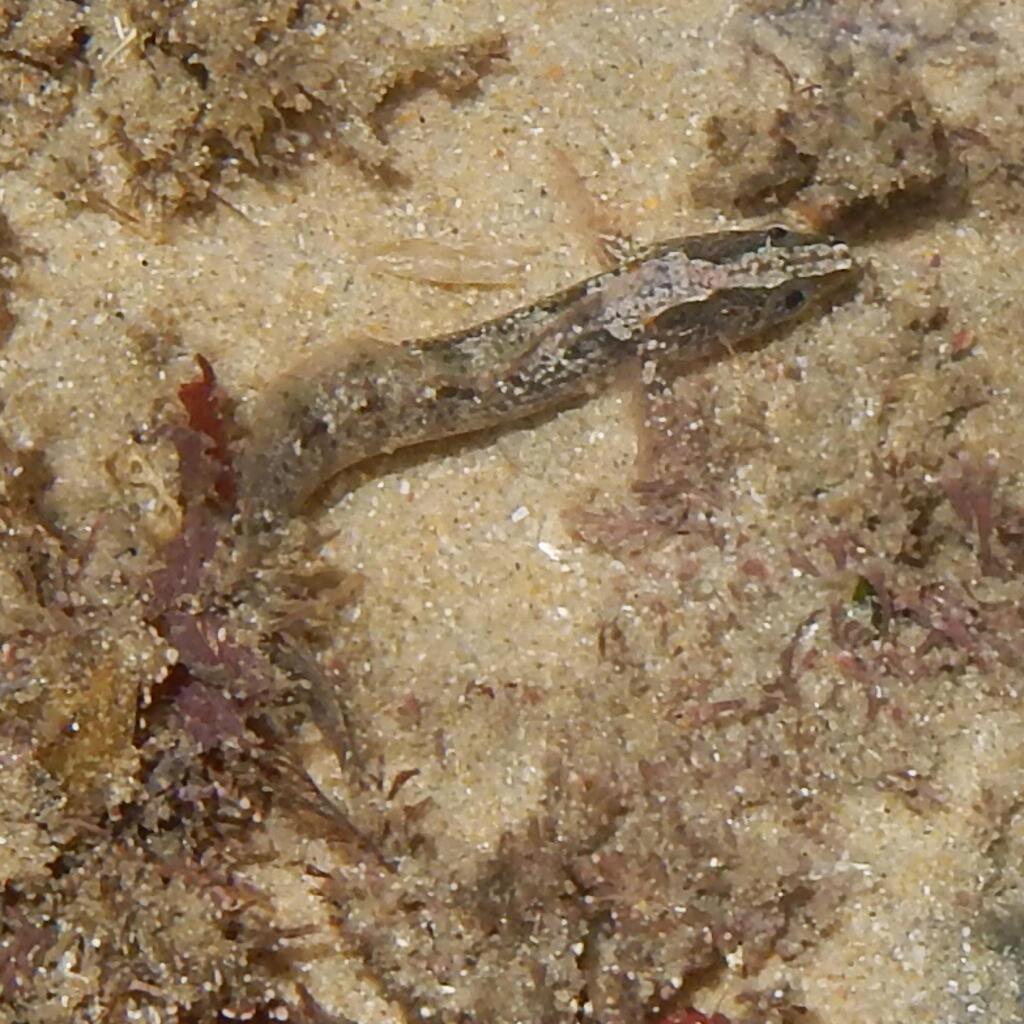
Photo: Henry de Lange
Feravox · The Voice of the Wild
Sad Klipfish
Clinus acuminatus
Least Concern
Sad Klipfish (Clinus acuminatus) lives in shallow rock pools across Namibia and South Africa. It feeds on crustaceans including amphipods. Its conservation status is Least Concern.
The sad klipfish, Clinus acuminatus, is a modestly sized member of the Clinidae, reaching about 13 cm in total length. Its slightly compressed body ends in a wedge-shaped snout, while a pair of prominent supra-orbital tentacles, short, flattened stalks capped with simple branches, frame its eyes. The fish’s dorsal fin is low and even, the first spine the shortest of the series, and its coloration shifts from pale buff to light green, yellowish-brown or grey, speckled with tiny white spots and accented by darker mosaic-like bars. Vermilion tips on the fins and tentacles, a dark shoulder spot, and radiating dark bands from the eye give it a perpetually “sad” expression, a trait that distinguishes it from its close relative Clinus heterodon, which lacks the mosaic bars and has a smaller head. Juveniles are stark white with bold black cross-bars, a dramatic contrast to the adult’s muted palette. Endemic to the rocky shores of southern Africa, the sad klipfish inhabits intertidal rock pools and the undersides of ledges from west of Algoa Bay to Lüderitzbucht, thriving especially west of Cape Point and the Cape Peninsula. Viviparous and opportunistic, it preys on small crustaceans, amphipods, isopods, and crabs, while females show a striking 36-53 % sexual frequency. Its ability to give birth to live young in the turbulent, shallow pools is a surprising adaptation that ensures the next generation is ready for the harsh, ever-changing tide environment, pulling the observer deeper into the hidden drama of these coastal micro-ecosystems…
Real recorded sounds, 11 nature games and a free Daily 5, 1v1 quiz duels, conservation wins and a safe Kids mode. Free on Feravox.