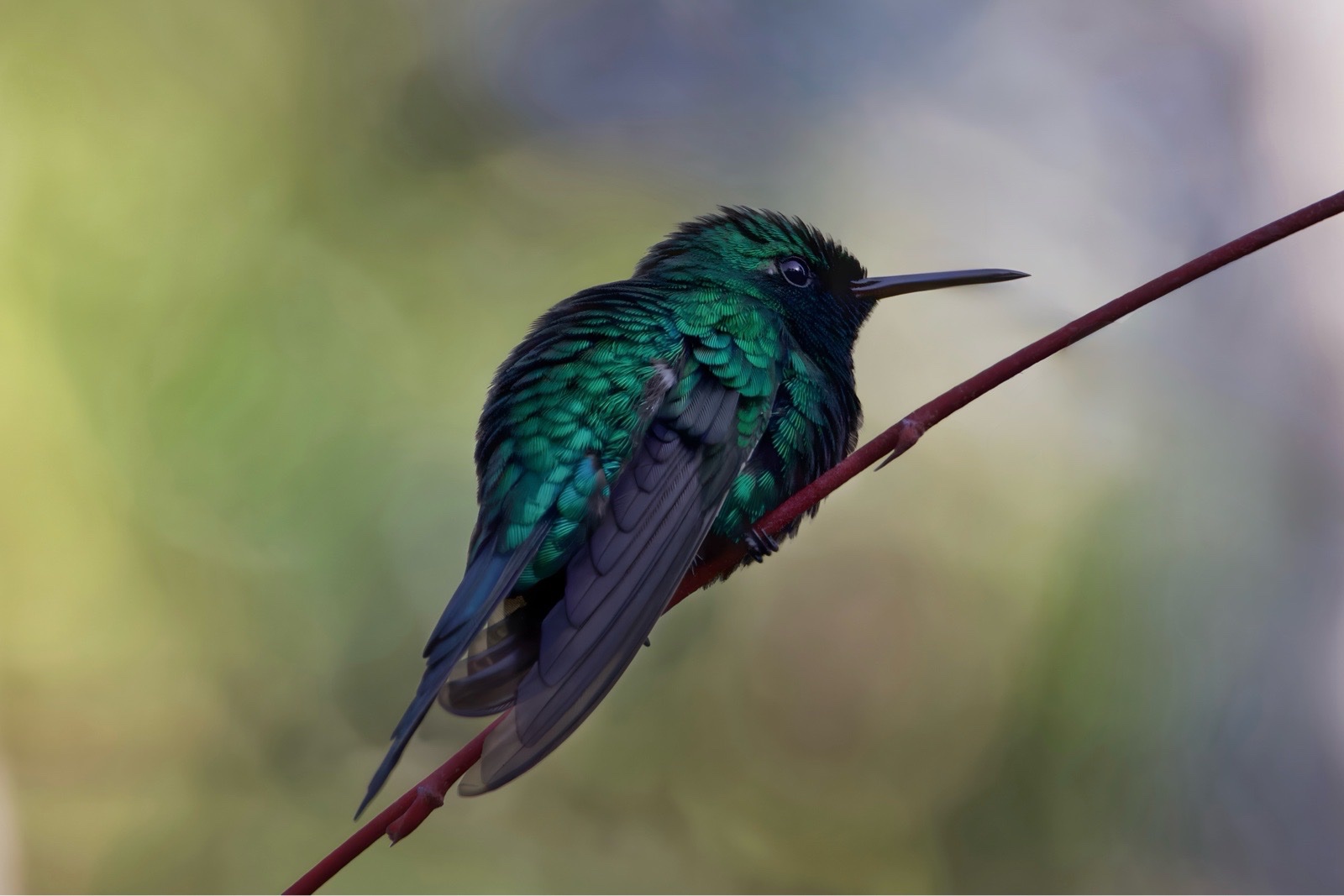
Puerto Rican Emerald (Riccordia maugaeus) lives in forested landscapes, plantations, gardens, urban areas across Throughout Puerto Rico. Its conservation status is Least Concern.
Fascinating facts about the Puerto Rican Emerald
- Remaining within Puerto Rico year-round, this hummingbird rarely undertakes long migrations, staying close to the flowering sites it depends on. Its breeding peak from February through May sees females constructing tiny cup nests of dry plant fibers, lining them with softer material and covering the exterior with lichen, usually tucked in low to medium shrubs or trees. After a two-week incubation, the chicks leave the nest about three weeks later. By feeding on nectar and catching tiny insects such as flies, Homoptera, Hymenoptera and spiders, the emerald transfers pollen among many plant species, linking forest and garden ecosystems. Its high-pitched twittering and sharp 'tsik' calls are frequently heard at feeders, making it a familiar presence for residents and visitors alike.
- Male Puerto Rican emeralds are 8.5 to 9.5 cm (3.3 to 3.7 in) long and females 7.5 to 8.5 cm (3.0 to 3.3 in), with a body mass between 3.4 and 3.8 g (0.12 and 0.13 oz). Both sexes have a small white spot behind the eye, but the male displays a short straight bill with a black-tipped red mandible and a black maxilla, while the female's bill is all black. The male's forehead and crown are iridescent green, the rest of the upperparts a dark shining metallic green, and the gorget a bluish-green sheen; its underparts are also shining green and the tail forked and steely blue. The female shows dull dark green on the crown, grass-green upperparts, a light-gray throat that darkens toward the belly, and a less forked tail with a complex pattern of white, steel-blue, green and brown feather sections.
- The Puerto Rican emerald is found throughout its namesake island, occupying almost every forested landscape from coastal mangroves to the summits of montane forest, including both dry and moist forests, plantations, and secondary growth. It readily uses human-altered habitats, occurring in gardens, parks and urban areas where suitable flowering plants are present. This broad habitat tolerance means the bird can be seen in a wide range of settings across Puerto Rico, from pristine forest edges to backyard feeders, demonstrating its adaptability to both natural and anthropogenic environments.
- Foraging Puerto Rican emeralds visit a wide variety of flowering plants and trees, extracting nectar primarily at low to medium forest levels where blossoms are most abundant. In addition to nectar, they supplement their diet by gleaning small arthropods from leaves and branches, capturing flies, Homoptera, Hymenoptera and spiders. This mixed diet provides the protein needed for breeding and sustains the high metabolic rate typical of hummingbirds, linking their foraging behavior directly to the availability of both floral resources and insect prey.
Sources
Every fact above was checked against these pages, and kept only where one of them states it.
At a glance
RangeThroughout Puerto Rico
HabitatForested landscapes, plantations, gardens, urban areas
DietNectar and small arthropods
About the Puerto Rican Emerald
The Puerto Rican emerald (Riccordia maugaeus) is a tiny hummingbird endemic to Puerto Rico, measuring 7.5-9.5 cm and weighing just 3.4-3.8 g. Males shine with iridescent green crowns, metallic upperparts and a steely-blue forked tail, while females display duller greens and a less forked tail with intricate feather patterning. The species occupies virtually every forested habitat on the island, from mangroves and lowland dry forest to montane cloud forest, and it readily uses plantations, gardens and urban parks. It feeds on nectar from a broad spectrum of flowering plants at low to medium heights and supplements this with small arthropods such as flies, Homoptera, Hymenoptera and spiders. Breeding peaks from February to May, with a cup-shaped nest built in low to medium shrubs or trees; the female incubates two eggs for 14-16 days and the chicks fledge after 20-22 days. Its adaptability to both natural and human-modified landscapes makes it a common sight across the island.
Hear the Puerto Rican Emerald, and 4,400+ more
Real recorded sounds, 11 nature games and a free Daily 5, 1v1 quiz duels, conservation wins and a safe Kids mode. Free on Feravox.