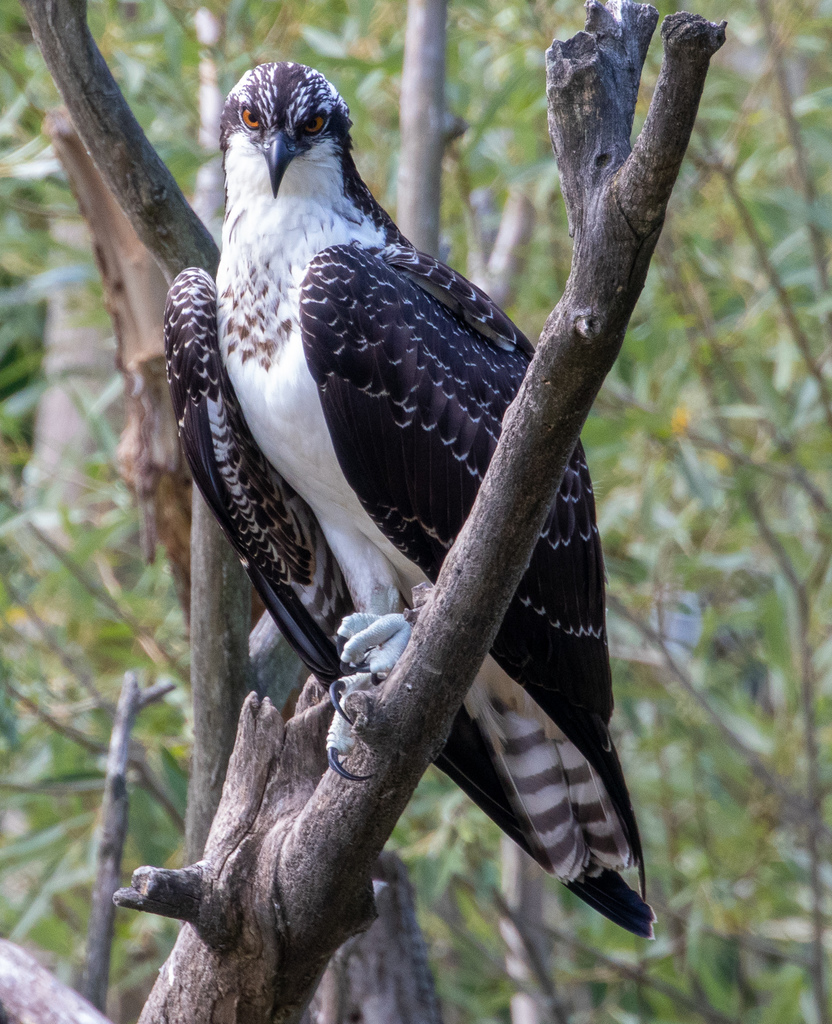
Osprey (Pandion haliaetus) lives in coastal and freshwater lake across Every continent except Antarctica. Its conservation status is Least Concern.
Fascinating facts about the Osprey
- Spanning almost the entire globe, the osprey occupies a range of 9,670,000 km² and supports a worldwide population of about 460,000 birds, making it the second-most widely distributed raptor after the peregrine falcon and one of only six land birds with a global distribution. This sheer breadth shows how the species thrives wherever safe water and fish are present, linking ecosystems from Arctic coasts to tropical rivers.
- Only the osprey and owls can turn their outer toes backward, giving them a reversible grip that lets them clasp a slippery fish with two toes in front and two behind. This unique toe arrangement, paired with spiny footpads, lets the bird snatch prey that would otherwise slip away, turning a watery hunt into a secure catch. It reveals an evolutionary solution to a fish-eating lifestyle that no other raptor has matched, highlighting the osprey's specialized hunting toolkit.
- During migration, ospreys typically cover 260-280 km (160-170 mi) each day, and on especially favorable days they can push that distance to a maximum of 431 km (268 mi). These long, steady hops across continents illustrate how the species relies on a chain of suitable water bodies and abundant fish.
- An osprey's nest can spread up to 2 m across and weigh roughly 135 kg (298 lb), turning the structure into a massive, multi-year platform that may even cause power outages when built on utility poles. Such colossal nests, rebuilt and expanded each season, provide a stable cradle for eggs and chicks, illustrating how the species engineers its own safe haven in otherwise exposed riverine or coastal sites. Their size also makes artificial platforms a practical conservation tool.
- Molecular studies show that the osprey's family, Pandionidae, split from its closest raptor relatives in the Accipitridae about 50.8 million years ago. This deep divergence places the osprey on a solitary branch of the raptor tree.
Sources
Every fact above was checked against these pages, and kept only where one of them states it.
At a glance
RangeEvery continent except Antarctica
HabitatCoastal and freshwater lake
DietFish and crustaceans
About the Osprey
As the osprey swoops down from its lofty perch, its piercing cry echoes across the waves, a haunting serenade to the aquatic realm it rules with precision and stealth. With wings outstretched, it hovers above the water's surface, its acute vision scanning the depths for the telltale glint of fish scales, before plunging into the blue with a swift, decisive stroke. In this fleeting moment, the osprey's majesty is revealed, a masterful fusion of power, agility, and patience that has captivated the hearts of all who have witnessed its reign over the ocean's domain.
Hear the Osprey, and 4,400+ more
Real recorded sounds, 11 nature games and a free Daily 5, 1v1 quiz duels, conservation wins and a safe Kids mode. Free on Feravox.
Osprey photographed on Feravox