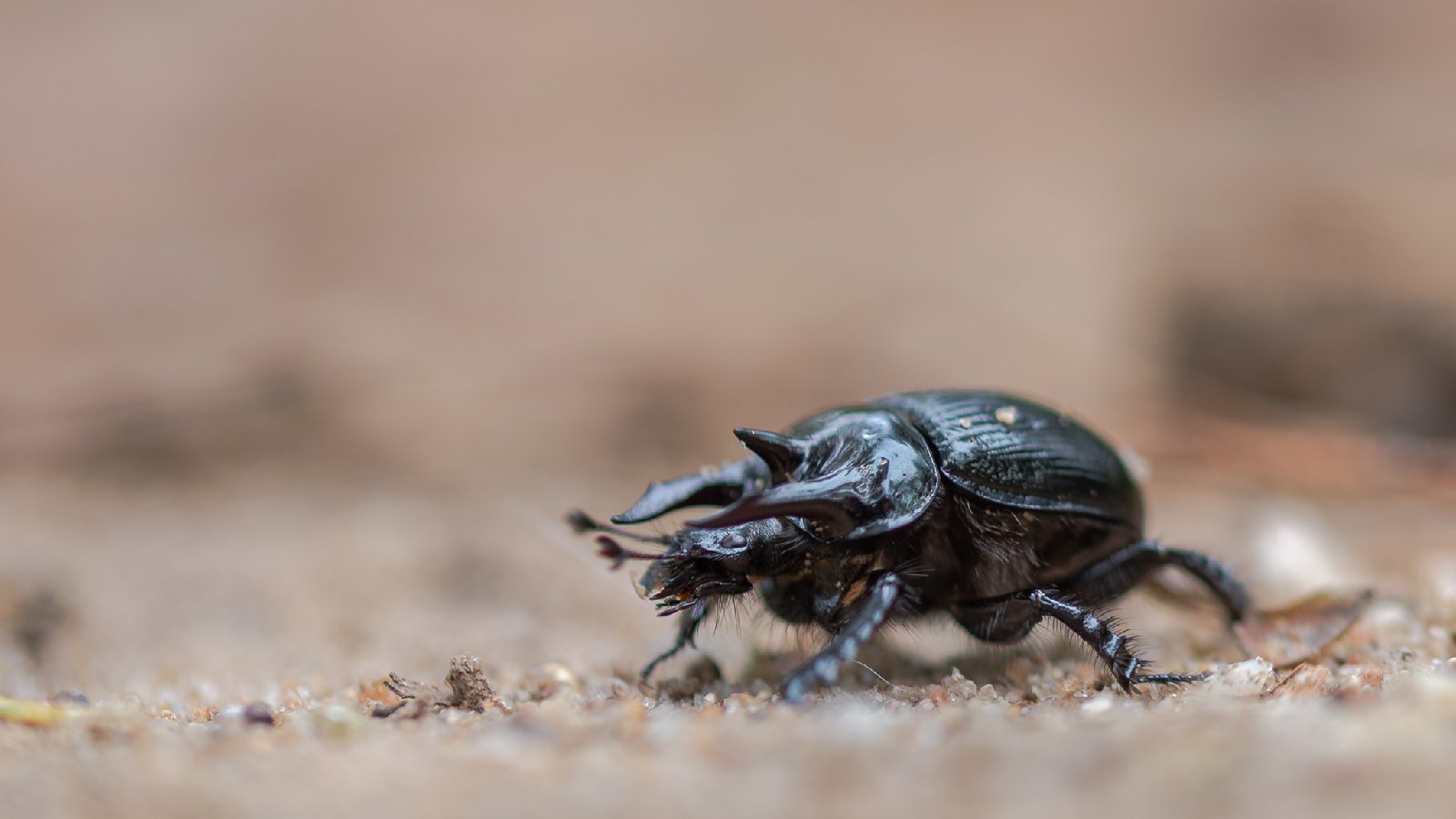
Minotaur Beetle (Typhaeus typhoeus) lives in sandy, sunny pine forests and moorland across Europe and North Africa.
Fascinating facts about the Minotaur Beetle
- The minotaur beetle measures between 15 and 24 mm in length. Its entire body is black with a slight sheen, giving it a uniform, glossy appearance, and its shape is stout and dome-shaped, a form that aids in digging. The elytra bear distinct longitudinal grooves punctuated by tiny pits, while each leg is equipped with numerous small spines that help the beetle grip the sandy substrate it inhabits.
- Sexual dimorphism is pronounced in Typhaeus typhoeus. Males are distinguished by three horn-like outgrowths on the pronotum; the two outer horns extend noticeably longer than the central one, giving the male a trident-like silhouette. Females lack these horns and instead display a few pointed humps on the same region.
- The minotaur beetle occupies a limited geographic belt, occurring only in certain regions of Europe and North Africa. Within this range it prefers sandy, sun-exposed habitats, most commonly the dry understory of pine forests or the open expanses of sandy moorland. These habitats provide the loose, well-drained soils needed for the beetle's burrowing lifestyle.
- In Germany the minotaur beetle enjoys the highest level of legal protection, being listed as an "especially protected" species under the Bundesartenschutzverordnung (BArtSchV). This designation means that any activity threatening its populations, such as habitat disturbance, collection, or trade, is prohibited by law.
Sources
Every fact above was checked against these pages, and kept only where one of them states it.
At a glance
RangeEurope and North Africa
HabitatSandy, sunny pine forests and moorland
DietDetritus, leaf litter, occasionally dung
About the Minotaur Beetle
Typhaeus typhoeus, the minotaur beetle, is a beetle in the family Geotrupidae, also referred to as earth-boring dung beetles. Like its relatives, it excavates burrows in which to lay its eggs, often creating chambers up to two metres deep in the loose, sandy soils of pine forests and moorland. The species is typically detritivorous, provisioning its nests with leaf litter, often moldy, but it will also consume dung when available, reflecting the occasional coprophagous habit of its family. Adults are active in sunny, open microhabitats where they can dig efficiently, and the larvae develop within the buried provision masses, feeding on the stored organic material until they emerge as mature beetles. This life cycle ties the minotaur beetle closely to the health of its sandy, forested environments.
Common questions
What does the Minotaur Beetle eat?
Diet: detritus, leaf litter, occasionally dung.
Where does the Minotaur Beetle live?
Habitat: sandy, sunny pine forests and moorland. Range: Europe and North Africa.
Hear the Minotaur Beetle, and 4,400+ more
Real recorded sounds, 11 nature games and a free Daily 5, 1v1 quiz duels, conservation wins and a safe Kids mode. Free on Feravox.
Minotaur Beetle photographed on Feravox
More insects and spiders to discover