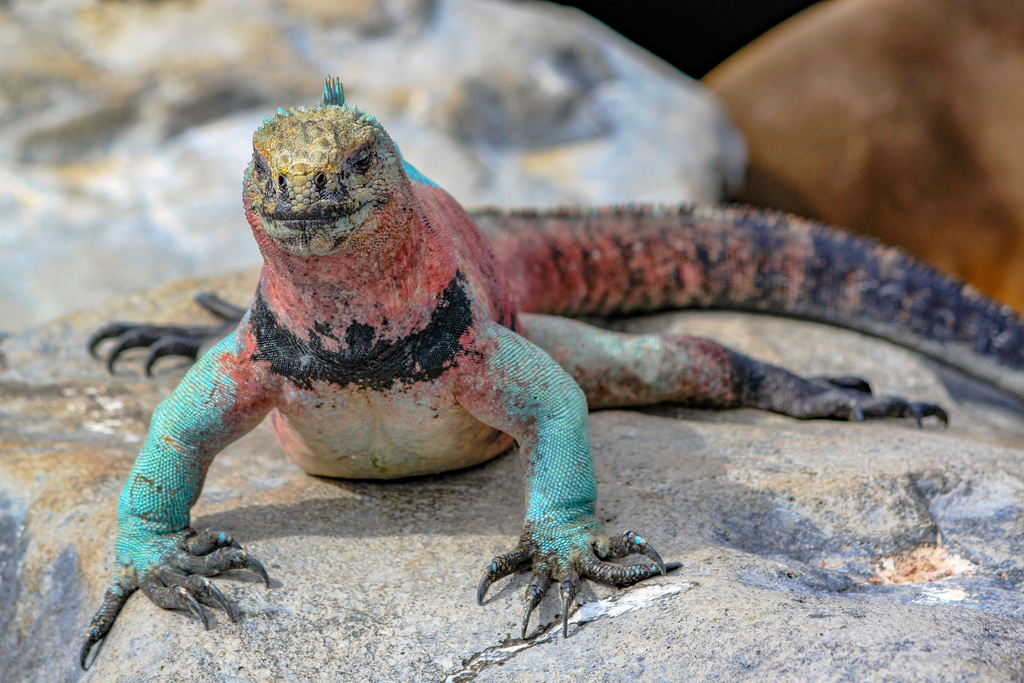
Marine Iguana (Amblyrhynchus cristatus) lives in rocky volcanic coastline across Galapagos Islands, Ecuador. Its conservation status is Vulnerable.
Fascinating facts about the Marine Iguana
- Marine iguanas split from their land-iguana cousins far earlier than any island they now call home. One DNA study placed the break at 5-15 million years ago, predating the current Galápagos archipelago. A newer analysis that added nuclear DNA nudged that date to about 4.5 million years, matching the age of the oldest islands like Española. Even the deepest splits among marine-iguana populations are recent, no older than 230 000 years and probably under 50 000, showing how quickly they diversified across the islands.
- Adults range from 12 cm to 56 cm in body length, with tails stretching another 17 cm to 84 cm, but the biggest weight gap is dramatic: a male on southern Isabela can tip the scales at 12 kg, while a Genovesa male weighs just 1 kg. This 12-fold difference mirrors food availability, richer algal beds let iguanas grow massive, whereas leaner waters keep them tiny.
- Marine iguanas take years to join the breeding crowd. Females become sexually mature at 3-5 years old, while males wait longer, reaching maturity at 6-8 years. Once adult, they can live up to 60 years, though most only make it about a dozen years in the wild. This long lifespan means that a single female, but the delayed male maturity also fuels fierce competition for the best territories.
- The breeding calendar of marine iguanas is tightly tied to the ocean's rhythm. Mating kicks off from December through March, and nesting follows from January to April, timed to the nutrient-rich Cromwell Current that fuels algal growth. After about a month, females lay 1-6 eggs, usually two or three, each about 9 cm by 4.5 cm and weighing 80-120 g, a quarter of the mother's weight, underscoring the huge investment each clutch represents.
- Marine iguanas gather in seaside crowds that can swell from a few dozen to over a thousand individuals. Within these colonies, dominant males carve out territories they defend for up to three months, sometimes battling rivals. A prime spot may cover almost 40 m², though many are as tiny as 1 m². Holding a central territory boosts a male's chances of attracting mates.
Sources
Every fact above was checked against these pages, and kept only where one of them states it.
At a glance
RangeGalapagos Islands, Ecuador
HabitatRocky volcanic coastline
DietAlgae & seaweed
About the Marine Iguana
As the waves crash against the sun-baked shores of the Galapagos, a most singular creature emerges from the turbulent surf, its scaly form glistening like polished onyx as it hauls itself onto the rocky outcroppings. The marine iguana, with its spiky crest and eyes that seem to hold a primordial wisdom, moves with a deliberate slowness, as if savoring the warmth that seeps from the black volcanic stone beneath its feet. In this desolate yet majestic landscape, it reigns supreme, a remarkable and resilient sentinel of the sea, its very existence a testament to the boundless adaptability of life on Earth.
Hear the Marine Iguana, and 4,400+ more
Real recorded sounds, 11 nature games and a free Daily 5, 1v1 quiz duels, conservation wins and a safe Kids mode. Free on Feravox.
More reptiles to discover