Photo: Matt Berger
Feravox · The Voice of the Wild
Maculated Forest Skink
Sphenomorphus maculatus
Least Concern
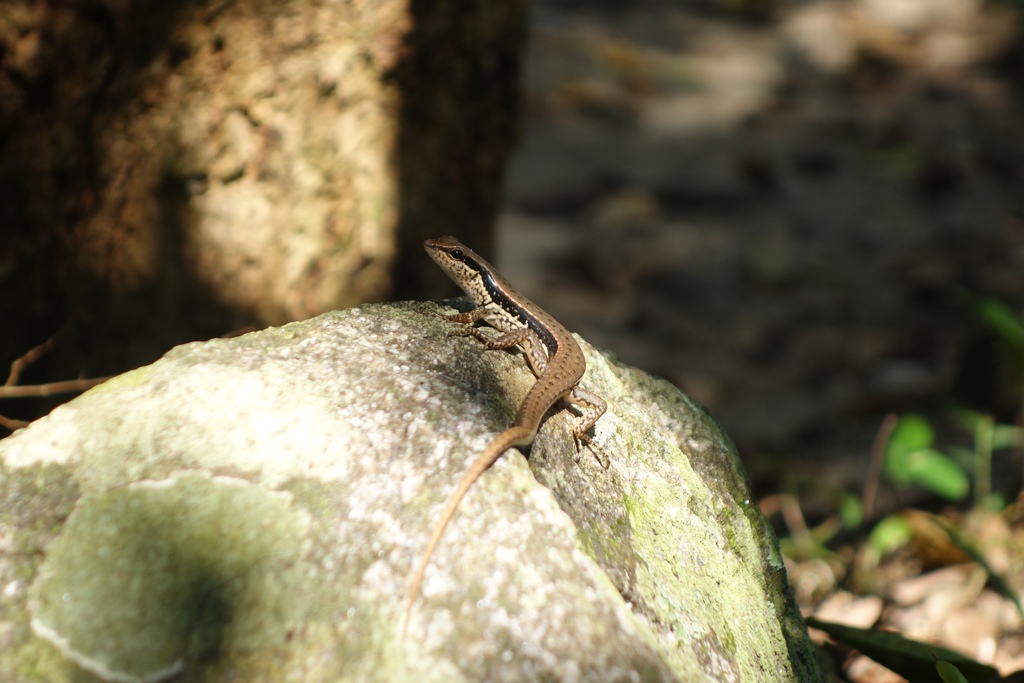
Maculated Forest Skink (Sphenomorphus maculatus) lives in streamside lowland forest across South and Southeast Asia. Its conservation status is Least Concern.
The maculated forest skink, Sphenomorphus maculatus, is a sleek, non-venomous lizard that slips through the shadowed banks of streams across a vast swathe of Asia. Its head tapers to a flat crown, and its tail stretches to twice its snout-vent length, giving the animal a graceful, elongated silhouette that can reach a maximum of 19 cm, though most individuals hover around 17 cm. The dorsal surface is a muted brown, punctuated by faint darker markings, while the throat and belly remain immaculate and pale. Along the flanks, a mottled zone of yellowish-brown spots lies beneath a dark stripe, a subtle camouflage that blends with leaf litter and river stones. By day it rests among rocks and low vegetation; by night it becomes a nocturnal forager, darting after small insects and other invertebrates that linger at the water’s edge. Its diet is opportunistic, reflecting the abundance of riparian prey in lowland and hilly terrains of Bangladesh, Bhutan, Cambodia, China’s southern Yunnan and SE Xizang (Tibet), India’s Andaman and Nicobar Islands and Darjeeling, Malaysia, Myanmar, Nepal, Singapore, the Sunda region (Brunei, Indonesia, Papua New Guinea, Timor-Leste), northern Thailand and Vietnam. A striking, almost theatrical behavior emerges when the skink is handled: it drops onto its back, stiffens, and feigns death for 35–45 seconds, its limbs splayed and heart racing, before rolling over in a rapid, escape-ready motion, an unexpected survival tactic that hints at a complex anti-predator repertoire. Reproduction in this species follows a strict seasonal rhythm. Courtship and mating unfold in a ritualized dance from April through June, after which the female lays eggs that incubate through the monsoon heat. Hatchlings break free at the close of August and September, emerging into the same riparian world that shaped their parents. This life cycle, tightly linked to the monsoonal pulse of its habitat, ensures that the youngest skinks arrive when insect prey is most plentiful, allowing them to grow swiftly and join the nocturnal foraging ranks of their species, perpetuating the quiet, stream-side ballet that defines the maculated forest skink.
Real recorded sounds, 11 nature games and a free Daily 5, 1v1 quiz duels, conservation wins and a safe Kids mode. Free on Feravox.