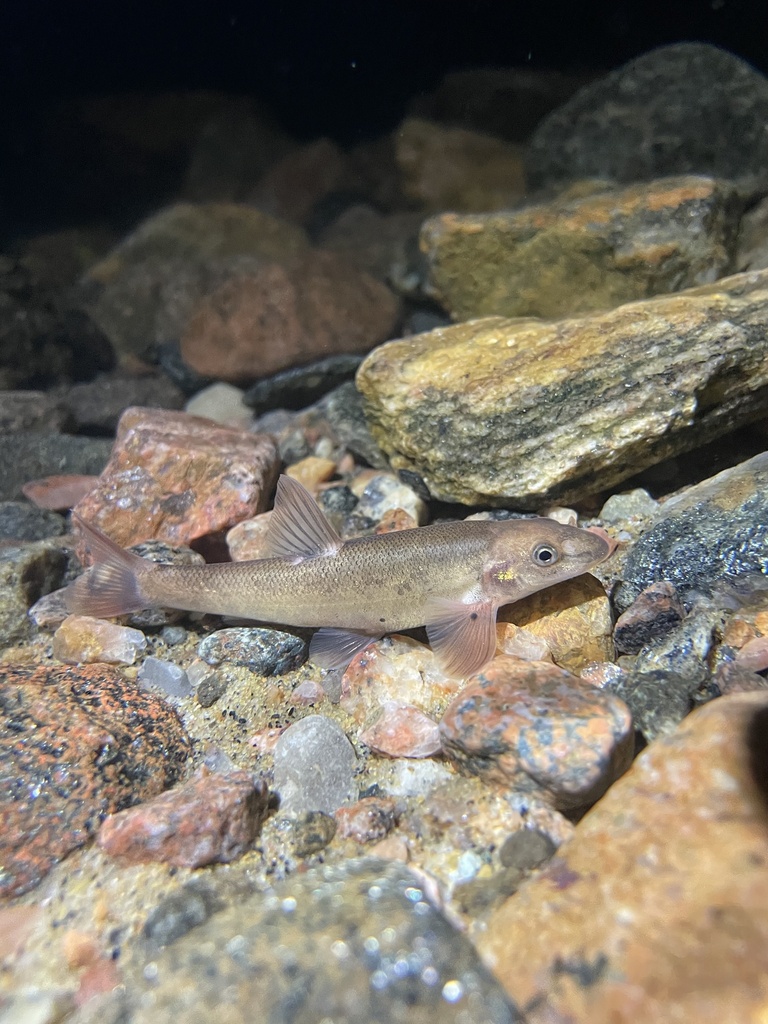
Photo: Sam Turner
Feravox · The Voice of the Wild
Longnose Dace
Rhinichthys cataractae
Least Concern
Longnose Dace (Rhinichthys cataractae) lives in rocky fast streams across North America. It feeds on algae and aquatic insects. Its conservation status is Least Concern.
The longnose dace (Rhinichthys cataractae) glides along the stony beds of swift, cool streams, its fleshy snout jutting past a subterminal mouth that hints at a sucker’s silhouette yet lacks the papillae that true suckers bear. Adults, usually under 100 mm, display a dark green to black dorsal hue, a silvery-mottled flank, and a pearly belly, while juveniles flash a stark black lateral line that fades with age. In breeding season, both sexes may blaze with orange-reddish accents on the bases of their pectoral, pelvic, and anal fins and on the upper lip, a vivid signal that, despite its association with males in the putative subspecies R. c. cataractae, proves unreliable for sexing. These benthic minnows favor shallow, turbulent riffles and the near-shore churn of lakes, nesting under rocks by day and emerging at night to feed. Their diet shifts with size: fish under 50 mm scrape algae and tiny invertebrates, while larger individuals opportunistically gulp fish scales, eggs, terrestrial insects, and macroinvertebrates, a flexibility that sustains them across the continent’s vast range. A surprising trait is their occasional long-distance dispersal; though most stay within tight home ranges, some have been documented traveling over 500 km, hinting at hidden corridors linking isolated waterways.
Real recorded sounds, 11 nature games and a free Daily 5, 1v1 quiz duels, conservation wins and a safe Kids mode. Free on Feravox.