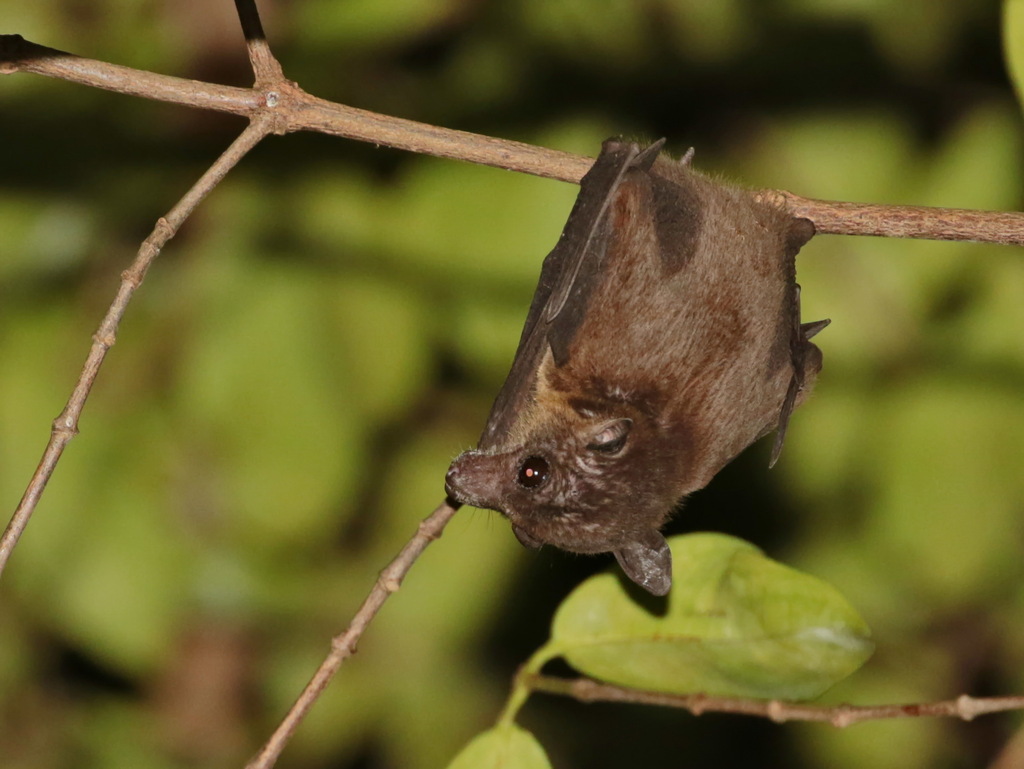
Lesser Dawn Bat (Eonycteris spelaea) lives in tropical caves across Southeast Asia. It feeds on nectar and pollen. Its conservation status is Least Concern.
Fascinating facts about the Lesser Dawn Bat
- Cave nectar bats form huge colonies inside caves, sometimes exceeding fifty thousand individuals. These colonies are typically found in primary forests but also in disturbed and agricultural areas where the bats roost. The bats often share these roosts with other bat species, creating mixed-species gatherings. Such massive roosting numbers contribute to their IUCN status of least concern despite limited population data.
- Each night the lesser dawn bat travels many kilometres across the landscape to sip nectar from flowering trees and shrubs. This long-distance foraging allows the bat to visit a wide range of nectar sources in both forest and semi-urban habitats. By moving such distances it pollinates numerous fruit trees, most notably durians, and also feeds on crops like banana and jackfruit. Its nightly journeys therefore underpin its role as a key pollinator.
- The lesser dawn bat is a vital pollinator of durian trees, including both Durio zibethinus and Durio graveolens. While feeding on their nectar, the bat transfers pollen between flowers, aiding fruit set. Its preference for these trees is linked to the proximity of its roosting sites, which often lie near durian-bearing habitats. This interaction makes the bat essential for the reproduction of commercially important durian crops.
- Scientists have recently mapped the entire genome of the lesser dawn bat using PacBio long-read sequencing. The species is a small, frugivorous bat that specialises in nectar feeding and has strong flight ability, which together make it well suited for laboratory work. It also reproduces quickly, breeding once or twice each year, providing ample material for studies.
- The lesser dawn bat can harbour a wide range of viruses, including filoviruses, coronaviruses and lyssavirus, yet it shows no obvious signs of disease. Recent evidence lists additional agents such as astrovirus, picornavirus, pteropine orthoreovirus and flavivirus among those it carries. This tolerance means the bat can serve as a natural reservoir without apparent health impacts.
Sources
Every fact above was checked against these pages, and kept only where one of them states it.
At a glance
RangeSoutheast Asia
HabitatTropical caves
DietNectar and pollen
About the Lesser Dawn Bat
In the sweltering twilight of tropical caves, the Lesser Dawn Bat stirs, its delicate wings unfolding like dark petals as it takes to the evening air. With a gentle flutter, it dances through the shadows, its large eyes drinking in the faint light that filters through the cavernous openings, guiding it towards the sweet nectar of blooming flowers. As it flits and weaves, its high-pitched calls echo off the limestone walls, a symphony of sound that heralds the arrival of night in this subterranean world.
Hear the Lesser Dawn Bat, and 4,400+ more
Real recorded sounds, 11 nature games and a free Daily 5, 1v1 quiz duels, conservation wins and a safe Kids mode. Free on Feravox.