Photo: Nicola Crockford
Feravox · The Voice of the Wild
Japanese Eagle Ray
Myliobatis tobijei
Vulnerable
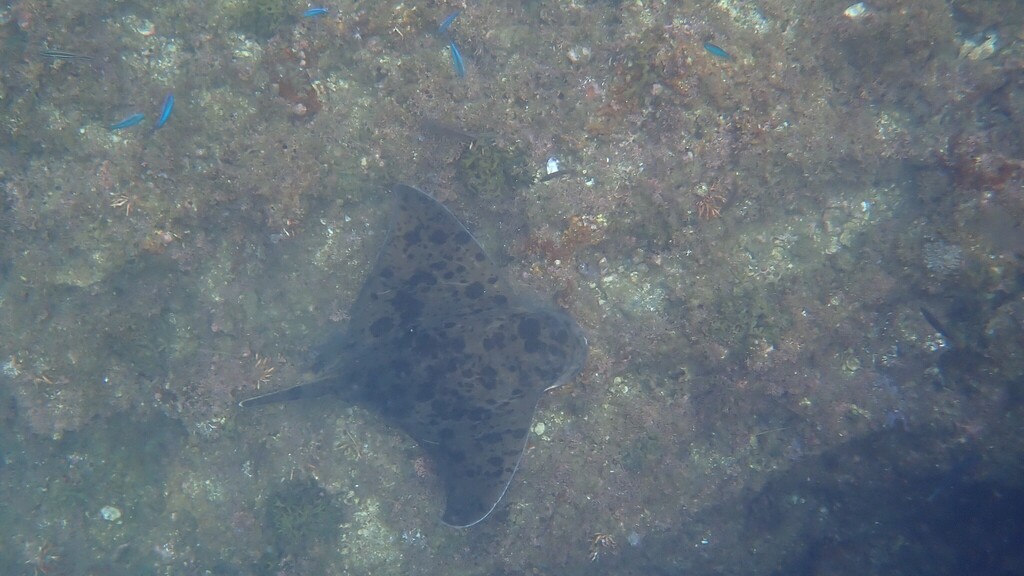
Japanese Eagle Ray (Myliobatis tobijei) lives in demersal tropical marine across East Asia. It feeds on crustaceans, fish, plants. Its conservation status is Vulnerable.
The Japanese eagle ray, Myliobatis tobijei, glides through the deep tropical waters of East Asia with a disc that can span at least 114 cm and a total length of up to 150 cm. Its yellow-brown skin is peppered with darker spots, a camouflage that blends with the muted seafloor. Long, slender stinging spines line its tail, while the male’s claspers are strikingly short, less than one-tenth the disc’s width. Each jaw houses seven rows of teeth, a dental arsenal that lets the ray crush crustaceans and small fish, and even nibble on benthic plants when the opportunity arises. A demersal specialist, this ray dwells on sea floors deeper than 220 m, hunting benthic animals that scuttle across the substrate. Like its mylobatid relatives, it is ovoviviparous: embryos first rely on yolk, then absorb uterine fluid from the mother, a subtle form of nourishment that bypasses a placental connection. Though little else is known about its biology, the combination of a broad disc, vivid coloration, and the surprising fact that its claspers are proportionally tiny for a ray of its size makes the Japanese eagle ray a striking, yet enigmatic, inhabitant of the Indo-Pacific deep.
Real recorded sounds, 11 nature games and a free Daily 5, 1v1 quiz duels, conservation wins and a safe Kids mode. Free on Feravox.