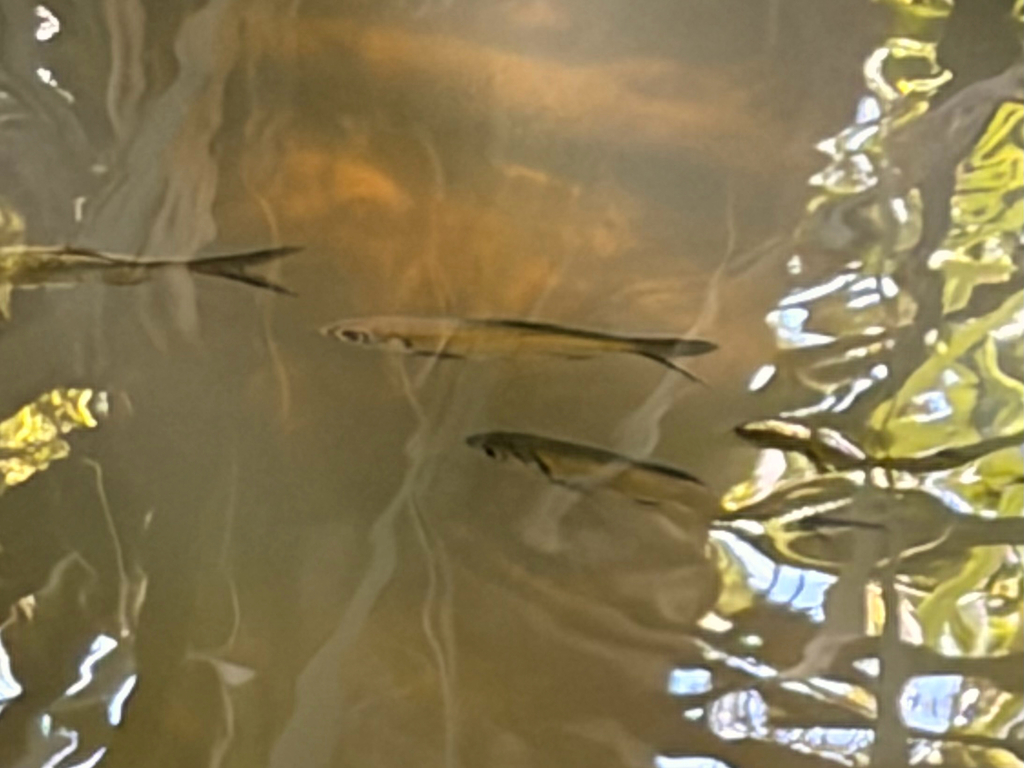
Photo: Tom Ferguson
Feravox · The Voice of the Wild
Indo-Pacific Tarpon
Megalops cyprinoides
Data Deficient
Indo-Pacific Tarpon (Megalops cyprinoides) lives in coastal, estuarine, freshwater across East Africa to Australia.
The Indo-Pacific tarpon (Megalops cyprinoides) glides through tropical waters with an olive-green back and silvery flanks, a strikingly large upward-turned mouth, and a distinctive elongated bony plate on the lower jaw. Its dorsal fin culminates in a single, dramatically long ray that sweeps nearly to the tail, while a unique physiological trick lets it fill its swim bladder with air and extract oxygen directly, a rare adaptation among fish. Fresh-water individuals stay modest, just over 50 cm (20 in) long, whereas their salt-water cousins can exceed a meter (3.3 ft). Lifespans top 44 years, yet they reach sexual maturity within two, and their larval metamorphosis is astonishingly swift, completing in only ten days. These tarpons are true wanderers, migrating between open seas and inland rivers, spawning offshore twice a year before their leptocephalic larvae drift inland. They haunt depths to 50 m (160 ft) but are most often seen near the surface of shallow, inshore habitats, coral reefs, mangroves, swamps, rivers, lakes, reservoirs, floodplains, and even canals. Their diet is opportunistic: in salt water they chase prawns and herring, while in fresh water they favor freshwater prawns and bony bream. Remarkably, unlike many of their Elopiform relatives, they can reproduce in both fresh and salt water, a flexibility that underpins their broad distribution from East Africa and the Arabian Peninsula to South Asia, Southeast Asia, southern Japan, French Polynesia, and southern Australia.
Real recorded sounds, 11 nature games and a free Daily 5, 1v1 quiz duels, conservation wins and a safe Kids mode. Free on Feravox.