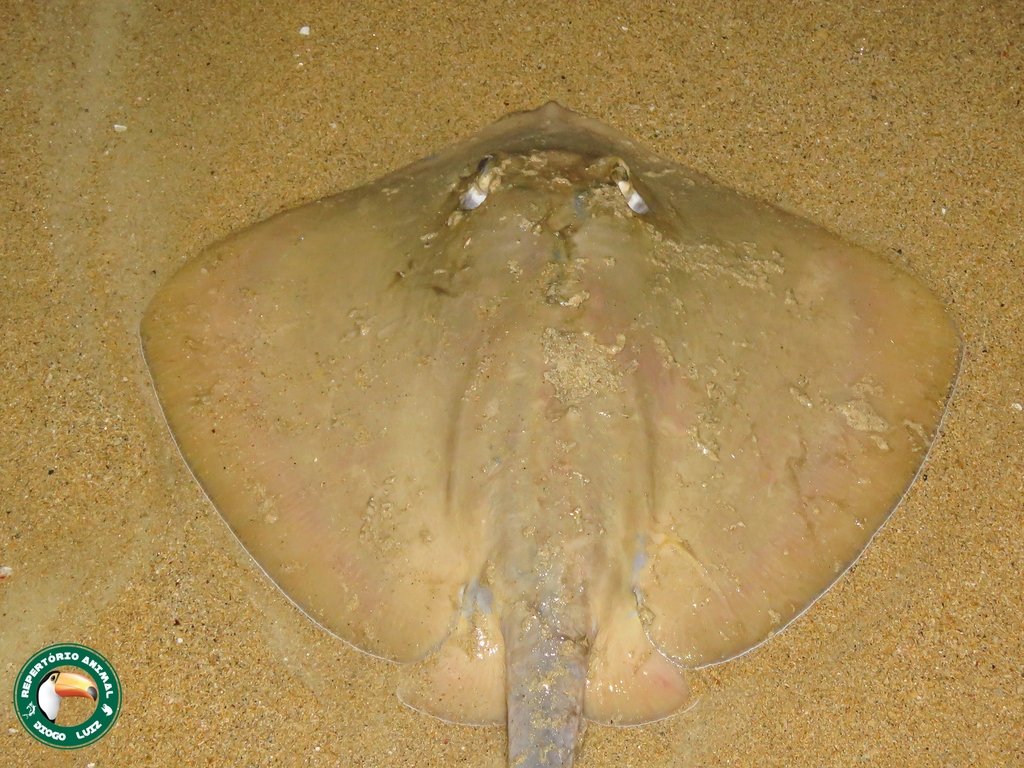
Photo: Diogo Luiz
Feravox · The Voice of the Wild
Groovebelly Stingray
Dasyatis hypostigma
Endangered
Groovebelly Stingray (Dasyatis hypostigma) lives in sandy or muddy bottoms across southern Brazil to Argentina. Its conservation status is Endangered.
The groovebelly stingray, Dasyatis hypostigma, glides over the soft sands and muds of southern Brazil’s coastal waters, its diamond-shaped disc barely wider than its length and its tail whipping like a thin ribbon one and a half times the disk’s span. Its dorsal surface shimmers in yellow-green to brown hues, turning reddish toward the edges, while the underside remains stark white, highlighted by dark fin margins and black tail folds. A distinctive W-shaped furrow marks the belly behind the fifth gill slits, a trait shared only with the distant pitted stingray, and most individuals boast completely smooth skin, only the largest females show a scattering of tiny denticles near the tail base. Reaching up to 65 cm (26 in) across, this ray’s eyes protrude, spiracles flare angularly, and a single serrated spine sits near the top of its tail, ready to defend against predators. In the shallow 5–40 m (16–131 ft) waters it inhabits, occasionally as deep as 80 m (260 ft), it reproduces aplacental viviparously, with females nurturing embryos that hatch inside the uterus, first sustained by yolk then by histotroph delivered through trophonemata. The only examined pregnant female carried two tiny embryos, just over 55 mm long.
Real recorded sounds, 11 nature games and a free Daily 5, 1v1 quiz duels, conservation wins and a safe Kids mode. Free on Feravox.