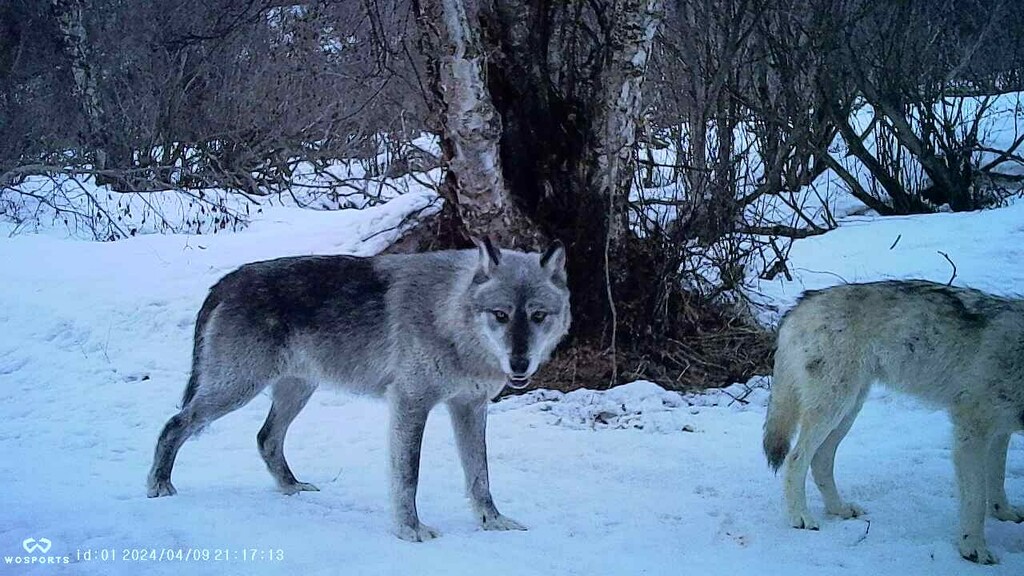
Grey wolf (Canis lupus) lives in forests, tundras, and grasslands across Northern hemisphere, including North America, Europe, and Asia. Its conservation status is Least Concern.
Hear the Grey wolf
A real field recording of the Grey wolf, made in the wild.
A wolf can stretch 105-160 cm long and stand 80-85 cm at the shoulder, but its weight swells with latitude thanks to Bergmann's rule. The average body mass sits at 40 kg, yet the tiniest recorded individual weighed just 12 kg while the heftiest tipped 79.4 kg.
Wolves still mingle genetically with dogs and other canids. Recent studies show some male Italian wolves carry dog ancestry, proving females will mate with male dogs in the wild. In the Caucasus, about ten percent of dogs, including guardian breeds, are first-generation wolf-dog hybrids. A 2021 genetic analysis even concluded that most of the similarity between wolves and dogs stems from substantial dog-into-wolf gene flow.
Wolves live in packs of two to thirty-six, forming tight social units where the breeding pair leads and all members help raise pups. In British Columbia, 200-300 wolves are killed each year, and the province estimates a total of 5,300-11,600 wolves remain. Scientists warn that removing breeding adults erodes pack knowledge and reduces reproductive success.
Between 200,000 and 250,000 wolves still roam the wild, a figure that keeps the species in the IUCN's Least Concern category.
The oldest known modern grey wolf fossil comes from Ponte Galeria, Italy, and dates to 406,500 ± 2,400 years ago.
Sources
Every fact above was checked against these pages, and kept only where one of them states it.
RangeNorthern hemisphere, including North America, Europe, and Asia
HabitatForests, tundras, and grasslands
DietLarge ungulates, such as deer and elk, as well as smaller mammals and plants
About the Grey wolf
The Grey wolf is a highly adaptable and widely distributed species, with a range that spans across the northern hemisphere. Although they are currently listed as Least Concern, Grey wolves have faced significant threats in the past, including habitat loss and hunting, which led to their decline in certain regions.
Common questions
What does the Grey wolf eat?
Diet: large ungulates, such as deer and elk, as well as smaller mammals and plants.
Where does the Grey wolf live?
Habitat: forests, tundras, and grasslands. Range: Northern hemisphere, including North America, Europe, and Asia.
Is the Grey wolf endangered?
The Grey wolf is listed as Least Concern on the IUCN Red List.
How can I learn about the Grey wolf?
Feravox has a two-minute lesson on the Grey wolf: five facts and five questions. See the lesson
Hear the Grey wolf, and 4,400+ more
Real recorded sounds, 11 nature games and a free Daily 5, 1v1 quiz duels, conservation wins and a safe Kids mode. Free on Feravox.