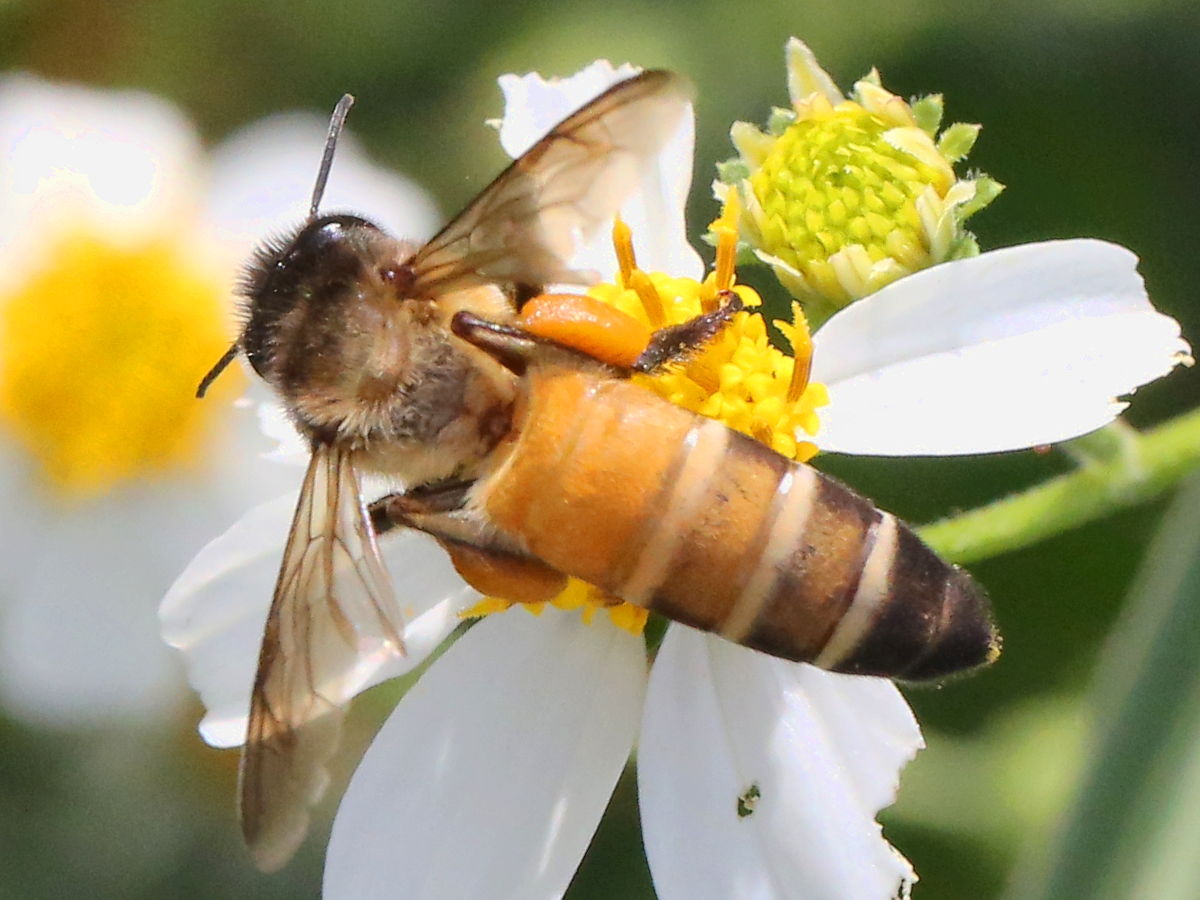
Giant Honey Bee (Apis dorsata) lives in tropical forest across South and Southeast Asia. It feeds on nectar and pollen.
Fascinating facts about the Giant Honey Bee
- Giant honeybee colonies can swell to a one-meter-tall comb that houses up to 100,000 workers, and dozens of these massive nests crowd together, sometimes 200 colonies sharing a single tree. The comb hangs vertically, swathed in several layers of buzzing bees, turning the tree into a living skyscraper of wax. Such dense aggregations boost colony defense, showing how this species turns open, exposed sites into fortified super-colonies that dominate the landscape.
- Each giant honeybee colony lives in one spot for only three to four months before migrating to a new tree or building as the rains end, a seasonal shuffle that repeats year after year. Workers live less than two months, so the original individuals are usually gone when the colony returns to the same nesting site later. This nomadic rhythm lets the bees chase blooming flowers across the landscape while keeping familiar roosts for future generations.
- When a wasp attacks, giant honeybees heat their thoraxes to a scorching 45 °C, a tactic called heat-balling. If the heat isn't enough, the outer bees perform a synchronized "shimmering" wave, thrusting abdomens upward and shaking in unison, creating a visible and audible ripple that confuses the predator.
- A single giant honeybee nest can hold up to 45 kg of honey, making it a lucrative target for honey hunters who rely on the harvest for income and wax for candles. Because the bees store such massive stores in exposed, easily accessed combs, people regularly raid the colonies, a practice that can destabilize local populations when combined with habitat loss. Understanding this economic pull highlights why sustainable harvesting is essential to keep both the bees and the livelihoods they support alive.
- Giant honeybee foragers can travel farther than their smaller cousins, yet most still stay within 400 m of the nest, 72 % of observed trips fall inside that range, while the other Asian species rarely exceed 500 m.
Sources
Every fact above was checked against these pages, and kept only where one of them states it.
At a glance
RangeSouth and Southeast Asia
HabitatTropical forest
DietNectar and pollen
About the Giant Honey Bee
In the sweltering heart of the tropical forest, the Giant Honey Bee reigns supreme, its thrumming wings a mesmerizing blur as it dances through the air with reckless abandon, driven by an insatiable hunger for nectar and pollen. With colonies that defy gravity, clinging to towering tree trunks and rocky outcroppings, these magnificent creatures weave a complex social tapestry, their every movement a testament to the intricate hierarchies and ancient rituals that govern their lives. As the warm sunlight catches their iridescent bodies, the Giant Honey Bees shimmer like a thousand tiny jewels, their very existence a potent reminder of the beauty and wonder that still awaits us in the uncharted depths of the natural world.
Hear the Giant Honey Bee, and 4,400+ more
Real recorded sounds, 11 nature games and a free Daily 5, 1v1 quiz duels, conservation wins and a safe Kids mode. Free on Feravox.
More insects and spiders to discover