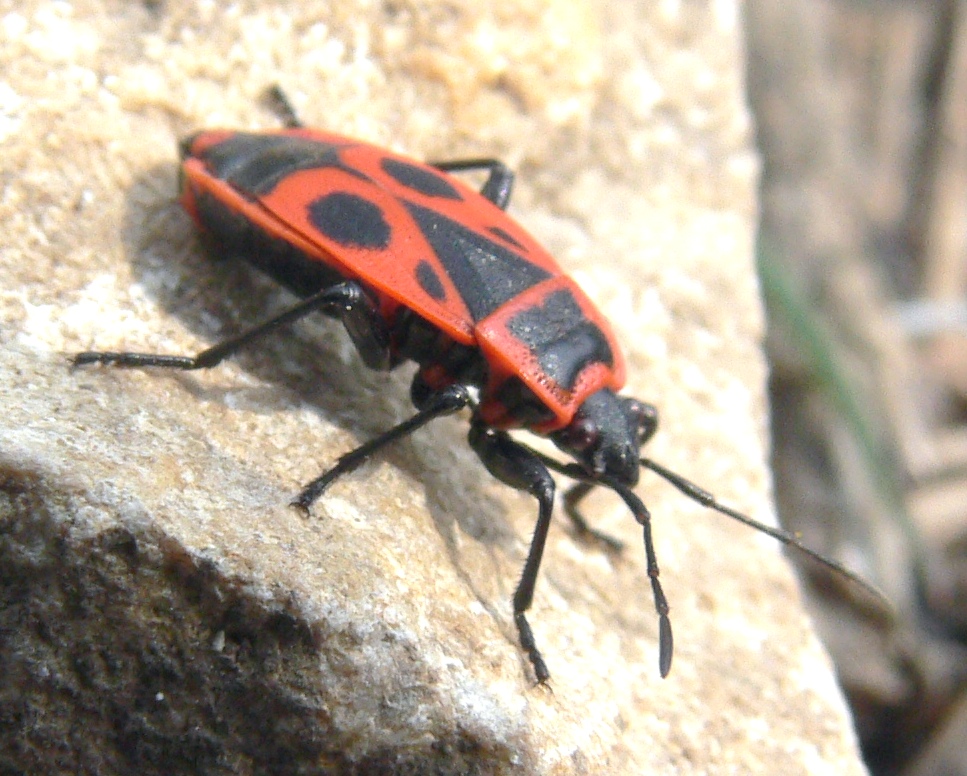
European Firebug (Pyrrhocoris apterus) lives in near base of lime tree trunks across Palaearctic from the Atlantic coast of Europe to northwest China.
Fascinating facts about the European Firebug
- The firebug's striking red and black pattern makes it instantly noticeable, yet observers sometimes mistake it for the unrelated cinnamon bug because of the similar colours. Both species share the same bright warning hues but belong to different families, so the resemblance is only superficial. This visual similarity can lead to misidentification in the field, especially by casual observers who focus on colour rather than taxonomic details.
- Firebugs have established populations far beyond their native Palaearctic range, with records from the United States, Central America, Southern Ontario, India and Australia. In Southern Ontario they are specifically noted as an invasive species, indicating they have successfully colonised that region. Their spread demonstrates a capacity to thrive in diverse climates far from their original Atlantic-to-northwest China distribution.
- Immature firebugs often gather in large groups, forming clusters of tens to perhaps a hundred individuals. Such gatherings are especially frequent among the younger stages, where the insects are seen aggregating near the base of lime tree trunks on sunny sides.
- When firebugs mate they stay linked in a tandem position, a behaviour that can last from twelve hours to a full week. This prolonged coupling is observed during the April-May breeding period and often occurs on the sunny side of lime trees where the insects gather. Researchers suggest the unusually long duration serves as ejaculate-guarding, a male strategy to outcompete rivals.
- Rearing firebugs on American paper towels prevented them from reaching adulthood, with many individuals remaining in extra nymphal stages. After the fifth instar the bugs either entered a sixth instar or became malformed adults, and some even progressed to a seventh instar before all died without maturing. The problem was traced to chemicals from balsam fir trees used in North American paper, a hormone that mimics juvenile hormone.
Sources
Every fact above was checked against these pages, and kept only where one of them states it.
At a glance
RangePalaearctic from the Atlantic coast of Europe to northwest China
HabitatNear base of lime tree trunks
DietSeeds and fruits
About the European Firebug
In the warm, sun-baked landscapes of Europe, the European Firebug moves with a quiet confidence, its deep red and black hues glistening like polished gemstones as it navigates the intricate web of life. With a delicate, almost ethereal quality to its movements, this tiny insect weaves in and out of the undergrowth, its slender legs carrying it effortlessly across the rustling leaves and weathered bark. As it goes about its daily rituals, the European Firebug embodies a sense of unassuming resilience, its very existence a testament to the enduring power of nature's smallest, yet most remarkable, creations.
Hear the European Firebug, and 4,400+ more
Real recorded sounds, 11 nature games and a free Daily 5, 1v1 quiz duels, conservation wins and a safe Kids mode. Free on Feravox.
More insects and spiders to discover